

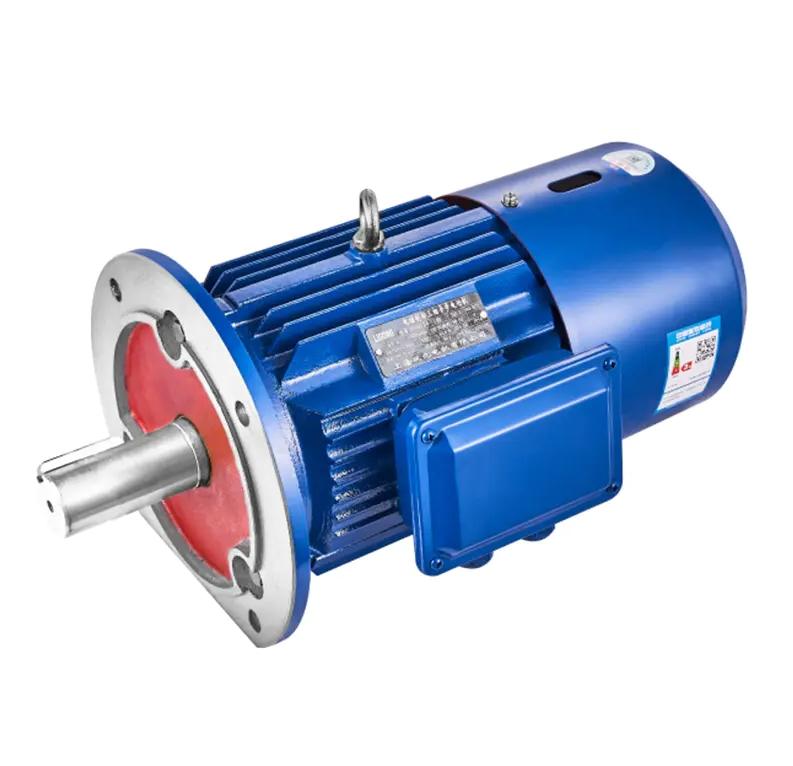
Modern industries rely on versatile motor technologies to address shifting operational demands. Two popular choices, the Multi Speed Motor and the Single Phase Brake Motor, each serve distinct yet occasionally overlapping roles in automation and processing environments.
A Multi Speed Motor is particularly appreciated in systems where speed control is necessary but full variable frequency drives are either too complex or unnecessary. This type of motor allows different preset speeds, typically achieved by altering pole configurations. It proves useful in applications such as blowers, mixers, or textile equipment, where process conditions may require shifts between fast and slow cycles.
Meanwhile, the Single Phase Brake Motor finds its niche in locations with limited power infrastructure or in applications where load-holding is vital. Unlike standard motors, these include a built-in braking mechanism, usually spring-loaded, to stop or hold the shaft when power is cut. This design reduces the need for external brake systems and simplifies assembly.
While their core functions differ—speed control vs. braking—the two motor types can complement each other in integrated systems. In a small manufacturing unit, for example, a brake motor might be used to hold a workpiece in place during machining, while a multi speed motor powers an adjacent polishing system with variable torque demands.
By understanding the strengths of each, system designers can create setups that are both functional and adaptable, even in resource-limited environments. Both Multi Speed Motors and Single Phase Brake Motors offer practical solutions for common industrial challenges.

 English
 Arabic
 French
 Spanish
 Deutsch
 Turkish
 Dutch
 Italiano
 Russian
 Romaian
 Portuguese (Brazil)
 Greek