

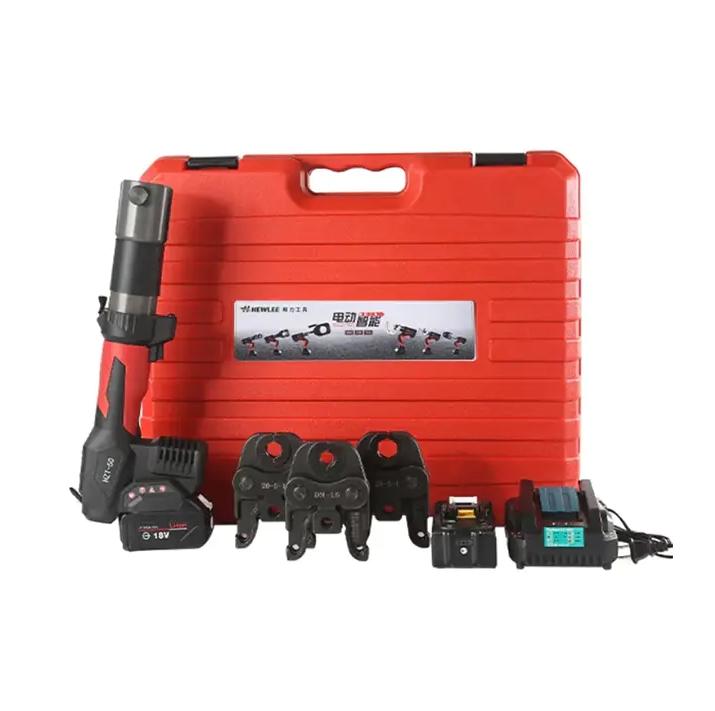
When selecting tools for pipe joining tasks, it’s essential to consider whether a manual or hydraulic crimping tool better meets the project requirements. Each has distinct advantages depending on job complexity, frequency of use, and operator strength.
Manual Plumbing Pipe Crimping Tools typically suit small-scale or occasional plumbing tasks. These tools are cost-effective and require no external power. However, they rely entirely on physical effort, which may cause user fatigue over prolonged use or when dealing with larger-diameter pipes.
Hydraulic Crimping Tools, in contrast, are designed to reduce the physical strain on operators. Using hydraulic force, these tools enable users to apply consistent pressure with minimal effort. This makes them ideal for high-volume or professional applications, especially when precision and consistency are critical.
Moreover, hydraulic tools can accommodate a broader range of pipe sizes and materials. Their modular design and availability of various jaw types or dies make them versatile for different crimping tasks. This flexibility is beneficial for plumbers working on diverse installations involving copper, stainless steel, or PEX systems.
The key to choosing the right tool lies in balancing ease of use, portability, and job demands. While manual tools are light and compact, hydraulic versions offer better performance for frequent use and heavy-duty applications.
Understanding the differences between these tool types helps ensure that plumbing projects are completed efficiently, with reliable outcomes in terms of pipe connection integrity and longevity.

 English
 Arabic
 French
 Spanish
 Portuguese
 Deutsch
 Turkish
 Dutch
 Russian
 Romaian
 Portuguese (Brazil)
 Greek