

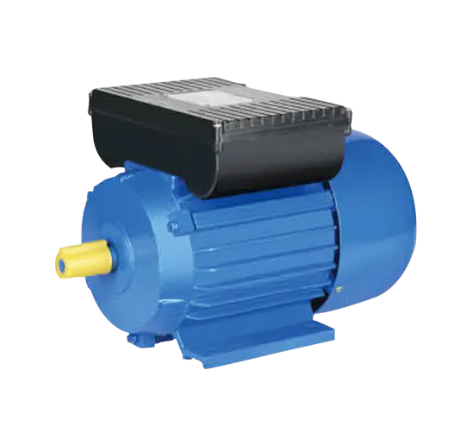
A single-phase dual-capacitor induction motor, often called a capacitor-start capacitor-run (CSCR) motor, marries high starting torque with smooth, energy-efficient continuous operation. Inside the motor, the main winding handles the running load, while an auxiliary winding, connected through two capacitors, creates the necessary phase shift to establish a rotating magnetic field. During start-up, a high-value electrolytic capacitor delivers a strong current pulse, producing up to 300 % of the rated torque to accelerate heavy loads such as air compressors, pumps, and conveyors. Once the machine approaches full speed, a centrifugal switch or electronic relay disconnects the start capacitor and leaves a smaller, oil-filled run capacitor in series with the auxiliary winding. This run capacitor optimizes the phase angle between windings, reducing current draw, vibration, and noise while improving power factor to 0.90 or better. Compared with single-capacitor split-phase or shaded-pole designs, the dual-capacitor configuration offers higher efficiency, cooler operation, and longer insulation life. Maintenance is straightforward: periodically inspect capacitors for bulging or leakage, verify switch operation, and test insulation resistance. Proper sizing of both capacitors according to manufacturer tables is critical; an incorrect microfarad value can cause overheating, failed starts, or reduced torque. Integrating modern electronic relays in place of mechanical switches further enhances reliability by eliminating arcing and mechanical wear. Technicians appreciate the motor’s transparent wiring diagram: five clearly labeled leads exit the conduit box, making reversal, speed control, or dual-voltage conversion intuitive. For farmers, HVAC contractors, and workshop owners, the single-phase dual-capacitor induction motor remains the workhorse that balances brute starting force with refined running economy, all while remaining compatible with standard residential 230 V single-phase supply.

 English
 Arabic
 French
 Spanish
 Portuguese
 Deutsch
 Turkish
 Dutch
 Russian
 Romaian
 Portuguese (Brazil)
 Greek