

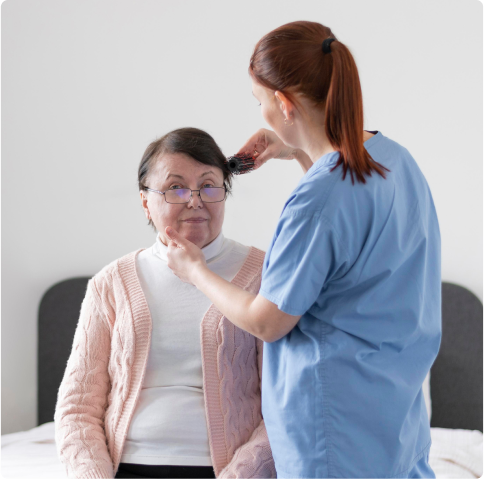
You now have a solid grasp of Activities of Daily Living (ADLs) and Instrumental Activities of Daily Living (IADLs). These two concepts represent the complete spectrum of daily life activities required for basic personal care and independent living in the community.
But how do professional caregivers and healthcare providers objectively measure a person's abilities in these areas to create a truly effective care plan?
The answer lies in standardized functional assessment tools. These tools remove guesswork and provide a clear, measurable snapshot of a senior's functional status, serving as the basis for all personalized in-home support.
The Two Pillars of Functional Assessment
There are two widely accepted, highly-effective scales used globally to assess the ability to perform daily life activities: the Katz Index and the Lawton IADL Scale.
1. The Katz Index of Independence in ADL
Developed by Dr. Sidney Katz in the 1960s, this is the gold standard for measuring a person's fundamental self-care capacity. It focuses specifically on the six basic ADLs. The scale determines whether the person is independent, requires assistance, or is fully dependent for each activity.
The Score's Value: The Katz Index provides a quick measure of physical function. A decline in the ability to perform any of these six tasks is a critical signal that hands-on personal care or specialized equipment (like a wheelchair or hospital bed) is necessary for safety and comfort.
2. The Lawton Instrumental Activities of Daily Living (IADL) Scale
This scale is used to assess the more complex and cognitive skills required to live independently, focusing on the higher-level daily life activities often managed outside the body.
The Score's Value: The Lawton Scale is highly sensitive to early cognitive decline (such as in dementia) because these organizational and problem-solving tasks are often the first to become difficult. Difficulties here typically trigger the need for companion care, medication management support, and home-making services.
How A Better Solution Uses These Tools
The true value of these assessments is not the score itself, but how it informs the care delivery, ensuring maximum independence.
-
Baseline & Benchmarking: We establish a baseline score for both scales upon starting service. Regular reassessments (every few months or after a significant health event) allow us to immediately recognize improvement or decline.
-
Tailoring Care: The assessment dictates the specifics of the care plan. If a client scores low on Dressing (Katz), the plan focuses on physical assistance and adaptive devices. If they score low on Financial Management (Lawton), the plan focuses on cognitive support, organization, and trusted supervision.
-
Promoting Re-ablement: By clearly identifying which daily life activities a client can almost perform, we know exactly where to apply minimal support—a guiding hand, a verbal cue—to help the client retain that functional skill for as long as possible.
Understanding and utilizing these objective measures ensures that the care provided by A Better Solution Home Care is always person-centered, dignified, and designed to support the highest possible level of independence in all daily life activities. Which of the IADLs are you most concerned about your loved one managing safely right now?

 English
 Arabic
 French
 Spanish
 Deutsch
 Turkish
 Dutch
 Italiano
 Russian
 Romaian
 Portuguese (Brazil)
 Greek