

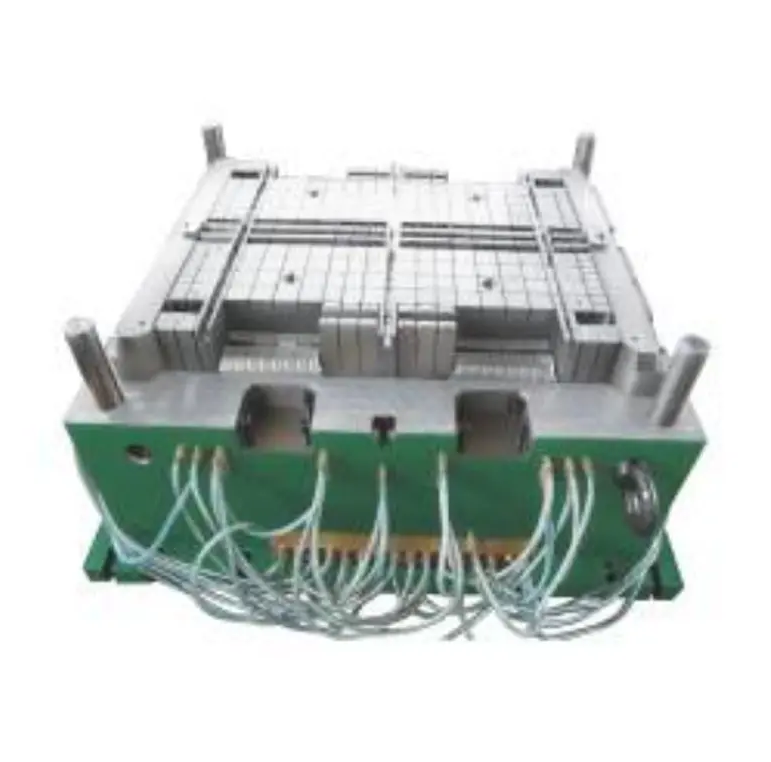
Importance of Cooling System Design
In injection molding, the cooling system plays a decisive role in determining both product quality and manufacturing efficiency. For large-scale components such as pallets, the design of the cooling channels within a Plastic Pallet Mold directly affects how quickly and evenly the material solidifies. Because plastic pallets are thick and wide, uneven or delayed cooling can lead to internal stresses, warpage, or sink marks. An optimized cooling layout ensures uniform temperature distribution across the mold cavity, minimizing the risk of defects while shortening the overall production cycle.
Cooling Channel Layout and Heat Transfer Efficiency
A well-designed cooling system involves the precise placement of channels to maximize contact between the circulating coolant and the mold surface. Factors such as the distance between channels, their diameter, and the flow rate of the cooling medium determine heat transfer efficiency. Spiral or conformal cooling designs—often created through advanced manufacturing methods like 3D printing—can significantly improve temperature uniformity. When heat is removed effectively, the solidification phase is completed faster, allowing earlier ejection of the molded pallet without compromising its dimensional accuracy.
Material and Flow Considerations
The choice of mold material, such as P20 or H13 steel, also influences the cooling performance. Metals with higher thermal conductivity accelerate heat dissipation from the plastic melt. Additionally, using high-efficiency coolants like water-glycol mixtures can further stabilize the temperature. The flow direction and turbulence within the channels are equally important; turbulent flow enhances heat exchange by preventing hot spots or stagnant zones. By adjusting these parameters, mold designers can achieve a balance between fast cooling and consistent structural integrity of the pallet.
Impact on Cycle Time and Productivity
In the production of plastic pallets, each second of cycle time reduction translates to significant cost savings, especially in mass production environments. If the cooling system is poorly designed, the mold must remain closed longer to ensure proper hardening, leading to slower output and higher energy consumption. Conversely, an optimized cooling design can reduce the cycle time by up to 20–30%, allowing manufacturers to produce more pallets per hour. This improvement not only enhances productivity but also extends mold life, as lower thermal stress reduces wear on critical components.
Balancing Cooling Speed and Product Quality
While faster cooling increases efficiency, it must not compromise the mechanical performance of the pallet. Excessively rapid cooling may create temperature gradients that cause uneven shrinkage or internal cracks. Therefore, modern mold designers use simulation software to analyze thermal flow patterns before fabrication. By simulating the cooling behavior under different conditions, they can fine-tune the channel geometry to achieve an ideal balance between cooling speed and dimensional stability. This digital approach helps ensure that each pallet meets strength and durability requirements without sacrificing production speed.
Precision Cooling for Consistent Performance
In conclusion, the cooling system is one of the most critical aspects of mold engineering, directly influencing both the cycle time and the final quality of molded pallets. Through careful design of cooling channels, material selection, and fluid dynamics control, manufacturers can significantly enhance the performance of their molds. For large products such as pallets, an efficient and well-optimized cooling structure not only reduces production time but also ensures consistent quality, lower rejection rates, and longer mold lifespan.

 English
 Arabic
 French
 Spanish
 Portuguese
 Deutsch
 Turkish
 Dutch
 Russian
 Romaian
 Portuguese (Brazil)
 Greek