

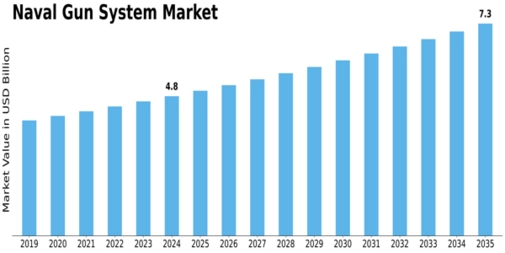
As global maritime dynamics shift rapidly, the naval gun system market is gaining renewed attention. With an estimated value of USD 4.47 billion in 2022 and a forecast to reach USD 6.5 billion by 2032, the industry is poised for significant growth at a CAGR of approximately 3.81% from 2024-2032.
Industry Overview
From coastline defence to blue-water operations, navies are rethinking their weapon-system mix. Traditional gun systems are being upgraded—or in some cases, replaced—with offerings that deliver greater precision, automation and integration. The naval gun system market stands at the intersection of these tactical and technological shifts. Countries with emerging naval ambitions are particularly active, driving procurement of modern artillery systems for vessels and patrol craft.
Key Players
A handful of leading manufacturers dominate the market: General Dynamics, BAE Systems, Northrop Grumman, Lockheed Martin and Navantia. Through continuous innovation, strategic partnerships and global reach, these companies coordinate with naval customers worldwide to deliver systems tailored to specific mission profiles.
Market Outlook
The market outlook remains favourable. Defence budgets continue to rise globally, while geopolitical tensions and maritime security imperatives fuel demand. The projected value of USD 4.65 billion for 2023 rising to USD 6.5 billion by 2032 underscores this trend. Emerging naval powers in Asia-Pacific, Latin America and the Middle East are expected to contribute significantly to demand.
Segmentation Growth
In examining segmentation growth, several key developments stand out:
-
Technology: Conventional gun systems continue to lead, but the electromagnetic railgun segment is expanding rapidly thanks to its promise in future naval engagements. Smart munitions and automated gun systems are also growing. For instance, smart munitions were valued at USD 0.9 billion in 2023 and are expected to reach USD 1.3 billion by 2032.
-
Application: Surface warfare remains a core driver, but anti-air, land attack and undersea missions are increasingly important as navies adopt multi-mission platforms.
-
Caliber Size: Large-caliber systems dominate value, yet smaller calibers are gaining share because of their affordability and flexibility in littoral zones.
-
End-Use: Military naval forces hold the lion’s share, but growth in coast guard fleets and commercial shipping security is notable. The commercial segment reflects rising non-state threats such as piracy and maritime crime.
Conclusion
For companies engaged in maritime defence, the naval gun system market Forecast offers substantive opportunity. With steady growth, broad segmentation and increasing importance of advanced technologies, this market warrants attention from players aiming to support next-generation naval platforms.

 English
 Arabic
 French
 Spanish
 Portuguese
 Turkish
 Dutch
 Italiano
 Russian
 Romaian
 Portuguese (Brazil)
 Greek