

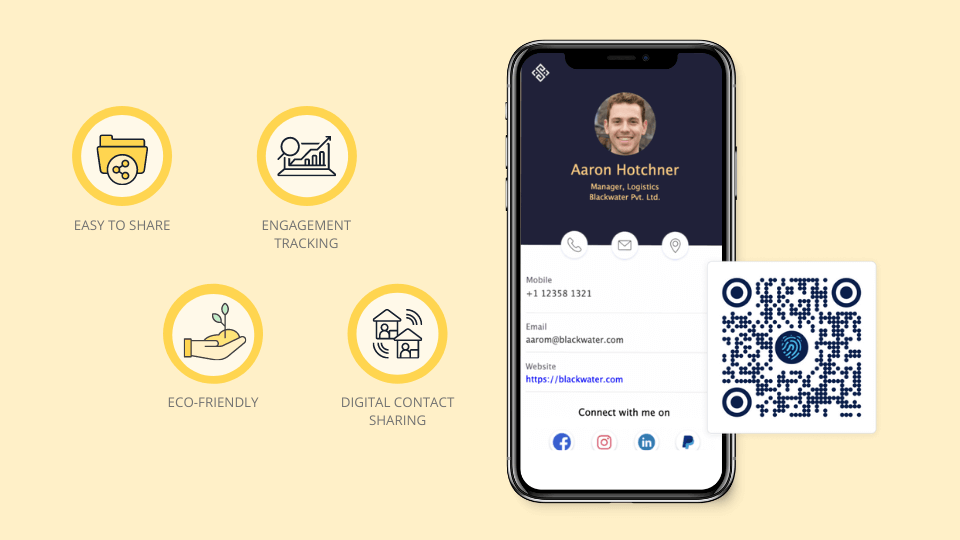
The Digital Business Card Industry Competition is a highly fragmented and increasingly fierce arena, characterized by a very low barrier to entry for basic applications but a significantly higher barrier for creating a scalable, enterprise-grade platform. At the lower end of the market, the competition is intense. There are hundreds of small mobile apps that offer basic digital business card functionality, many of them created by individual developers or small teams. These apps compete primarily on price (often free) and a simple, clean user interface. However, they often lack the advanced features, security, and reliability required for professional use. This has created a crowded and noisy environment, making it difficult for any single player to stand out based on basic features alone. The competition in this segment is a race to acquire users through app store optimization and word-of-mouth.
The real competitive battleground is in the premium and enterprise segments of the market. Here, the competition is fought on a much more sophisticated set of factors. The first is the depth and quality of the feature set. Leading platforms are competing by offering advanced capabilities such as customizable branding, embedded multimedia content, lead capture forms, and detailed analytics dashboards. The most critical competitive differentiator is the strength of a platform's integrations. The ability to seamlessly synchronize new contacts captured via the digital business card with a user's CRM system (like Salesforce or HubSpot) or to integrate with HR systems for automated employee onboarding and offboarding is a massive value proposition for businesses. A platform with a rich library of pre-built, robust integrations has a significant competitive advantage over a closed, siloed system.
A third, and often overlooked, competitive pressure comes not from direct competitors, but from the "good enough" solutions offered by major technology platforms. For example, LinkedIn offers a simple QR code feature that allows users to quickly connect on the platform. Apple's iOS has a "NameDrop" feature for easily sharing contact information between iPhones. While these features lack the richness and analytical capabilities of a dedicated digital business card platform, their native integration and convenience make them a significant competitor for simple contact exchange use cases. This forces the dedicated digital business card providers to constantly innovate and to clearly articulate the superior value of their platforms, which lies in the branding control, the rich media capabilities, and, most importantly, the trackable analytics and lead capture functionality that these simple, built-in features do not offer. The Digital Business Card Market size is projected to grow to USD 518.35 Billion by 2035, exhibiting a CAGR of 10.01% during the forecast period 2025-2035.
Top Trending Reports -
Germany Self Checkout In Retail Market

 English
 Arabic
 French
 Spanish
 Portuguese
 Deutsch
 Turkish
 Dutch
 Russian
 Romaian
 Portuguese (Brazil)
 Greek