

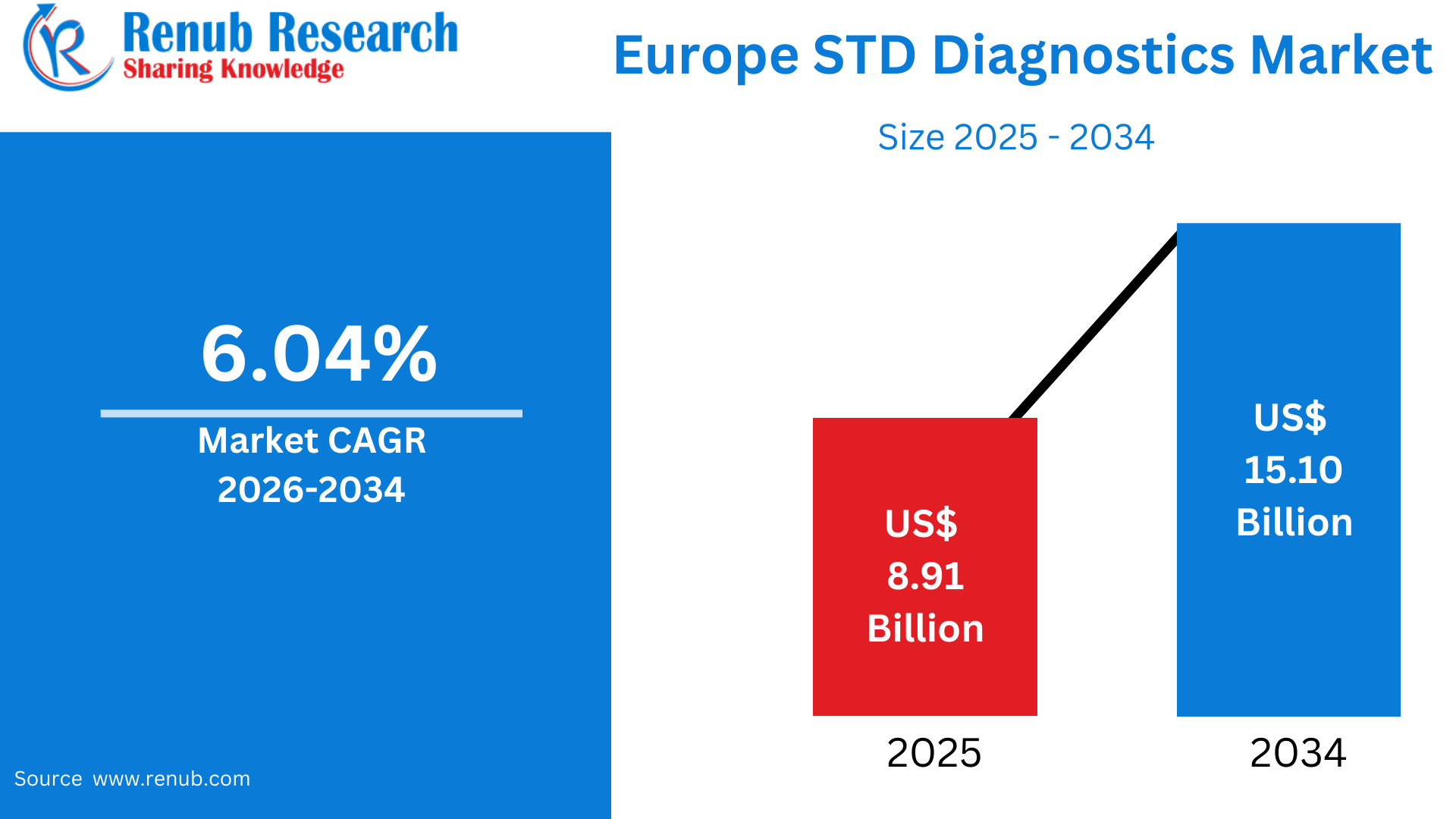
Europe STD Diagnostics Market Size and Forecast 2026–2034
According to Renub Research Europe STD diagnostics market is positioned for steady and sustainable growth over the forecast period from 2026 to 2034. Valued at approximately USD 8.91 billion in 2025, the market is projected to reach USD 15.10 billion by 2034, expanding at a compound annual growth rate (CAGR) of 6.04%. This growth trajectory reflects a combination of epidemiological, technological, and policy-driven factors shaping sexual health management across Europe. Rising prevalence of sexually transmitted diseases (STDs), improved public health surveillance, strong healthcare infrastructure, and continuous innovation in diagnostic technologies are collectively driving demand for accurate, accessible, and timely STD testing solutions throughout the region.
Download Free Sample Report:https://www.renub.com/request-sample-page.php?gturl=europe-std-diagnostics-market-p.php
Overview of STD Diagnostics and Their Role in Healthcare
STD diagnostics encompass a broad range of laboratory-based and point-of-care tests designed to detect sexually transmitted infections such as chlamydia, gonorrhea, syphilis, HIV, HPV, HSV, and others. These diagnostic methods include serological assays, molecular diagnostics such as polymerase chain reaction (PCR), immunoassays, rapid antigen and antibody tests, and increasingly, self-testing kits intended for home use. The core objective of STD diagnostics is early and precise identification of infections to enable prompt treatment, reduce transmission, and prevent long-term complications such as infertility, neonatal infections, and increased cancer risk.
In Europe, STD diagnostics are deeply integrated into preventive healthcare strategies. Screening programs target high-risk populations, including sexually active youth, men who have sex with men, pregnant women, and individuals with multiple sexual partners. The emphasis on routine screening, rather than symptom-driven testing alone, has significantly increased test volumes and normalized STD diagnostics as a routine component of healthcare monitoring.
Epidemiological Trends Driving Market Growth
One of the most influential drivers of the Europe STD diagnostics market is the rising burden of sexually transmitted diseases across the region. Surveillance data indicate consistent increases in reported cases of chlamydia, gonorrhea, syphilis, and HIV over the past decade. Changes in sexual behavior, increased urbanization, improved case reporting, and enhanced awareness have all contributed to higher detection rates. Public health authorities emphasize early and periodic screening as a critical tool for controlling infection spread, particularly among young adults and vulnerable populations.
The growing recognition of asymptomatic infections, especially chlamydia and gonorrhea, has further reinforced the need for widespread diagnostic testing. As governments and healthcare bodies expand screening recommendations, the demand for reliable and scalable diagnostic solutions continues to rise.
Technological Advancements Transforming STD Diagnostics
Technological innovation represents a major catalyst for growth in the European STD diagnostics industry. Molecular diagnostics have become the gold standard for detecting many STDs due to their high sensitivity and specificity. Automation, digital integration, and improved sample processing have enhanced laboratory efficiency, reduced turnaround times, and increased confidence in test results.
Multiplex testing platforms, which allow simultaneous detection of multiple pathogens from a single sample, are gaining widespread adoption. These platforms are particularly valuable in high-throughput laboratory settings, as they reduce costs per test while improving diagnostic yield. Advances in assay design, reagent stability, and data connectivity are further strengthening the clinical value of molecular diagnostics.
Rapid diagnostic technologies are also evolving, narrowing the performance gap between laboratory-based tests and point-of-care solutions. Improved accuracy, shorter processing times, and simplified workflows are expanding their use in clinics, outreach programs, and emergency care settings.
Impact of Screening and Preventive Healthcare Programs
Government-supported screening initiatives and preventive healthcare programs play a central role in sustaining market growth. Across Europe, national and regional health authorities actively promote STD testing as part of broader sexual and reproductive health strategies. Programs focused on repeat testing, partner notification, antenatal screening, and cancer prevention are directly increasing the utilization of diagnostic services.
Collaborative initiatives at the European level aim to harmonize testing standards, expand access, and integrate diagnostics with vaccination and treatment pathways. These programs reinforce the importance of early detection and create a stable demand environment for diagnostic manufacturers and service providers.
Challenges in the Europe STD Diagnostics Market
Despite favorable growth drivers, the Europe STD diagnostics market faces several structural and social challenges. One of the most significant obstacles is the fragmented nature of healthcare systems across European countries. Regulatory requirements, reimbursement policies, and procurement processes vary widely between markets, increasing complexity for diagnostic companies. A test approved and reimbursed in one country may face delays or barriers in another, slowing market entry and expansion.
Smaller diagnostic companies are particularly affected by this fragmentation, as navigating multiple regulatory frameworks and funding systems requires significant resources. As a result, market access strategies often prioritize larger or more lucrative markets, potentially delaying innovation diffusion in smaller countries.
Social stigma associated with sexually transmitted diseases also continues to hinder testing uptake in certain populations. Although awareness campaigns and education initiatives have reduced stigma in many regions, cultural and social barriers persist, particularly in conservative communities. Lower patient engagement can reduce screening effectiveness and limit the overall impact of diagnostic programs.
Europe Syphilis Testing Market Insights
The syphilis testing segment in Europe is experiencing renewed growth due to rising incidence rates and heightened awareness of the severe consequences of untreated infections. Syphilis screening is a core component of antenatal care, blood donation programs, and surveillance of high-risk populations. Laboratory-based serological tests remain the foundation of syphilis diagnosis, often supported by confirmatory testing algorithms to ensure accuracy.
Rapid syphilis tests are increasingly used in outreach and community-based programs, enabling immediate diagnosis and referral to care. The emphasis on preventing congenital syphilis has further strengthened the role of routine screening and sustained investment in diagnostic infrastructure.
Europe HIV Testing Market Dynamics
The HIV testing market in Europe is mature yet continues to grow steadily, driven by prevention goals and decentralized testing strategies. Early diagnosis remains a public health priority, as timely treatment significantly reduces transmission and improves patient outcomes. While laboratory immunoassays are still widely used, rapid tests and self-testing kits are gaining popularity due to convenience, privacy, and accessibility.
Innovations aimed at reducing diagnostic window periods and delivering faster results are enhancing the effectiveness of HIV testing programs. Expanded access through pharmacies, community organizations, and home testing options supports broader population coverage and aligns with long-term elimination targets.
Europe STD Molecular Diagnostics Market
Molecular diagnostics represent the fastest-growing and largest revenue-generating segment of the Europe STD diagnostics market. These technologies are particularly dominant in the diagnosis of chlamydia and gonorrhea, where accuracy is critical. Centralized laboratories and hospital settings account for the majority of molecular testing volumes, supported by automation and high-throughput systems.
Multiplex molecular assays improve operational efficiency and reduce overall testing costs, making them attractive for large healthcare providers. Although capital investment requirements are relatively high, the long-term benefits in terms of accuracy, scalability, and workflow optimization support continued adoption across the European Union.
Europe STD Rapid Point-of-Care Diagnostics Market
Rapid point-of-care STD diagnostic platforms are gaining momentum due to their ability to deliver same-visit results and enable immediate treatment decisions. These platforms are particularly valuable in sexual health clinics, mobile testing units, and emergency care settings, where patient follow-up may be uncertain.
Advancements in assay performance have improved clinician confidence in rapid tests, while ongoing innovation aims to combine speed with laboratory-level accuracy. Although cost considerations remain a challenge in some healthcare systems, the public health benefits of reduced transmission and improved treatment compliance are driving steady uptake.
Hospitals and Clinics as Key End Users
Hospitals and clinics constitute the largest end-user segment in the Europe STD diagnostics market. Hospitals typically manage complex diagnostic cases and rely on high-capacity analyzers, while clinics focus on routine testing and rapid diagnostics to support efficient patient flow. Integration with electronic medical record systems is an increasingly important purchasing criterion, as healthcare providers seek seamless data management and reporting.
Country-Level Market Highlights
France benefits from a highly structured healthcare system and strong government support for preventive care. National screening programs for HIV and syphilis ensure consistent demand, while recent initiatives promoting self-collection and home testing reflect progressive policy approaches.
Germany stands out for its advanced laboratory infrastructure and high healthcare expenditure, fostering widespread adoption of molecular and automated diagnostic platforms. The market emphasizes prevention, efficiency, and technological excellence.
The United Kingdom maintains high testing volumes through well-established sexual health services and public health campaigns. Despite budget constraints, innovation in point-of-care and molecular diagnostics supports steady market growth.
Russia presents a more heterogeneous market, with advanced diagnostic capabilities in urban centers and simplified solutions in less developed regions. Cost sensitivity and public health surveillance needs shape demand patterns.
Competitive Landscape and Company Analysis
The Europe STD diagnostics market is characterized by the presence of global and regional players offering diverse technology portfolios. Key companies include Abbott Laboratories, F. Hoffmann-La Roche AG, Hologic Inc., Becton Dickinson and Company, Danaher Corporation, Siemens Healthineers AG, bioMérieux SA, Thermo Fisher Scientific Inc., Qiagen N.V., and Bio-Rad Laboratories Inc.. These companies compete through innovation, regulatory approvals, strategic partnerships, and expansion of testing portfolios tailored to European healthcare needs.
Market Segmentation Overview
The Europe STD diagnostics market is segmented by test type, technology, location of testing, end user, and country. Test types include chlamydia, gonorrhea, syphilis, HPV, HSV, HIV, trichomonas, Mycoplasma genitalium, and chancroid testing. Technologies range from immunoassays and molecular diagnostics to next-generation sequencing and emerging biosensor platforms. Testing locations include central laboratories, rapid point-of-care settings, and over-the-counter or home self-testing. End users span hospitals, clinics, diagnostic laboratories, and home care environments, reflecting the diversified and evolving nature of STD diagnostics across Europe.
Future Outlook for the Europe STD Diagnostics Market
Looking ahead to 2034, the Europe STD diagnostics market is expected to continue its steady expansion, supported by epidemiological trends, technological progress, and sustained public health investment. Greater emphasis on decentralized testing, digital integration, and patient-centric solutions such as self-testing will reshape diagnostic pathways. As healthcare systems prioritize prevention, early detection, and equity in access, STD diagnostics will remain a critical pillar of sexual health management across Europe.

 English
 Arabic
 French
 Spanish
 Portuguese
 Deutsch
 Turkish
 Dutch
 Russian
 Romaian
 Portuguese (Brazil)
 Greek