

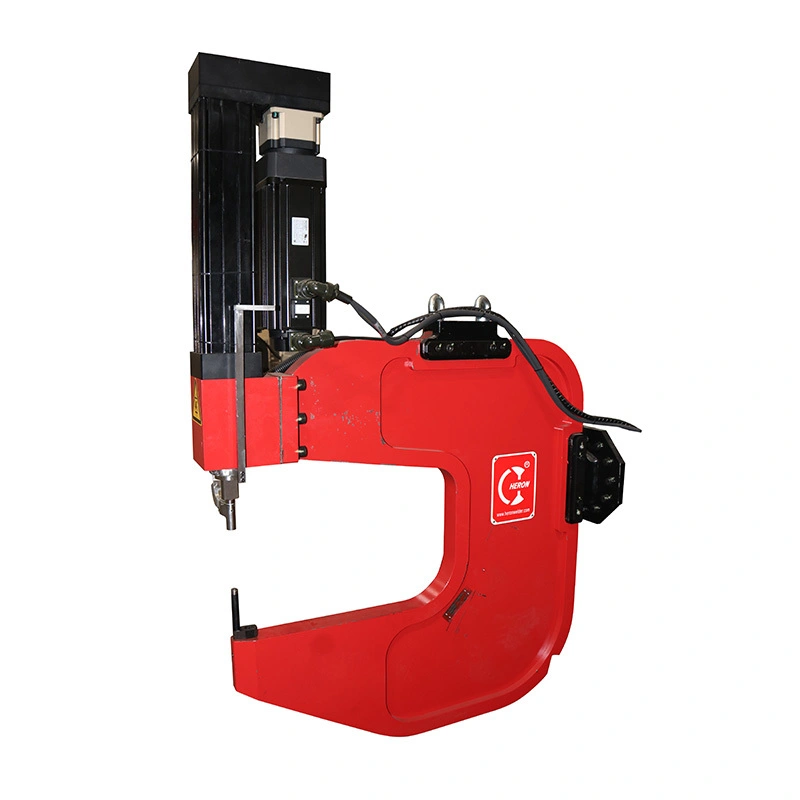
In high-speed production environments where strength, precision, and reliability are non-negotiable, riveting guns have emerged as indispensable tools for joining sheet metal, composites, and multi-material assemblies. For manufacturing engineers, OEMs, automation integrators, and factory decision-makers evaluating metal-joining strategies, understanding how a riveting gun works, where it fits relative to other joining technologies, and how to optimize its use can drive quality gains, cost savings, and production efficiency.
At Heron Welder, we design and deliver advanced riveting systems including Self-Pierce Riveting (FSPR) and pneumatic riveting guns tailored to the unique demands of industrial automation and high-volume assembly lines.
What Is a Riveting Gun?
A riveting gun is a mechanical or pneumatic tool engineered to install rivets into workpieces, fastening them together through plastic deformation. It’s widely used across automotive, aerospace, appliance, electronics, and construction industries where permanent joints are required.
Unlike simple handheld hammer riveters, industrial riveting guns deliver controlled force and precision through powered actuation. They are purpose-built for factory settings—integrable into robotic cells or automated lines, and capable of consistent cycle times with repeatable joint quality.
How a Riveting Gun Works: Principles & Mechanics
Pneumatic and Electric Actuation
Industrial riveting guns typically use one of two actuation methods:
-
Pneumatic Riveting Guns
Use compressed air to drive a piston that applies a precise, repeatable force to set the rivet. Pneumatic systems are robust, relatively low-maintenance, and well-suited for heavy-duty applications. -
Electric Riveting Guns
Use servomotor or electric actuators to control stroke and force. They offer fine control over riveting parameters, integration with digital control systems, and energy efficiency.
The Riveting Process
-
Positioning the Workpieces
Sheets or components are clamped and aligned. -
Feeding the Rivet
Rivet is delivered from a magazine or feeder to the gun nose. -
Actuation & Deformation
The rivet is driven into the materials. The force causes the rivet’s tail to flare, creating a mechanical lock. -
Release & Ejection
The gun retracts, leaving a fully formed, permanent joint.
The result is a solid-state, interference-fit joint that doesn’t rely on heat, preventing thermal distortion and preserving material properties.
Industrial Applications of Riveting Guns
Automotive Manufacturing
In automotive body assembly—particularly with high-strength steels and aluminum alloys—riveting guns are used to join:
-
Outer body panels
-
Interior subassemblies
-
Lightweight structural components
Self-Pierce Riveting (FSPR) guns, a specialized type, pierce and flare rivets through layers without pre-drilled holes—ideal for mixed materials like steel and aluminum.
Electronics & Appliances
For metal housings and enclosure assembly, riveting guns provide:
-
Quick, secure fastening
-
Vibration-resistant joints
-
Clean finishes without weld spatter
This makes them invaluable for products requiring high aesthetics and reliability.
Aerospace & Structural Applications
Riveting guns are fundamental in aerospace applications, where strength-to-weight ratios are critical. They enable joining of thin skins and stiffeners while minimizing heat effects that could compromise integrity.
Riveting Gun vs. Other Joining Technologies
When choosing a joining method, engineers must evaluate multiple factors: strength, cycle time, materials, cost, and integration complexity.
| Technology | Heat Input | Material Compatibility | Repeatability | Automation |
|---|---|---|---|---|
| Riveting Gun (FSPR) | ❌ No | Excellent for dissimilar metals | ✔ High | ✔ High |
| Resistance Welding | ✔ Yes | Best for similar metals | ✔ Very High | ✔ Very High |
| Threaded Fasteners | ❌ No | Good | Medium | Medium |
| Adhesive Bonding | ❌ No | Dissimilar materials | Variable | Medium |
Riveting Gun Advantages
-
No Heat Affected Zone
No thermal distortion or metallurgical changes. -
Dissimilar Material Joining
Great for aluminum, steel, composites. -
High Strength & Reliability
Mechanical interlock resists vibration and load cycling. -
Fast Cycle Times
Ideal for automated high-volume production.
When Welding Makes Sense
Resistance welding (spot, projection, seam) excels when joining similar metals at very high speeds, particularly in steel body assembly. However, welding can struggle with aluminum and dissimilar metals—where riveting guns shine.
Best Practices for Implementing Riveting Guns
To maximize performance and uptime:
Select the Right Rivet Type & Size
Match rivet diameter, grip range, and material to the specific stack-up and load requirements. FSPR rivets with controlled flare geometry deliver optimal strength.
Integrate with Positioning & Clamping Systems
Consistent part location and clamp force are critical for joint quality and repeatable results. Automated positioning minimizes rework.
Control Parameters
Monitor and control:
-
Actuation force
-
Stroke depth
-
Feed rate
-
Cycle timing
Digital control interfaces (PLC/robot controller integration) allow closed-loop quality assurance and analytics.
Maintain the Gun Systematically
Preventive maintenance—cleaning feed paths, inspecting nose assemblies, checking actuator seals—reduces downtime and increases service life.
Train Operators
Even in automated cells, operators should understand riveting principles, joint inspection criteria, and error recovery procedures.
Why Heron Welder for Riveting Guns?
At Heron Welder, we specialize in industrial riveting solutions engineered for performance and reliability:
-
High-precision riveting guns for Self-Pierce Riveting (FSPR) and traditional riveting needs
-
Robust pneumatic or electric actuators tailored for specific application forces
-
Seamless automation integration with robots, conveyors, and PLC systems
-
Custom tooling and control packages optimized for your production line and material set
-
Global support and service for uptime and quality assurance
Whether you’re assembling automotive body-in-white structures, appliance cabinets, or structural components, Heron’s riveting systems deliver consistent joint quality and production efficiency.
FAQs: Riveting Guns in Industrial Manufacturing
1. What materials can a riveting gun join?
Riveting guns can join steel, aluminum, titanium, and many composites—especially beneficial when materials are dissimilar and welding is impractical.
2. How does Self-Pierce Riveting differ from traditional riveting?
Self-Pierce Riveting (FSPR) pierces and flares the rivet through materials without pre-drilling. Traditional riveting typically requires holes and manual insertion.
3. Can riveting guns be automated?
Yes. Industrial riveting guns are designed for robotic cells or integration with PLC-controlled production lines for high throughput.
4. Are riveting joints as strong as welds?
Riveted joints provide excellent mechanical strength with superior performance in mixed-material stacks. For similar metals and certain applications, welding may still offer higher joint strength.
5. How do I maintain a riveting gun for long life?
Regular maintenance includes inspection of feed mechanisms, actuator seals, lubrication, and calibration checks to sustain performance.
Ready to Upgrade Your Joining Process?
Choosing the right riveting gun system can transform your assembly line performance. Heron Welder is your partner for advanced riveting and industrial joining solutions—combining engineering expertise with robust equipment built for automation and high-volume production.
➡️ Request a quote or consult with our experts today to tailor a riveting solution that fits your application, materials, and production goals.

 English
 Arabic
 French
 Spanish
 Portuguese
 Deutsch
 Turkish
 Dutch
 Russian
 Romaian
 Portuguese (Brazil)
 Greek