

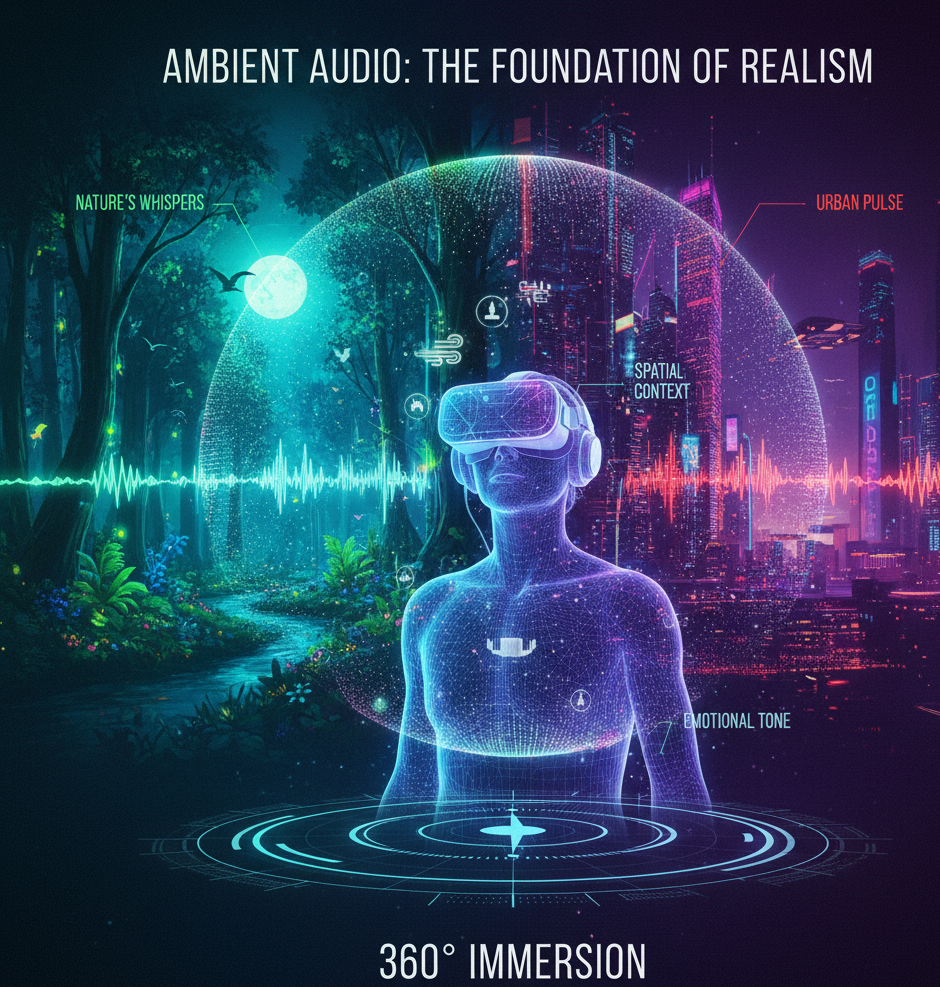
How Ambient Audio Enhances Realism in 360° Experiences
In immersive environments like 360° videos, virtual reality (VR), and interactive audio experiences, ambient audio plays a crucial role in shaping realism. While visuals provide the backdrop and structure of a digital world, it’s the ambient soundscape that convinces the brain it’s inside that world — increasing presence, emotional engagement, and authenticity. Platforms like AudioVR leverage cinematic audio techniques to create immersive experiences where ambient audio is a foundational sensory layer.
🎧 What Is Ambient Audio?
Ambient audio refers to background sound that surrounds a listener without a specific source, such as wind rustling through trees, distant city noise, or subtle room reverberations. In everyday life, these sounds help our brains understand and interpret our surroundings. When replicated in virtual environments, they provide essential context and spatial cues that visually tie the scene together.
While dialogue and sound effects deliver specific narrative information, ambient sound supports the environment — grounding users in time and space and making the experience feel complete and believable.
🧠 Why Ambient Audio Matters in 360° Experiences
When users enter a 360° or VR environment, their brains naturally try to make sense of the sensory information they receive. Visuals show what the environment looks like, but audio fills in the gaps by signaling what’s happening beyond sight. This creates a richer mental model of the space and boosts realism.
Psychological research has demonstrated that including realistic ambient soundscapes in virtual environments increases perceived authenticity compared with silent or flat audio conditions. People consistently report higher immersion and realism when ambient audio is present, indicating its impact on sensory integration.
🌍 How Ambient Audio Enhances Realism
1. Provides Spatial Context
Ambient audio creates a sonic backdrop that fills the entire 360° space. Whether it’s distant wildlife in a forest scene or murmurs and traffic in an urban environment, these sounds help users feel the environment — not just see it. This is especially important in panoramic experiences where the user can turn in any direction.
Rather than flat or stereo sound, ambient audio paired with spatial sound techniques gives users a full 3D listening field, which mirrors how we perceive sound in the real world and strengthens the feeling of presence.
2. Enhances Emotional Engagement
Physics of sound have emotional power. Ambient sound can set a tone even before dialogue or music begins — a light breeze can imply serenity, a distant storm can hint at danger, and echoing footsteps can suggest isolation. These ambient cues work below conscious awareness, creating emotional responses that visuals alone often fail to evoke.
This emotional layer amplifies the narrative experience, pulling the listener deeper into the story or environment in ways visuals can’t match on their own.
3. Improves Environmental Awareness
Realistic ambient audio helps the brain interpret environmental dynamics — what’s nearby versus far away, what’s static versus dynamic, and how the sound changes as the user moves or turns. For instance, a distant train horn that seems louder when a user looks in its direction — even without visual confirmation — strengthens the sense of space and depth.
This environmental awareness makes virtual worlds feel alive and coherent, enhancing overall immersion.
🎶 Ambient Audio in Practice: Techniques for 360° Experiences
To achieve truly immersive ambient sound in 360° and VR settings, creators often use the following techniques:
Ambisonics Recording: Captures the complete spherical audio field around the listener, enabling sound representation in every direction and supporting head movement responsiveness.
Layered Ambient Tracks: Combines multiple background sounds — like wind, birds, water flow, and distant traffic — to avoid audio monotony and enrich the soundscape.
Dynamic Mixing: Adjusts ambient elements based on user movement or interaction, making environments feel reactive rather than static.
These methods help produce ambient audio that not only complements visuals but actively supports the sensation of “being there.”
🎮 Beyond Realism: Cognitive and Narrative Impact
Ambient audio does more than create realism; it also influences cognitive processing and narrative interpretation. Studies of immersive environments show that appropriate ambient soundscapes can make experiences feel more coherent and emotionally consistent, leading to stronger engagement and memory of the experience.
Additionally, ambient audio can guide user attention subtly — drawing listeners toward narrative clues or specific areas in a scene — without the need for visual cues or text prompts.
⭐ Conclusion
In 360° experiences, ambient audio is far more than background noise — it’s a central ingredient in creating realism, presence, and emotional engagement. Combined with spatial audio design and other cinematic techniques, ambient sound transforms flat environments into rich, believable worlds that users feel part of rather than just observers. Whether in VR, interactive storytelling, or panoramic videos, ambient audio enhances the sense of immersion, deepens emotional impact, and makes each experience feel more authentic and memorable.
If you’re creating or exploring immersive experiences, paying attention to ambient audio isn’t optional — it’s essential for realism and engagement.

 English
 Arabic
 French
 Spanish
 Portuguese
 Deutsch
 Turkish
 Dutch
 Russian
 Romaian
 Portuguese (Brazil)
 Greek