

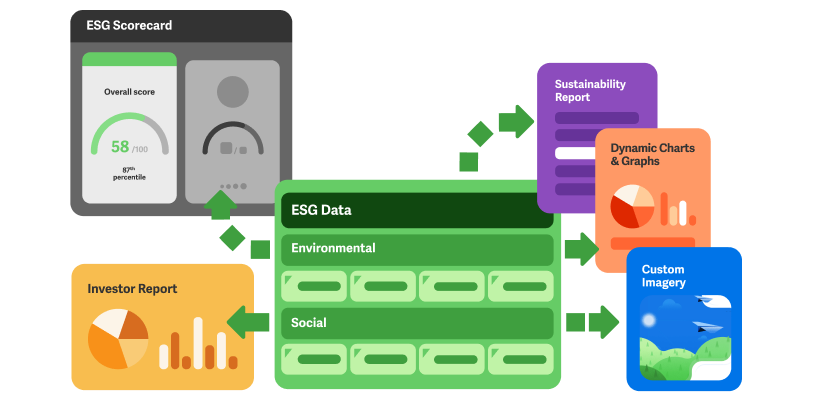
In the contemporary corporate landscape, the definition of business success is undergoing a profound and fundamental expansion. No longer is performance measured solely by financial metrics like revenue and profit; a company's impact on the planet and its people has become a critical indicator of long-term value. This shift has given rise to the strategically vital and rapidly growing ESG Reporting Software industry, a sector dedicated to helping organizations measure, manage, and disclose their performance across three key pillars: Environmental, Social, and Governance. This specialized software acts as a central, auditable system of record for all of a company's non-financial data. It automates the complex process of collecting data on everything from carbon emissions and water usage to employee diversity and supply chain labor practices, and then helps to format this data into compliant reports for a variety of stakeholders, including investors, regulators, and customers. As ESG moves from a "nice-to-have" corporate social responsibility activity to a "must-have," board-level strategic imperative, this software has become the essential tool for navigating the complex demands of a more conscious and accountable form of capitalism.
The software is designed to address the three distinct but interconnected pillars of ESG. The Environmental component is often the most data-intensive. The software provides modules to track a company's environmental footprint, with a major focus on climate-related data. This includes tools for automatically collecting utility data to calculate energy consumption and for performing complex greenhouse gas (GHG) accounting across Scope 1 (direct emissions), Scope 2 (indirect emissions from purchased energy), and the notoriously difficult Scope 3 (all other indirect emissions from the value chain). Beyond carbon, these modules can also track metrics related to water consumption, waste management and recycling rates, and the impact on biodiversity. The Social pillar focuses on a company's relationships with its stakeholders. The software helps to manage and report on a wide range of social metrics, such as employee health and safety statistics, diversity, equity, and inclusion (DE&I) data, employee turnover rates, community investment, and the ethical labor practices within the company's supply chain. This helps companies to manage their "social license to operate" and to demonstrate their commitment to being a responsible employer and community member.
The third pillar, Governance, is about the systems and processes a company has in place to manage itself, make effective decisions, and be accountable to its stakeholders. The ESG reporting software itself is a key governance tool. It provides a robust framework for data governance, ensuring that all the reported ESG data is accurate, consistent, auditable, and has a clear data lineage back to its source. It includes workflow management tools for assigning data collection tasks to individuals across the organization and for managing the internal review and approval process for the final report. Critically, the software addresses the immense challenge of reporting against a complex and fragmented landscape of different standards and frameworks. Leading platforms come with pre-built templates for all the major reporting standards, such as the Global Reporting Initiative (GRI), the Sustainability Accounting Standards Board (SASB), the Task Force on Climate-related Financial Disclosures (TCFD), and the emerging standards from the International Sustainability Standards Board (ISSB). This dramatically simplifies the reporting process and ensures that a company's disclosures are compliant and meet the expectations of different stakeholder groups.
Ultimately, the ESG reporting software industry exists to solve a fundamental problem for the modern corporation: the management of non-financial data is just as critical as the management of financial data. In the past, this ESG data was often scattered across the organization in a chaotic mess of spreadsheets, utility bills, and departmental reports, making it nearly impossible to get a consolidated, accurate, and auditable view of performance. A dedicated ESG reporting platform brings the same level of rigor, control, and process discipline to non-financial data that an ERP system brings to financial data. It creates a single source of truth that can be trusted by the CFO, the board of directors, and external auditors and investors. By providing this foundational "system of record," the software not only enables compliant reporting but also provides the data-driven insights needed to manage ESG risks, identify opportunities, and build a more resilient and sustainable business strategy for the long term.
Top Trending Reports:

 English
 Arabic
 French
 Spanish
 Portuguese
 Deutsch
 Turkish
 Dutch
 Russian
 Romaian
 Portuguese (Brazil)
 Greek