

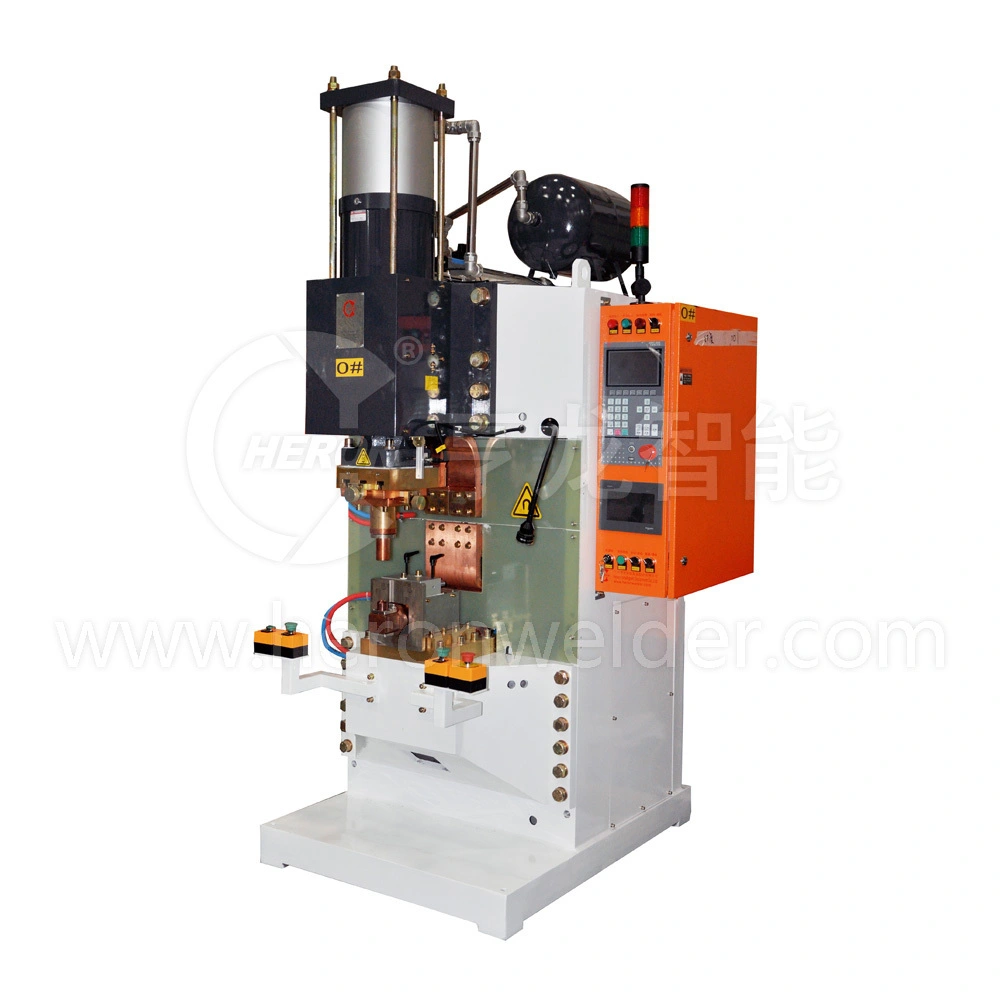
In today’s competitive manufacturing landscape, efficiency, precision, and reliability are critical. For industries relying on metal joining, spot resistance welding has emerged as a preferred method due to its speed, repeatability, and compatibility with automation. At Heron Welder, we design and manufacture advanced spot resistance welders that empower factories, OEMs, and automation integrators to achieve consistent, high-quality results across diverse industrial applications.
In this guide, we will explore the principles, applications, benefits, and best practices of spot resistance welders, while demonstrating how Heron’s expertise can help manufacturers optimize their welding operations.
What is a Spot Resistance Welder?
A spot resistance welder is a type of resistance welding machine designed to join two or more metal sheets at discrete points using controlled heat generated by electrical resistance. Unlike traditional arc welding, spot welding does not require filler material, making it highly efficient and ideal for high-volume production.
Key Components of a Spot Resistance Welder:
-
Electrodes: Conduct electrical current into the workpieces while applying pressure.
-
Transformers/Power Source: Deliver the precise current required for welding.
-
Controls and Timers: Ensure consistent weld quality by regulating current, pressure, and duration.
-
Cooling Systems: Maintain electrode temperature for durability and performance.
By focusing current and pressure at specific points, spot resistance welders create strong, uniform welds without deforming surrounding material, making them indispensable in precision metal fabrication.
How Spot Resistance Welding Works
The principle behind spot resistance welding is straightforward yet precise:
-
Preparation: Clean, properly aligned metal sheets are positioned between copper electrodes.
-
Pressure Application: Electrodes apply pressure to hold the sheets in place.
-
Current Flow: A high current passes through the electrodes, generating heat due to electrical resistance at the contact points.
-
Fusion: The heat melts the metal locally, forming a weld nugget.
-
Cooling: The current stops while pressure is maintained, allowing the weld to solidify.
This process can be repeated at multiple points along the workpiece, enabling rapid assembly of metal panels, frames, or components with minimal material distortion.
Applications of Spot Resistance Welders
Spot resistance welders are widely used across industries where speed, consistency, and strength are essential:
-
Automotive Manufacturing: Welding car body panels, chassis components, and brackets.
-
Aerospace and Aviation: Joining thin metal sheets in fuselage and aircraft components.
-
Appliance and Electronics: Producing metal housings, enclosures, and frames.
-
Metal Furniture and Construction: Fabricating steel frames, racks, and enclosures.
-
Battery and Energy Storage: Welding battery tabs and thin foils for electric vehicles and energy devices.
Heron’s range of spot resistance welders is specifically designed to accommodate both standard and specialized manufacturing processes, making them suitable for high-volume production and complex automation setups.
Advantages of Spot Resistance Welding
Manufacturers increasingly rely on spot resistance welding for several reasons:
-
Speed and Productivity: Rapid weld cycles reduce assembly time.
-
Material Efficiency: No filler metal is required, minimizing material costs.
-
Consistency and Repeatability: Precise control ensures uniform weld quality across multiple points.
-
Automation-Friendly: Easily integrated into robotic or automated production lines.
-
Minimal Heat-Affected Zone: Reduces warping and preserves material integrity.
By combining these advantages with Heron’s advanced control systems and electrode designs, manufacturers can achieve optimized production efficiency without compromising weld quality.
Spot Resistance Welding vs. Other Welding Methods
Understanding how spot resistance welding compares to other metal-joining techniques can guide decision-making:
| Welding Method | Strengths | Limitations | Best Use Case |
|---|---|---|---|
| Spot Resistance Welding | Fast, repeatable, automation-friendly | Limited to sheet metal and small thicknesses | Automotive panels, enclosures |
| MIG/TIG Welding | Versatile, strong welds, thicker metals | Slower, requires filler material | Structural frames, heavy-duty parts |
| Laser Welding | Precise, minimal distortion | High equipment cost | Aerospace, medical devices |
| Arc Welding | Suitable for thick metals | Slower, manual skill-intensive | Construction, repair work |
Heron’s spot resistance welders provide a balanced solution where speed, repeatability, and integration with automated systems are paramount.
Best Practices for Spot Resistance Welding
For optimal performance, manufacturers should consider the following:
-
Electrode Maintenance: Regularly inspect and dress electrodes to maintain consistent weld quality.
-
Material Preparation: Ensure surfaces are clean, free from oxides, oil, or coatings that may affect resistance.
-
Current Calibration: Adjust current and pressure settings based on material type and thickness.
-
Cooling Management: Maintain electrode cooling systems to prevent overheating and prolong lifespan.
-
Automation Integration: Use programmable controllers and sensors for repeatable, high-precision welds.
Heron Welder provides both consultation and equipment customization to help factories implement these best practices effectively.
FAQs About Spot Resistance Welders
1. What metals can be welded with spot resistance welders?
Spot resistance welders are ideal for ferrous and non-ferrous metals, including steel, stainless steel, aluminum, and nickel alloys, depending on thickness and electrode configuration.
2. Can spot welders be automated?
Yes, spot resistance welders are highly compatible with robotic arms and automated assembly lines for mass production.
3. How long does a typical weld cycle take?
Weld cycles usually range from 0.1 to 1 second per spot, depending on material thickness and machine power.
4. What thickness can spot welding handle?
Standard machines typically weld sheets from 0.5 mm to 6 mm; specialized machines from Heron can handle thicker metals.
5. How do I ensure consistent weld quality?
Consistent welds depend on proper electrode maintenance, calibrated current and pressure, and clean, aligned metal surfaces.
Why Choose Heron for Spot Resistance Welding Solutions?
At Heron Welder, we combine decades of industrial expertise with cutting-edge technology to deliver customized spot resistance welding solutions for manufacturers worldwide. Our machines are designed for high productivity, seamless automation integration, and long-term reliability.
Whether you are an OEM, factory decision-maker, or automation integrator, Heron provides expert guidance, technical support, and tailored solutions to optimize your welding operations.
Ready to elevate your production efficiency? Contact Heron Welder today to request a quote or consult with our engineers for a customized spot resistance welding solution that fits your manufacturing needs.

 English
 Arabic
 French
 Spanish
 Portuguese
 Deutsch
 Turkish
 Dutch
 Russian
 Romaian
 Portuguese (Brazil)
 Greek