

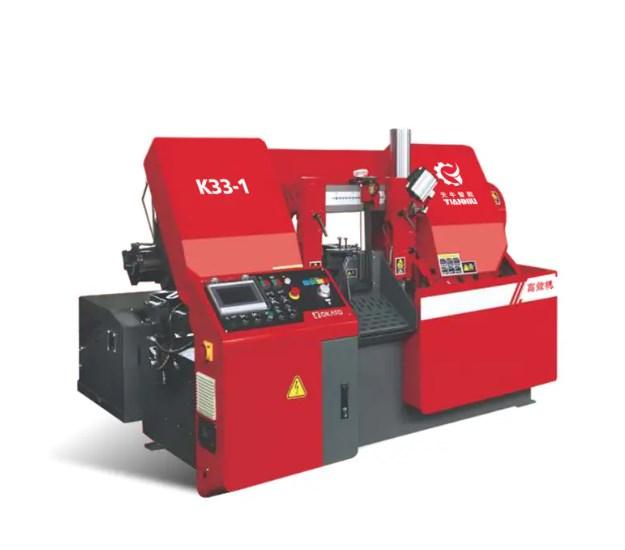
Introduction to Semi-Automatic Band Saws
A Semi-Automatic Band Saw is a versatile cutting tool widely used in metalworking, woodworking, and manufacturing industries. It combines the precision of manual operation with partial automation, allowing for efficient, accurate, and repeatable cuts. By streamlining the cutting process, a Semi-Automatic Band Saw improves productivity while reducing operator fatigue and material waste.
Structure and Components
The key components of a Semi-Automatic Band Saw include the saw blade, blade guide, motor, control system, and worktable. The blade is usually made of high-speed steel or bi-metal for cutting durability and strength. The motor drives the blade at adjustable speeds, while the blade guides maintain precise alignment. The semi-automatic mechanism controls feed rates or blade movement, allowing operators to focus on positioning and measurement rather than constant manual effort.
Working Principle
A Semi-Automatic Band Saw works by moving the blade across the material while the semi-automatic feed system controls cutting pressure and speed. Operators position the workpiece and initiate the cutting cycle, and the machine automatically lowers the blade to complete the cut. This process ensures consistent cut quality and reduces the risk of human error. The semi-automatic function balances control and efficiency, making it suitable for both simple and complex cutting tasks.
Advantages of Semi-Automatic Band Saws
One of the main advantages of a Semi-Automatic Band Saw is its precision. The automated feed allows for uniform cuts across multiple workpieces, improving accuracy and repeatability. It also reduces operator fatigue, as the machine handles part of the cutting effort. Additionally, these saws minimize material waste by maintaining consistent blade pressure and reducing the likelihood of errors. Their versatility allows them to cut various materials, including steel, aluminum, and plastics, in different shapes and sizes.
Applications in Industry
Semi-Automatic Band Saws are used in workshops, factories, and construction sites for cutting metal bars, pipes, profiles, and wood pieces. They are suitable for batch production, small-scale manufacturing, and prototyping. By combining manual control with semi-automatic feed, operators can perform complex cuts safely and efficiently, enhancing overall workflow and reducing production time.
Maintenance and Safety
Regular maintenance is essential for optimal performance. Blade tension, lubrication, and guide alignment should be checked periodically. Operators must follow safety guidelines, such as wearing protective gear and keeping their hands away from the blade during operation. Semi-Automatic Band Saws often include safety features like emergency stops and blade guards, ensuring secure operation while maximizing productivity.
Conclusion
A Semi-Automatic Band Saw offers a practical balance between manual control and automation, delivering precise, efficient, and reliable cuts. With proper maintenance and safe operation, it is a valuable tool for workshops and industrial environments. Its versatility, accuracy, and productivity benefits make the Semi-Automatic Band Saw an essential piece of equipment in modern manufacturing and metalworking applications.

 English
 Arabic
 French
 Spanish
 Portuguese
 Deutsch
 Turkish
 Dutch
 Russian
 Romaian
 Portuguese (Brazil)
 Greek