

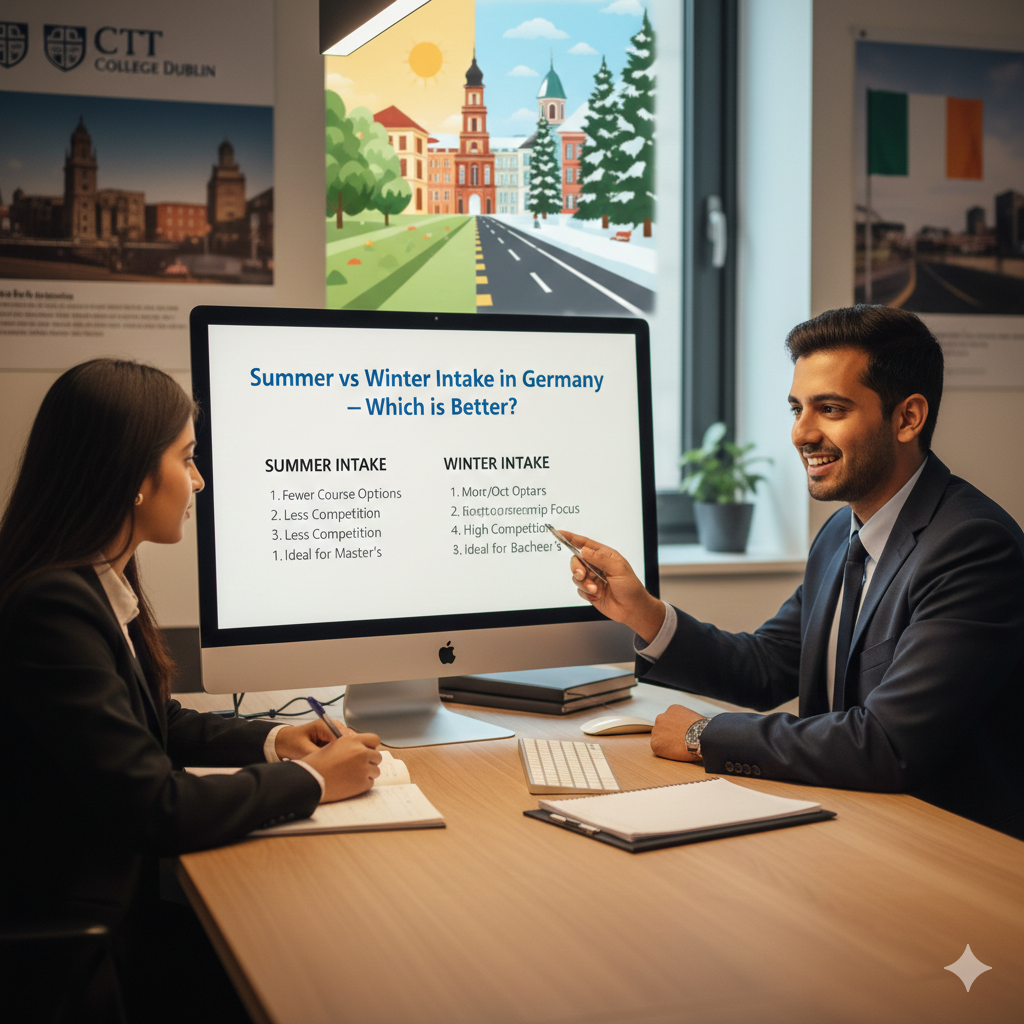
Hey, if you're an Indian student right now trying to decide between the summer intake (April start) and the winter intake (October start) for your bachelor's or master's in Germany in 2026 or 2027, you're asking one of the most common and most important questions early on. Both intakes lead to the same degree and same visa rights, but in real life they feel completely different course choices, competition level, preparation time, visa queues, campus vibe, and even your job/PR timeline after graduation all shift depending on which one you pick.
Germany has two main intakes: Winter (Hauptsemester, October start) is the big primary one, and Summer (Sommersemester, April start) is the smaller secondary one. For most Indian students one usually ends up being way more practical than the other. Here's a straight, no-fluff comparison of Summer intakes in Germany vs Winter Intake in Germany so you can see which one actually fits your marks, timeline, budget, and goals.
1. Course Availability – Winter Wins by a Huge Margin
Winter intake is when every single German university opens its full catalog every bachelor's, every master's, every English-taught program, every restricted (NC/numerus clausus) course. Summer intake is much narrower:
-
Many universities only run a handful of master's programs in summer (often just continuations from winter starters)
-
Full bachelor's programs almost never start in April
-
Competitive or lab-heavy fields (medicine, pharmacy, certain engineering branches) rarely if ever have summer intake
-
English-taught options drop sharply in summer compared to winter
If your dream program say Data Science at TU Munich, Mechanical Engineering at RWTH Aachen, or Business at University of Mannheim is only offered in winter (which most are), then summer simply isn't an option. Winter gives you choices; summer gives you leftovers.
2. Competition & Acceptance Chances
Summer intake usually sees far fewer applicants most Indian students aim for winter because of more programs and bigger scholarship pots. That means:
-
Higher acceptance rates at universities that do offer summer intake
-
Less chance of waitlists or outright rejections
-
Easier entry into restricted (NC) programs if they happen to run in summer
Winter intake is way more competitive bigger applicant pools from India, China, Middle East, Africa, and Europe. If your profile is average (60–65% bachelor's, IELTS 6.5–7.0), summer can give you a noticeably better shot at getting accepted.
3. Timeline & Preparation Breathing Room
Summer intake gets you studying faster finish your degree 6 months earlier, enter the job market or start building PR points sooner. The situation requires tighter control because three factors need earlier access to applications which begin their operations between October and December of the preceding year. The application process requires shorter time periods which last from November 2026 until January and February 2027 to apply for summer 2027 admission. The three requirements APS certificate language tests and visa application process need to be completed within the same restricted time period. The winter intake period allows students to apply between May and February which provides them extra time to complete IELTS retakes and handle APS delays and financial proof collection and visa slot reservations.
4. Scholarships & Funding
Most scholarships DAAD funding, university merit awards, Deutschlandstipendium, Erasmus are tied to the winter intake because it's the main start. Summer has far fewer scholarships many aren't even offered, or the amounts are smaller.
If funding is a big part of your plan, winter usually gives you way more realistic options.
5. Visa Processing & Blocked Account
The German consulates in India have limited available visa slots during summer intake processing which leads to shorter waiting times for applicants than during the winter peak period from May to September. You should submit your application early because processing takes 6 to 12 weeks. The winter intake period from June to September experiences its highest visa demand which results in extended waiting periods at VFS and consulates yet applicants who submit their applications early face more reliable processing times.
6. Campus Life & Job/Internship Start
The winter intake provides a complete freshman experience through its two main orientation weeks and its welcome activities and its larger Indian student groups and its active student organizations and its Diwali and Holi festivities which begin on the first day. Summer starts quieter fewer new students, most domestic students already settled from winter.
Job and internship opportunities often ramp up in fall/winter many companies hire then. Summer starters finish earlier and can enter the job market 6 months ahead, but the start feels slower.
Who Should Pick Which Intake?
Go for Summer 2027 if:
-
Your results come late (Dec–Feb)
-
You want to avoid a gap year
-
You prefer less competition and smaller classes
-
Your target program actually runs in summer
Go for Winter 2026/27 if:
-
You want the widest possible course selection
-
Scholarships or funding matter
-
You want the full student life and bigger Indian community
-
Your timeline lets you apply by early 2026
Final Thoughts Right Now
For most Indian students, winter intake is still the stronger, safer, and more practical choice because of more programs, more scholarships, better job/PR pathways, and the full campus experience. Summer is a good backup or fast-track option if your situation lines up perfectly.
Start by checking DAAD.de and uni-assist.de — search for “Sommersemester 2027” or “Wintersemester 2026/27” to see which universities and programs are actually available in each intake.
If you're not sure which one suits your marks, timeline, budget, or target field, or you need help shortlisting realistic universities, sorting APS, or planning the visa, reach out to study in Germany consultants in India. We can look at your grades, language level, budget, and goals to give you honest, practical advice. Things move fast always verify directly on university sites, DAAD, uni-assist, and the German Embassy. What's your current qualification, approximate percentage, language level, or preferred field? I can tell you which intake looks more realistic for you right now.

 English
 Arabic
 French
 Spanish
 Portuguese
 Deutsch
 Turkish
 Dutch
 Italiano
 Russian
 Romaian
 Portuguese (Brazil)