

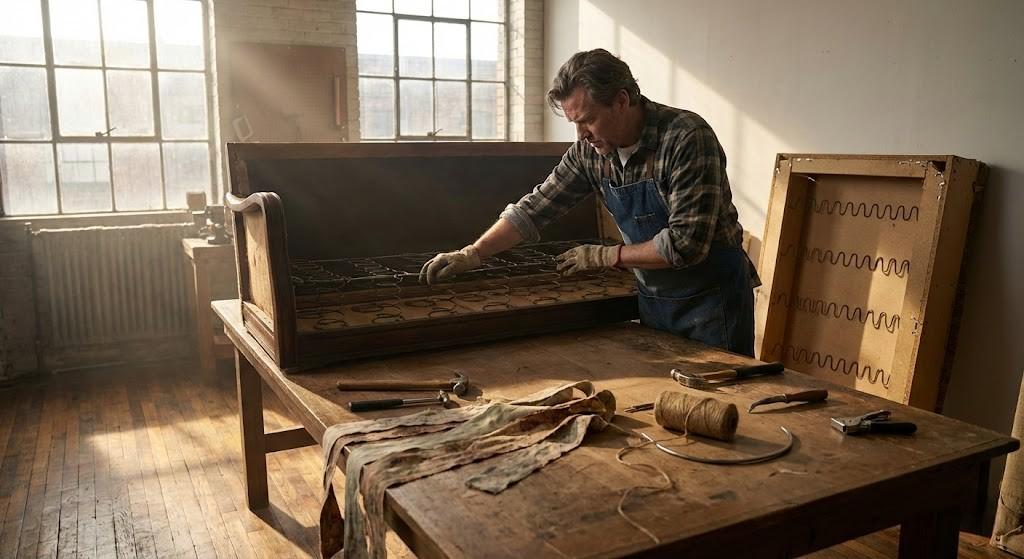
You've pulled the trigger. That sofa that's been holding your living room hostage with its sagging cushions and dated fabric is finally getting professional help. Maybe it's the springs that have given up completely. Perhaps it's the mysterious stains that have become conversation pieces. Whatever pushed you over the edge, you're now exploring sofa reupholstery—and realizing it's more complex than you anticipated.
Here's the unfiltered perspective from the people who do this work every day. They're not trying to complicate your life; they're trying to protect you from expensive mistakes.
Not Every Piece Earns a Second Chance
This is the conversation upholsterers dread, because crushing someone's attachment to their furniture feels terrible. But silence feels worse when the project fails.
A well-built sofa—kiln-dried hardwood frame, eight-way hand-tied springs, mortise-and-tenon joinery—can absolutely justify professional sofa upholster services. But that discount special with the particleboard skeleton, serpentine springs, and staple-gun construction? It's a money pit wearing upholstery. That beautiful new fabric will look spectacular until the frame starts cracking and the springs start popping—usually right after you've stopped holding your breath.
When you bring a piece in, expect the flip test. A serious professional will turn it over, knock on the rails, check the spring attachments, and look for the telltale signs of quality or compromise. If they deliver bad news about the frame, don't shop for a second opinion that tells you what you want to hear. The labor doesn't get cheaper just because the bones are bad.
Do your own homework first. Sit on the arms—yes, really. Quality frames don't groan or flex. Flip it and look at the undercarriage. Hardwood looks like furniture; particleboard looks like it belongs in a shipping crate. Trust your hands and eyes before you trust your hopes.
The Fabric You Love Might Destroy Your Budget
Walking in with a color palette is fine. Walking in with nothing else is a recipe for disappointment.
In the universe of sofa reupholstery, fabric selection is where amateur dreams meet professional reality. That delicate bouclé you love? It'll look like a cat scratching post within a week if you actually have cats. That pristine white linen? It has a half-life of approximately one glass of red wine.
The magic number is the double rub count—how many times a machine can rub the fabric before it shows wear. For daily-use furniture, 30,000 double rubs is the safety zone. For showpieces, you can go lower. Modern performance fabrics have changed the game: they look like luxury natural fibers but clean up like outdoor furniture. They're not cheap, but neither is doing this twice.
Pattern matching is the hidden budget killer. A large-scale geometric or dramatic floral requires careful alignment at every seam, every cushion, every curve. Your upholsterer isn't being greedy when they calculate extra yardage—they're being honest. A bold pattern can require 50% more fabric than a solid, and that math hits your wallet hard.
Live with your samples. Tape them to the existing sofa. Spill coffee on them (seriously, test cleanability). See how they look at 7 AM and 10 PM. The fabric that charmed you under fluorescent lights might look like a hospital waiting room in your natural light.
Labor Isn't a Line Item—It's the Whole Story
When that quote arrives and your jaw drops, remember: you aren't buying fabric. You're buying expertise.
Complete sofa reupholstery is a surgical procedure. It requires stripping every layer down to the frame, repairing structural damage, rebuilding cushion cores, cutting and fitting new materials with millimeter precision, and finishing with techniques that take years to master. A skilled professional might invest 25-35 hours in a single three-seat sofa. That's not markup—that's mathematics.
The extras add up quickly, but they're often non-negotiable for quality results. Compressed foam that's lost its resilience must be replaced. Sagging springs need retightening or replacement. If you want firmer seating or a different silhouette, that means new materials and additional labor.
Ask for the detailed breakdown. A reputable shop will explain exactly where every dollar goes, from frame repair to final inspection. Understanding this transforms you from a anxious client into an informed partner.
The Calendar Is Not Your Friend
Quality sofa reupholstery operates on its own timeline, and that timeline is not fast.
Established shops with stellar reputations are usually booked weeks or months out. Once your piece enters the queue, the work itself demands patience. Multiple stages—stripping, repair, cutting, sewing, fitting, finishing—can't be rushed without compromising results. Six weeks is reasonable. Eight weeks is common. Anyone promising two weeks is either cutting corners or outsourcing to who-knows-where.
If you have immovable deadlines—a daughter's wedding, a house closing, holiday hosting—communicate these immediately and get explicit confirmation. Don't assume. And definitely don't wait until the last minute to discover you'll be floor-sitting for your own dinner party.
The Questions That Separate Smart Clients From Sorry Ones
Don't wing the consultation. Arrive with a list.
Ask who physically performs the work. In-house craftsmen? Subcontractors shipped overseas? You have a right to know. Ask to see finished pieces similar to yours. Ask about their discovery process—what happens when they find hidden damage after starting?
Question their confidence level. Do they warranty their sofa upholster services? For how long? Against what specific failures? A shop that stands behind its work will answer without hesitation.
Most importantly, listen when they push back. If your chosen fabric is wrong for your lifestyle, if your frame needs reinforcement, if your timeline is unrealistic—these aren't sales tactics. They're professional integrity. The upholsterer who agrees with everything you say is the one who will disappoint you later.
Genuine sofa reupholstery is about preserving pieces that matter while making them function beautifully again. Enter the process with eyes open, and you'll exit it with furniture that serves you for decades.

 English
 Arabic
 French
 Spanish
 Portuguese
 Deutsch
 Turkish
 Dutch
 Russian
 Romaian
 Portuguese (Brazil)
 Greek