

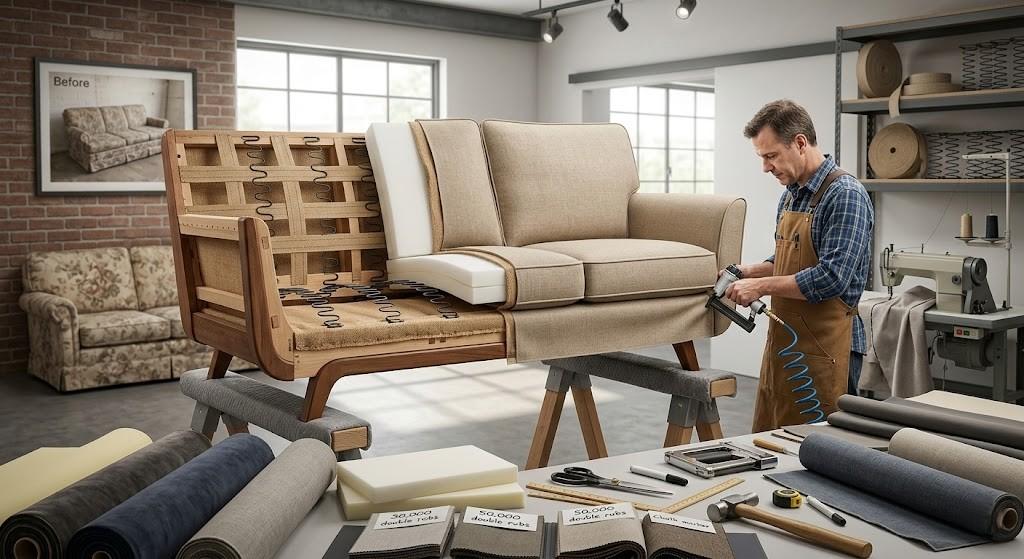
Your sofa has been the backdrop for countless memories—family gatherings, quiet evenings, and everything in between. Now its fabric bears the marks of those moments, and you're tempted to start fresh with something from a showroom floor. But before you do, consider that much of what you think you know about sofa reupholstery might be mistaken. These persistent myths cost homeowners dearly every year.
Myth 1: Reupholstery Always Costs More Than Buying New
This assumption rarely holds up to scrutiny.
A mid-range sofa fresh from the retailer will set you back $800 to $2,500. Compare that to revitalizing the hardwood-frame piece you already own—the kind built in the 1980s or 1990s, before manufacturers switched to particle board and staple-gun construction. Professional sofa reupholstery for quality pieces like this typically runs $400 to $1,200, depending on fabric choice and complexity.
The comparison becomes even more striking when you look at what you're actually getting. That $900 new sofa likely has a softwood or engineered wood frame, bonded leather or entry-level polyester fabric, and foam that will be compressed and uncomfortable within three to five years. Your existing sofa, still structurally sound after 20 or 30 years, has already proven it was built to last. You're investing in restoration, not replacement with an inferior product.
Sofa upholstery services also give you control over materials that furniture stores don't. You choose the fabric grade, the weave density, the thread count. A store selling a $1,500 sofa chose fabric that protects their margin, not your long-term comfort.
Myth 2: Any Fabric Can Be Reupholstered With the Same Result
Fabric selection is more technical than most people realize.
The outcome of sofa reupholstery depends heavily on fabric weight, stretch, weave structure, and how the material behaves around curves, corners, and tufting buttons. Get this wrong, and even expensive fabric looks cheap.
Loosely woven fabrics like linen blends look elegant on flat surfaces but distort visibly around curved armrests and rolled backs. Velvet requires directional cutting so the pile runs consistently across every panel—otherwise the sofa looks pieced together from different materials. Leather needs careful management of heat and moisture during application to avoid cracking at stress points.
A skilled upholsterer will discuss these variables with you before you order material. If a sofa upholstery service skips this conversation and just asks how many meters you need, that's a sign to ask more questions. Fabric durability matters too. For a sofa used daily, you want fabric rated above 30,000 double rubs. Decorative fabrics rated below 15,000 double rubs work fine on accent chairs that see light use, but they'll show wear on a sofa armrest within two years.
Myth 3: Reupholstery Is a DIY Project Anyone Can Pull Off
YouTube has made this myth worse. There are genuinely good tutorials for recovering dining chairs with flat drop-in seats. That skill does not transfer to sofa reupholstery.
A three-seat sofa involves between 12 and 20 individual fabric panels, each cut to account for seam allowances, pattern matching, and the specific geometry of that frame. The cushions require either foam cutting or re-wrapping existing foam, and the internal structure—including the webbing, springs, and padding layers—often needs assessment and repair before new fabric goes on.
Mistakes in DIY sofa reupholstery are expensive to fix. Cut panels incorrectly, and you've wasted material. Staple fabric without proper tension, and the finished surface puckers and creases. Professional upholsterers use tack strips, hand-stitching for specific seam types, and pneumatic tools that create consistent tension across large fabric spans. The time investment for a skilled professional is 20 to 40 hours for a full sofa. For someone attempting it without training, double that, and account for the cost of redoing sections that don't work out.
Myth 4: Old Furniture Isn't Worth Reupholstering
Age isn't the variable that matters. Frame construction is.
Furniture built before the 1990s in Singapore and across much of Southeast Asia used solid timber frames, often rubber wood, teak, or meranti, jointed with mortise-and-tenon or dowel construction and reinforced with corner blocks. That structure is worth restoring. A frame that has held its shape for 30 years will hold it for another 30 after sofa reupholstery.
The furniture to avoid reupholstering is the kind with frames that are already compromised: warped MDF panels, broken corner joints, collapsed seat platforms. A reputable sofa upholstery service assesses frame condition before quoting. If the frame needs significant structural repair, the quote reflects that work. If the frame is sound, you're investing in something that will outlast most new sofas at similar price points.
Antique and inherited pieces are the strongest case for sofa reupholstery over replacement. A rattan sofa from the 1970s or a teak-framed Chesterfield from a grandparent's home has material and sentimental value that a furniture store cannot replicate at any price point.
Myth 5: The Process Takes Too Long to Be Practical
Standard sofa reupholstery in Singapore takes seven to fourteen working days once fabric has been sourced and confirmed. That's the realistic turnaround for a three-seat sofa at a professional workshop with proper staffing.
Delays happen when fabric is imported and needs three to four weeks for delivery, or when structural repairs extend the work. Both are knowable upfront. A good sofa upholstery service provides a clear timeline at the start and flags any dependencies that could affect the schedule.
Compare that to lead times for custom furniture orders, which regularly run six to twelve weeks, and the reupholstery timeline looks reasonable. For pieces that need to be returned quickly, some upholsterers offer express services for an additional fee, which is worth asking about when getting quotes.
What This Means Practically
Before deciding a sofa needs replacing, get a structural assessment and a reupholstery quote from a professional service. The quote is usually free, and it gives you a real comparison point instead of an assumed one.
Sofa reupholstery makes financial sense when the frame is solid, when the piece has design or sentimental value, and when you want fabric quality above what's available at retail price points. It doesn't make sense for furniture with compromised frames or pieces where the cost of repair plus fabric approaches or exceeds replacement cost.
The myths around sofa upholstery services persist because people don't ask for the quote. Get the quote, assess the frame, and make the decision with actual numbers.

 English
 Arabic
 French
 Spanish
 Portuguese
 Deutsch
 Turkish
 Dutch
 Russian
 Romaian
 Portuguese (Brazil)
 Greek