• Exhibition Model in Singapore: Stunning Models for Exhibitions, Products & Engineering Prototypes
    Exhibition models help capture attention, communicate ideas, and showcase innovation at trade shows, expos, and product launches. Sridhar Model Designers delivers high-quality Exhibition Models in Singapore using CNC machining, laser cutting, 3D printing, and skilled craftsmanship for visually striking and precise models. These models enhance audience engagement and effectively present concepts at global exhibitions. For enquiries, contact +91 94481 39975 / +91 95131 00569 or email kn@sridharmodeldesigners.com.
    https://www.sridharmodeldesigners.com/
    Exhibition Model in Singapore: Stunning Models for Exhibitions, Products & Engineering Prototypes Exhibition models help capture attention, communicate ideas, and showcase innovation at trade shows, expos, and product launches. Sridhar Model Designers delivers high-quality Exhibition Models in Singapore using CNC machining, laser cutting, 3D printing, and skilled craftsmanship for visually striking and precise models. These models enhance audience engagement and effectively present concepts at global exhibitions. For enquiries, contact +91 94481 39975 / +91 95131 00569 or email kn@sridharmodeldesigners.com. https://www.sridharmodeldesigners.com/
    0 Comentários 0 Compartilhamentos
  • Top 7 Innovations Transforming the Stationary Dental 3D Printing Industry

    According to a newly published market research report by 24LifeSciences, global stationary dental 3D printing devices market was valued at USD 1.65 billion in 2025 and is projected to grow from USD 1.85 billion in 2025 to reach USD 3.54 billion by 2032, growing at a compound annual growth rate (CAGR) of 9.8% during the forecast period.

    Stationary dental 3D printing devices are advanced, non-portable systems used primarily in dental laboratories and clinical settings for additive manufacturing of dental prosthetics and appliances. These systems utilize technologies like Stereolithography (SLA), Digital Light Processing (DLP), and Material Jetting to produce high-precision, patient-specific items directly from digital models. Common applications include the fabrication of crowns, bridges, surgical guides, dentures, and orthodontic models, which are fundamental to restorative, cosmetic, and implant dentistry procedures.

    Download a Free Sample Report (PDF): https://www.24lifesciences.com/download-sample/10402/stationary-dental-d-printing-devices-market
    Top 7 Innovations Transforming the Stationary Dental 3D Printing Industry According to a newly published market research report by 24LifeSciences, global stationary dental 3D printing devices market was valued at USD 1.65 billion in 2025 and is projected to grow from USD 1.85 billion in 2025 to reach USD 3.54 billion by 2032, growing at a compound annual growth rate (CAGR) of 9.8% during the forecast period. Stationary dental 3D printing devices are advanced, non-portable systems used primarily in dental laboratories and clinical settings for additive manufacturing of dental prosthetics and appliances. These systems utilize technologies like Stereolithography (SLA), Digital Light Processing (DLP), and Material Jetting to produce high-precision, patient-specific items directly from digital models. Common applications include the fabrication of crowns, bridges, surgical guides, dentures, and orthodontic models, which are fundamental to restorative, cosmetic, and implant dentistry procedures. Download a Free Sample Report (PDF): https://www.24lifesciences.com/download-sample/10402/stationary-dental-d-printing-devices-market
    0 Comentários 0 Compartilhamentos
  • How Outsourcing and Advanced Manufacturing Are Shaping Orthopedic CMOs

    According to a newly published market research report by 24LifeSciences, global orthopedic contract manufacturing market is valued at USD 14.5 billion in 2026 and is projected to reach USD 23.2 billion by 2034, growing at a compound annual growth rate (CAGR) of 6.5% during the forecast period.

    Orthopedic contract manufacturing involves specialized third-party production for medical device companies, offering design, development, and manufacturing services. This sector is critical for producing a wide array of essential devices, including joint reconstruction implants (for hips, knees, and shoulders), spinal devices, trauma fixation systems, and precision surgical instruments. The outsourcing model enables original equipment manufacturers (OEMs) to leverage advanced capabilities in precision machining, additive manufacturing (3D printing), and surface treatments while navigating the complex regulatory landscape governed by agencies like the FDA and EMA.

    Download a Free Sample Report (PDF): https://www.24lifesciences.com/download-sample/8702/orthopedic-contract-manufacturing-market
    How Outsourcing and Advanced Manufacturing Are Shaping Orthopedic CMOs According to a newly published market research report by 24LifeSciences, global orthopedic contract manufacturing market is valued at USD 14.5 billion in 2026 and is projected to reach USD 23.2 billion by 2034, growing at a compound annual growth rate (CAGR) of 6.5% during the forecast period. Orthopedic contract manufacturing involves specialized third-party production for medical device companies, offering design, development, and manufacturing services. This sector is critical for producing a wide array of essential devices, including joint reconstruction implants (for hips, knees, and shoulders), spinal devices, trauma fixation systems, and precision surgical instruments. The outsourcing model enables original equipment manufacturers (OEMs) to leverage advanced capabilities in precision machining, additive manufacturing (3D printing), and surface treatments while navigating the complex regulatory landscape governed by agencies like the FDA and EMA. Download a Free Sample Report (PDF): https://www.24lifesciences.com/download-sample/8702/orthopedic-contract-manufacturing-market
    0 Comentários 0 Compartilhamentos
  • Digital Transformation Market Growth Outlook 2025–2032: A Strategic Forecast

    Global Digital Transformation Market to Exceed $4.6 Trillion by 2032, Fueled by Pandemic-Driven Innovation and Industry 4.0 Adoption

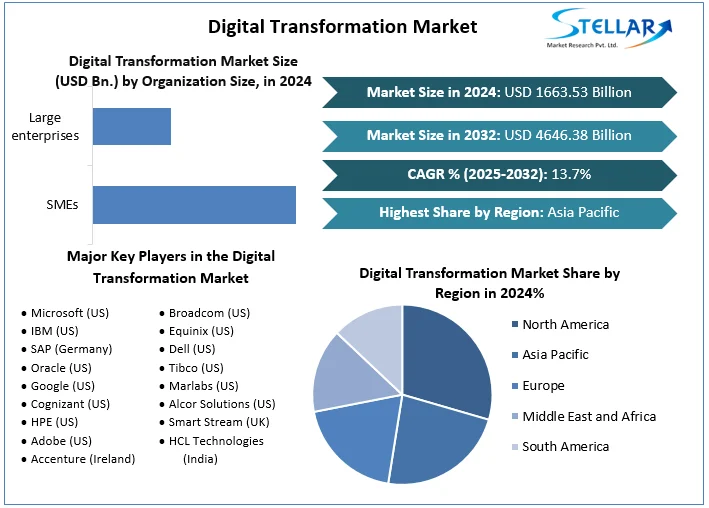
    The global Digital Transformation Market is experiencing an unprecedented surge, fundamentally redefining how businesses operate, innovate, and deliver value. Valued at a colossal $1,663.53 billion in 2024, the market is projected to expand at a compound annual growth rate (CAGR) of 13.7%, reaching a staggering $4,646.38 billion by 2032. This explosive growth is powered by a powerful imperative across all industries to integrate digital technologies, optimize costs, and build resilient, data-driven operations in the wake of global disruptions.

    Purchase This Research Report at up to 30% Off @ https://www.stellarmr.com/report/req_sample/Digital-Transformation-Market/352

    1. Market Estimation and Core Definition
    Digital transformation is defined as the comprehensive integration of digital technologies into all areas of a business, fundamentally changing how it operates and delivers value to customers. It is not merely about adopting new software but represents a profound cultural shift that reimagines business models, streamlines processes, and creates new revenue streams. The market's valuation encompasses a vast ecosystem of solutions and services, including automation, advanced manufacturing, cloud computing, data analytics, and artificial intelligence, which collectively empower organizations to enhance efficiency, reduce operational costs, and gain a decisive competitive edge.

    2. Market Growth Drivers and Key Opportunity
    The foundational driver of this market is the universal, cross-industry endorsement of digital initiatives as a strategic necessity. Organizations are moving beyond pilot projects to implement corporation-wide programs that reshape entire business segments. This is propelled by the need for operational resilience, as demonstrated during global challenges like the COVID-19 pandemic. A monumental opportunity lies in the decentralization and automation of production through technologies like industrial robotics. These systems enable remote surveillance and continuous, unattended operation, allowing businesses to maintain output irrespective of external disruptions. This capability to create autonomous, flexible, and reactive production lines is a critical value proposition driving massive investment.

    3. What Lies Ahead: Emerging Trends Shaping the Future
    The market's trajectory is being defined by the acceleration of specific technologies and regional hotspots. Industrial Robotics is emerging as the fastest-growing technology segment, projected to grow at a CAGR of 15.3%. Fueled by Industry 4.0, the rise of collaborative robots (cobots), AI-driven systems, and the need for social distancing in sensitive sectors like pharmaceuticals, robots are becoming central to automation and error reduction. Secondly, the Asia-Pacific region is ascending as the new epicenter of digital transformation. Government-led initiatives, such as Japan's establishment of a dedicated Digital Agency, combined with massive vendor investments in cloud, AI, IoT, and big data, are rapidly modernizing the business landscape across the region's burgeoning economies.

    Purchase This Research Report at up to 30% Off @ https://www.stellarmr.com/report/req_sample/Digital-Transformation-Market/352

    4. Segmentation Analysis
    The market structure reveals key adoption patterns across business size and technological focus:

    By Organization Size: Both Small and Medium Enterprises (SMEs) and Large Enterprises are driving demand. Large enterprises often lead in scaling complex transformations, while cloud-based solutions are making advanced technologies increasingly accessible and vital for the competitiveness of SMEs.

    By Technology: While Industrial Robotics shows the highest growth, the market is broad and includes Internet of Things (IoT), Artificial Intelligence & Machine Learning, Big Data & Analytics, and 3D Printing. Each technology addresses specific needs, from connected operations and predictive insights to on-demand manufacturing.

    About us

    Phase 3,Navale IT Zone, S.No. 51/2A/2,

    Office No. 202, 2nd floor,

    Near, Navale Brg,Narhe,

    Pune, Maharashtra 411041

    sales@stellarmr.com

    Digital Transformation Market Growth Outlook 2025–2032: A Strategic Forecast Global Digital Transformation Market to Exceed $4.6 Trillion by 2032, Fueled by Pandemic-Driven Innovation and Industry 4.0 Adoption The global Digital Transformation Market is experiencing an unprecedented surge, fundamentally redefining how businesses operate, innovate, and deliver value. Valued at a colossal $1,663.53 billion in 2024, the market is projected to expand at a compound annual growth rate (CAGR) of 13.7%, reaching a staggering $4,646.38 billion by 2032. This explosive growth is powered by a powerful imperative across all industries to integrate digital technologies, optimize costs, and build resilient, data-driven operations in the wake of global disruptions. Purchase This Research Report at up to 30% Off @ https://www.stellarmr.com/report/req_sample/Digital-Transformation-Market/352 1. Market Estimation and Core Definition Digital transformation is defined as the comprehensive integration of digital technologies into all areas of a business, fundamentally changing how it operates and delivers value to customers. It is not merely about adopting new software but represents a profound cultural shift that reimagines business models, streamlines processes, and creates new revenue streams. The market's valuation encompasses a vast ecosystem of solutions and services, including automation, advanced manufacturing, cloud computing, data analytics, and artificial intelligence, which collectively empower organizations to enhance efficiency, reduce operational costs, and gain a decisive competitive edge. 2. Market Growth Drivers and Key Opportunity The foundational driver of this market is the universal, cross-industry endorsement of digital initiatives as a strategic necessity. Organizations are moving beyond pilot projects to implement corporation-wide programs that reshape entire business segments. This is propelled by the need for operational resilience, as demonstrated during global challenges like the COVID-19 pandemic. A monumental opportunity lies in the decentralization and automation of production through technologies like industrial robotics. These systems enable remote surveillance and continuous, unattended operation, allowing businesses to maintain output irrespective of external disruptions. This capability to create autonomous, flexible, and reactive production lines is a critical value proposition driving massive investment. 3. What Lies Ahead: Emerging Trends Shaping the Future The market's trajectory is being defined by the acceleration of specific technologies and regional hotspots. Industrial Robotics is emerging as the fastest-growing technology segment, projected to grow at a CAGR of 15.3%. Fueled by Industry 4.0, the rise of collaborative robots (cobots), AI-driven systems, and the need for social distancing in sensitive sectors like pharmaceuticals, robots are becoming central to automation and error reduction. Secondly, the Asia-Pacific region is ascending as the new epicenter of digital transformation. Government-led initiatives, such as Japan's establishment of a dedicated Digital Agency, combined with massive vendor investments in cloud, AI, IoT, and big data, are rapidly modernizing the business landscape across the region's burgeoning economies. Purchase This Research Report at up to 30% Off @ https://www.stellarmr.com/report/req_sample/Digital-Transformation-Market/352 4. Segmentation Analysis The market structure reveals key adoption patterns across business size and technological focus: By Organization Size: Both Small and Medium Enterprises (SMEs) and Large Enterprises are driving demand. Large enterprises often lead in scaling complex transformations, while cloud-based solutions are making advanced technologies increasingly accessible and vital for the competitiveness of SMEs. By Technology: While Industrial Robotics shows the highest growth, the market is broad and includes Internet of Things (IoT), Artificial Intelligence & Machine Learning, Big Data & Analytics, and 3D Printing. Each technology addresses specific needs, from connected operations and predictive insights to on-demand manufacturing. About us Phase 3,Navale IT Zone, S.No. 51/2A/2, Office No. 202, 2nd floor, Near, Navale Brg,Narhe, Pune, Maharashtra 411041 sales@stellarmr.com

    0 Comentários 0 Compartilhamentos
  • Electronics Ceramics and Electrical Ceramics Market Size To Grow At A CAGR Of 5.46% In The Forecast Period Of 2025-2032

    Global Electronics and Electrical Ceramics Market to Exceed USD 21 Billion by 2032, Fueled by Consumer Electronics and IoT Expansion

    Steady 5.46% CAGR Driven by Miniaturization Demand and Renewable Energy Sector Growth

    A comprehensive industry analysis reveals robust growth for the global Electronics Ceramics and Electrical Ceramics market, an indispensable segment of the modern electronics industry. These advanced materials, prized for their exceptional electrical properties, form the foundation for countless devices enabling today's connected, high-tech world.

    Purchase This Research Report at up to 30% Off @ https://www.stellarmr.com/report/req_sample/electronics-ceramics-and-electrical-ceramics-market/2373

    1. Market Estimation & Definition
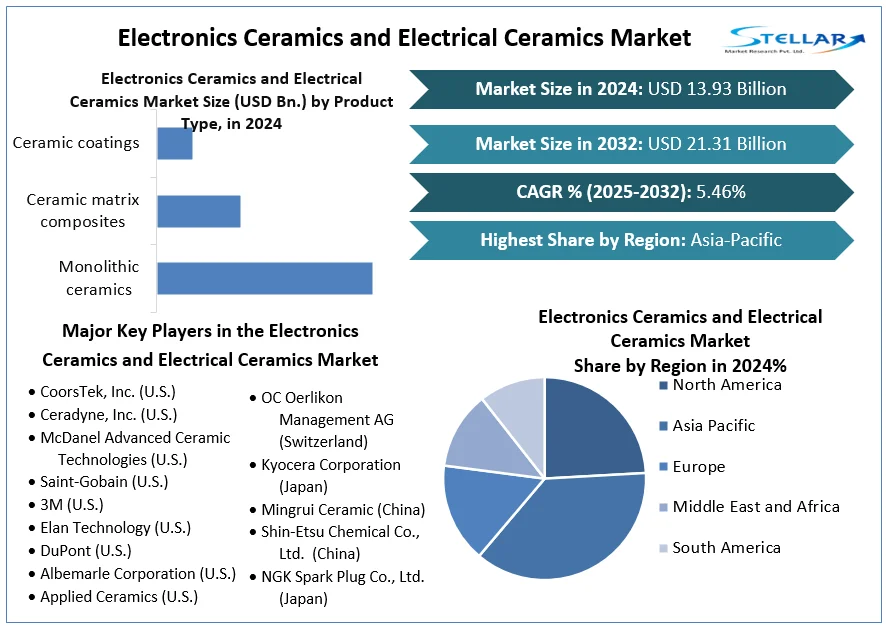
    The Electronics and Electrical Ceramics market comprises specialized engineered materials, such as alumina, zirconia, and titanate ceramics, designed for precise electrical functions. They are critical in manufacturing components like capacitors, insulators, substrates, and piezoelectric devices, providing essential properties including high resistance, dielectric strength, and semiconductivity. According to the report, the market was valued at USD 13.93 Billion in 2024. It is projected to grow at a Compound Annual Growth Rate (CAGR) of 5.46% from 2025 to 2032, reaching USD 21.31 Billion by 2032. This growth is anchored in the multi-trillion-dollar global electronics industry's reliance on these materials for performance and miniaturization.

    2. Market Growth Drivers & Opportunity
    The market's expansion is powered by the relentless global demand for consumer electronics and the pervasive adoption of advanced technologies. The need for miniaturization in devices like smartphones, where ceramics enable tiny multilayer ceramic capacitors (MLCCs) and compact antennas, is a primary driver. Furthermore, the widespread adoption of Internet of Things (IoT) and smart devices across healthcare, manufacturing, and transportation fuels demand for the reliable ceramic sensors and actuators at their core.

    Significant growth opportunities are emerging from the rapid expansion of the renewable energy sector. Ceramics are vital for insulators, sensors, and power distribution components in solar photovoltaic and wind energy systems. Concurrently, advancements in semiconductor manufacturing, particularly for high-frequency and high-power applications using materials like Gallium Nitride (GaN), create a pressing need for ceramics with superior thermal and electrical insulation properties.

    3. What Lies Ahead: Emerging Trends Shaping the Future
    The future of electroceramics is defined by performance, integration, and sustainability. A key trend is the ongoing pursuit of advanced material compositions to meet the extreme demands of next-generation 5G/6G communications, electric vehicles, and high-density computing. The integration of ceramic components in new energy systems, including electric vehicle power electronics and energy storage, will see accelerated growth. Additionally, additive manufacturing (3D printing) of complex ceramic parts is emerging as a transformative trend, allowing for unprecedented design freedom and rapid prototyping of specialized components. Finally, the entire supply chain is undergoing strategic optimization to mitigate risks from raw material shortages and shipping delays, emphasizing localized production and robust inventory management.

    4. Segmentation Analysis: A Detailed Market View
    By Material Type: Alumina Ceramics are expected to exhibit strong growth, valued for their high mechanical strength, thermal resistance, and corrosion tolerance. These properties make them indispensable in demanding applications from medical equipment to consumer appliances.

    About us

    Phase 3,Navale IT Zone, S.No. 51/2A/2,

    Office No. 202, 2nd floor,

    Near, Navale Brg,Narhe,

    Pune, Maharashtra 411041

    sales@stellarmr.com
    Electronics Ceramics and Electrical Ceramics Market Size To Grow At A CAGR Of 5.46% In The Forecast Period Of 2025-2032 Global Electronics and Electrical Ceramics Market to Exceed USD 21 Billion by 2032, Fueled by Consumer Electronics and IoT Expansion Steady 5.46% CAGR Driven by Miniaturization Demand and Renewable Energy Sector Growth A comprehensive industry analysis reveals robust growth for the global Electronics Ceramics and Electrical Ceramics market, an indispensable segment of the modern electronics industry. These advanced materials, prized for their exceptional electrical properties, form the foundation for countless devices enabling today's connected, high-tech world. Purchase This Research Report at up to 30% Off @ https://www.stellarmr.com/report/req_sample/electronics-ceramics-and-electrical-ceramics-market/2373 1. Market Estimation & Definition The Electronics and Electrical Ceramics market comprises specialized engineered materials, such as alumina, zirconia, and titanate ceramics, designed for precise electrical functions. They are critical in manufacturing components like capacitors, insulators, substrates, and piezoelectric devices, providing essential properties including high resistance, dielectric strength, and semiconductivity. According to the report, the market was valued at USD 13.93 Billion in 2024. It is projected to grow at a Compound Annual Growth Rate (CAGR) of 5.46% from 2025 to 2032, reaching USD 21.31 Billion by 2032. This growth is anchored in the multi-trillion-dollar global electronics industry's reliance on these materials for performance and miniaturization. 2. Market Growth Drivers & Opportunity The market's expansion is powered by the relentless global demand for consumer electronics and the pervasive adoption of advanced technologies. The need for miniaturization in devices like smartphones, where ceramics enable tiny multilayer ceramic capacitors (MLCCs) and compact antennas, is a primary driver. Furthermore, the widespread adoption of Internet of Things (IoT) and smart devices across healthcare, manufacturing, and transportation fuels demand for the reliable ceramic sensors and actuators at their core. Significant growth opportunities are emerging from the rapid expansion of the renewable energy sector. Ceramics are vital for insulators, sensors, and power distribution components in solar photovoltaic and wind energy systems. Concurrently, advancements in semiconductor manufacturing, particularly for high-frequency and high-power applications using materials like Gallium Nitride (GaN), create a pressing need for ceramics with superior thermal and electrical insulation properties. 3. What Lies Ahead: Emerging Trends Shaping the Future The future of electroceramics is defined by performance, integration, and sustainability. A key trend is the ongoing pursuit of advanced material compositions to meet the extreme demands of next-generation 5G/6G communications, electric vehicles, and high-density computing. The integration of ceramic components in new energy systems, including electric vehicle power electronics and energy storage, will see accelerated growth. Additionally, additive manufacturing (3D printing) of complex ceramic parts is emerging as a transformative trend, allowing for unprecedented design freedom and rapid prototyping of specialized components. Finally, the entire supply chain is undergoing strategic optimization to mitigate risks from raw material shortages and shipping delays, emphasizing localized production and robust inventory management. 4. Segmentation Analysis: A Detailed Market View By Material Type: Alumina Ceramics are expected to exhibit strong growth, valued for their high mechanical strength, thermal resistance, and corrosion tolerance. These properties make them indispensable in demanding applications from medical equipment to consumer appliances. About us Phase 3,Navale IT Zone, S.No. 51/2A/2, Office No. 202, 2nd floor, Near, Navale Brg,Narhe, Pune, Maharashtra 411041 sales@stellarmr.com

    0 Comentários 0 Compartilhamentos