

Browse the "free" section of any online classifieds during moving season. The listings multiply hourly—sofas with hardwood frames but torn fabric, solid construction abandoned because colors faded or springs lost tension. We've learned to see these as worthless. This perception is environmentally devastating and economically irrational.
Contemporary furniture consumption operates on timelines that serve manufacturing profits, not human needs. The industry now considers seven to ten years acceptable service life. This represents a dramatic departure from historical norms where quality pieces served multiple generations. The environmental consequences accumulate visibly in landfills and invisibly in depleted landscapes.
Sofa reupholstery interrupts this wasteful pattern. By preserving durable structure while renewing worn surfaces, we extend utility without demanding new resource extraction. This practice bridges traditional craftsmanship with contemporary environmental science.
The Hidden Costs of Manufacturing
New furniture production generates environmental impacts at every stage. Forest ecosystems fall for frame materials. Petroleum reserves transform into synthetic components. Mining operations scar terrain for metal hardware. Chemical processes pollute air and water producing adhesives, dyes, and finishes.
Geographic fragmentation magnifies these burdens. Global supply chains stretch production across continents and oceans. Raw materials travel to processing centers. Components move to assembly facilities. Finished products ship to distribution warehouses. Each leg consumes fossil fuels and generates emissions.
End-of-life management proves equally problematic. Bulky furniture strains landfill capacity. Mixed materials resist recycling economics. Synthetic components persist for centuries, slowly releasing toxins. Incineration releases hazardous substances from treated materials.
The mathematics are unsustainable: constant replacement accelerates resource depletion and waste accumulation. Alternative approaches are urgently needed.
The Restoration Process Revealed
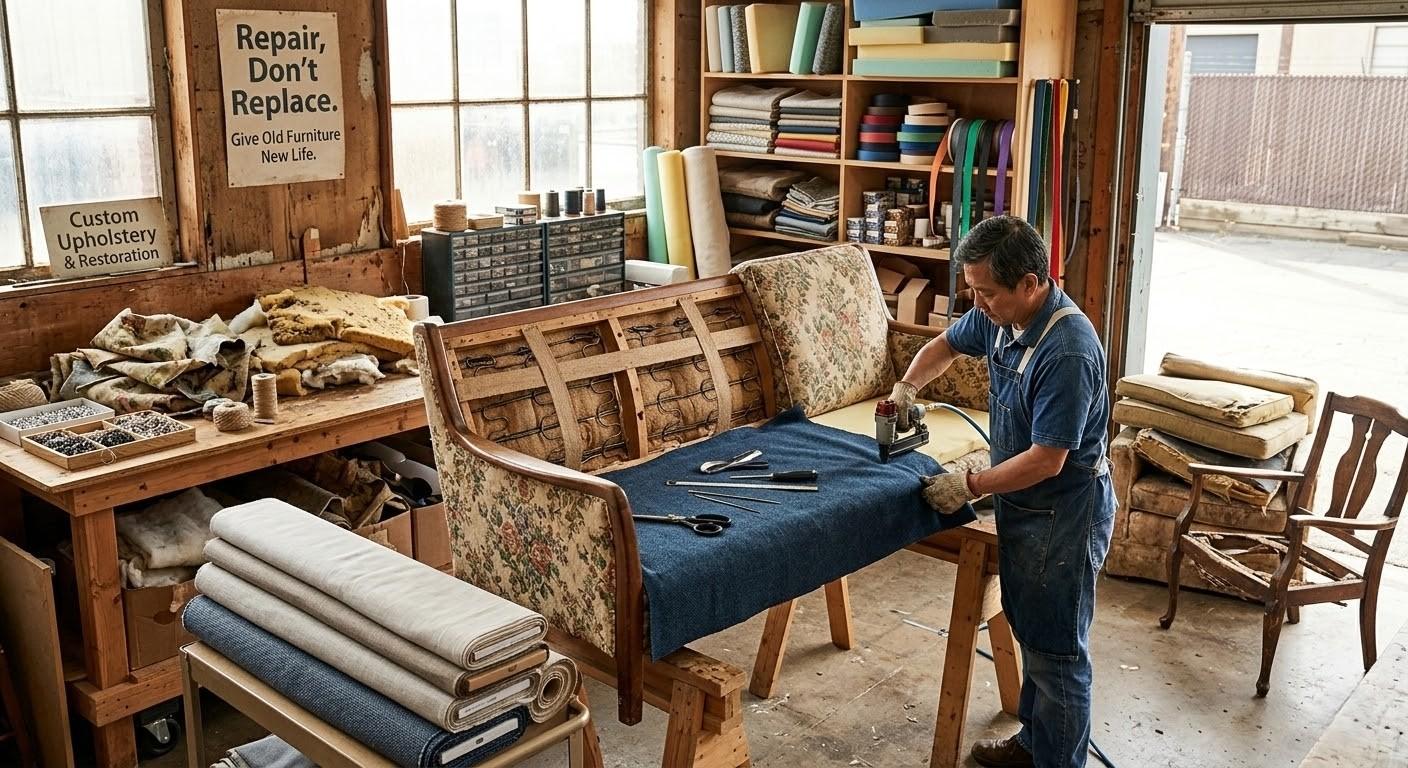
Professional sofa upholstery services perform comprehensive transformation. Technicians systematically remove every layer of exhausted material—fabric, padding, webbing, dust covers—exposing the frame's fundamental reality.
This process frequently reveals hidden assets. Vintage frames often display construction quality rarely seen in contemporary manufacturing. Solid hardwood timber. Hand-tied coil springs. Durable joinery techniques. These structural elements were engineered for decades of service, not planned obsolescence.
Restoration proceeds carefully. Spring systems receive adjustment or replacement with modern equivalents. Padding upgrades to high-performance materials unavailable in original construction. Frame repairs address any structural weaknesses revealed during inspection.
New fabric application demands skilled craftsmanship. Pattern matching across complex geometries requires spatial reasoning. Tension must be uniform to prevent future distortion. Seams need strategic reinforcement at stress points. Expert sofa reupholstery typically produces results superior to original factory standards.
The environmental benefit is substantial lifespan extension—fifteen to thirty years of additional service. This longevity translates directly into avoided manufacturing impacts, eliminated transportation emissions, and prevented waste generation.
Quality in an Age of Disposability
Modern furniture markets increasingly embrace rapid turnover. Designs chase fleeting trends. Construction ensures physical failure aligns with aesthetic fatigue. This "fast furniture" model depends upon constant replacement for profitability.
Authentic durability has become a luxury good. Artisanal manufacturers command premium prices for traditional construction. Mass-market alternatives use materials engineered for early failure—particle board, low-density foam, bonded leather surfaces.
Sofa reupholstery provides accessible middle ground. It preserves structural integrity from quality manufacturing eras while enabling complete customization of surfaces. Choose heavy-duty commercial fabrics for active households. Select natural fibers for chemical sensitivity. Opt for luxury textiles for formal applications.
This flexibility treats furniture as long-term investment rather than short-term commodity. It acknowledges embodied energy and craftsmanship in existing frames. It reduces waste generation by extending service life, regardless of whether pieces achieve heirloom status.
Financial Logic
Cost concerns are predictable. Comprehensive restoration can rival mid-range replacement costs. However, surface comparisons mislead by ignoring critical factors.
New furniture depreciates immediately upon delivery. That $2,600 showroom purchase becomes a $700 resale item within three years. Restoration maintains or enhances value by preserving structural elements unavailable in contemporary markets.
Lifecycle analysis strongly favors preservation. Compare one restoration serving twenty years against three $900 replacements. The restored piece typically delivers superior daily experience at comparable or lower total cost. Annualized economics clearly support maintenance.
Regional factors influence these calculations. Some jurisdictions impose substantial fees for bulky item disposal. Others provide tax incentives for repair services. Regardless of local variations, fundamental financial logic supports stewardship over consumption.
Local Craft vs. Global Industry
Fast furniture relies upon anonymous global supply chains. Manufacturing concentrates where environmental and labor regulations are weakest. Products travel worldwide before reaching consumers. This model maximizes corporate profit while externalizing true costs onto communities and ecosystems.
Local sofa upholstery services operate on different principles. These craftspeople maintain skills increasingly rare in automated manufacturing. They work within communities, often sourcing materials regionally. Their livelihoods depend upon quality rather than volume.
Community-based restoration generates multiple benefits. It preserves traditional trades as viable careers. It keeps economic activity circulating locally. It reduces transportation emissions through shorter supply chains. Visible repair work makes sustainable behavior seem normal and accessible.
Each restoration project challenges dominant narratives. It demonstrates that renewal surpasses replacement. It models stewardship over disposal. It keeps resources serving human needs rather than filling waste facilities.
Evaluation Framework
Determining restoration candidacy requires systematic assessment. Begin with frame material—solid hardwood suggests preservation value, while engineered wood indicates limitations. Test structural integrity through lifting and gentle movement.
Examine support systems. Surface sagging often indicates cushion foam degradation rather than spring failure. This distinction matters because foam replacement is relatively simple and affordable. Intact spring systems represent significant embedded value.
Consider emotional connections. Furniture from significant life events or inherited from family members carries meaning no new purchase can replicate. Sofa reupholstery honors these attachments while advancing environmental responsibility.
Conclusion
Planetary boundaries constrain infinite growth. We cannot perpetually extract virgin materials without ecosystem collapse. We cannot infinitely absorb waste without environmental degradation. These physical realities demand cultural transformation.
Furniture restoration exemplifies necessary change. It reduces resource demand more effectively than recycling, which still consumes substantial energy. It represents genuine waste prevention at the source.
When confronting worn seating, resist the disposal impulse. Investigate sofa upholstery services in your community. This choice extends beyond personal aesthetics into ethical responsibility. It supports skilled labor, local economies, and ecological preservation simultaneously.
The decision to restore creates meaningful ripples. It challenges disposable culture. It proves that sustainability and quality coexist comfortably. Your living space becomes a testament to values—comfort without destruction, beauty without waste, heritage without harm.

 English
 Arabic
 French
 Spanish
 Portuguese
 Deutsch
 Turkish
 Dutch
 Italiano
 Romaian
 Portuguese (Brazil)
 Greek