

• Global Crop Protection Chemicals Market to Reach USD 109.16 Billion by 2032: Trends & Forecast

    Global Crop Protection Chemicals Market: Catalyzing Agricultural Productivity and Food Security

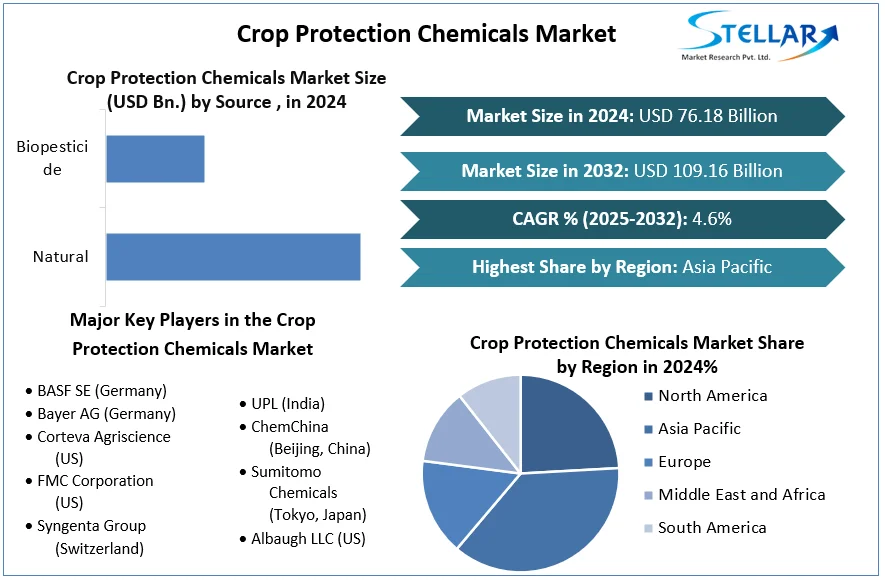
    The Crop Protection Chemicals Market is witnessing sustained growth as agricultural producers seek effective solutions to protect crops from pests, weeds, and diseases — key threats to food security and yield stability. According to industry estimates, the market was valued at around USD 76.18 billion in 2024 and is expected to reach approximately USD 109.16 billion by 2032, growing at a compound annual growth rate (CAGR) of roughly 4.6 % during the forecast period of 2025–2032. This projected expansion reflects rising demand for advanced crop protection solutions and an increasing global need for higher agricultural productivity.

    Request Free Sample Report : https://www.stellarmr.com/report/req_sample/crop-protection-chemicals-market/2445

    Market Estimation & Definition

    Crop protection chemicals are agrochemicals used to guard agricultural yields against crop‑destroying agents such as weeds, insects, fungi, and other pests. These chemicals include herbicides, insecticides, fungicides, biopesticides, and other specialty formulations that help stabilize yields and improve crop quality. By preventing losses caused by biological and environmental stresses, crop protection chemicals play a central role in modern agriculture — enhancing food production capacity while contributing to the economic viability of farming operations.

    The importance of these chemicals increases as farmers aim to meet the rising global demand for food, driven by population growth and changing dietary patterns. In addition to traditional chemicals, biopesticides and natural crop protection solutions are gaining attention for their reduced environmental impact and alignment with sustainable agriculture practices.

    Market Growth Drivers & Opportunity

    One of the primary drivers for the crop protection chemicals market is the growing global population and the corresponding need to increase crop yields and food supply. As the world’s population continues to rise, agricultural systems must produce more food from limited arable land, intensifying the need for effective pest and weed control solutions that optimize crop performance.

    Climate change — with its impacts on pest prevalence, weed resilience, and crop disease spread — exacerbates agricultural vulnerabilities, pushing farmers to adopt advanced protection chemicals to sustain yields under increasingly unpredictable conditions. Extreme weather events and shifting pest patterns challenge crop resilience, reinforcing the role of crop protection inputs in maintaining production stability.

    Opportunities in the market also arise from technological integration and precision agriculture tools that improve the targeting and efficiency of chemical applications. Drones, automated sprayers, and IoT‑linked monitoring systems help reduce chemical usage while maximizing protective effects. In addition, continued research into biopesticides and environmentally safer formulations presents growth prospects as regulatory frameworks and consumer preferences evolve toward sustainability.

    Request Free Sample Report : https://www.stellarmr.com/report/req_sample/crop-protection-chemicals-market/2445

    What Lies Ahead: Emerging Trends Shaping the Future

    The crop protection market is evolving with several emerging trends that will shape its future:

    Biopesticide Adoption: With increased awareness of environmental and health impacts, biopesticides and natural crop protection solutions are poised for higher adoption. These products offer reduced ecological footprints and align with sustainability goals embraced by many agribusinesses and policy frameworks.

    Precision Agriculture Integration: Advanced farming technologies — including GPS‑guided application, drones, and smart sensors — are enabling more precise chemical deployment, reducing waste and environmental exposure while improving efficacy.

    Formulation Innovation: Enhanced product formulations, such as controlled‑release and microencapsulated chemicals, are improving target specificity, reducing application frequency, and supporting integrated pest management strategies.

    Regulatory and Sustainability Shifts: Regulatory shifts toward tighter safety standards and sustainable practices are encouraging investment in safer, more effective crop protection solutions that meet both environmental and yield goals.
    About us

    Phase 3,Navale IT Zone, S.No. 51/2A/2,

    Office No. 202, 2nd floor,

    Near, Navale Brg,Narhe,

    Pune, Maharashtra 411041

    sales@stellarmr.com
    Global Crop Protection Chemicals Market to Reach USD 109.16 Billion by 2032: Trends & Forecast Global Crop Protection Chemicals Market: Catalyzing Agricultural Productivity and Food Security The Crop Protection Chemicals Market is witnessing sustained growth as agricultural producers seek effective solutions to protect crops from pests, weeds, and diseases — key threats to food security and yield stability. According to industry estimates, the market was valued at around USD 76.18 billion in 2024 and is expected to reach approximately USD 109.16 billion by 2032, growing at a compound annual growth rate (CAGR) of roughly 4.6 % during the forecast period of 2025–2032. This projected expansion reflects rising demand for advanced crop protection solutions and an increasing global need for higher agricultural productivity. Request Free Sample Report : https://www.stellarmr.com/report/req_sample/crop-protection-chemicals-market/2445 Market Estimation & Definition Crop protection chemicals are agrochemicals used to guard agricultural yields against crop‑destroying agents such as weeds, insects, fungi, and other pests. These chemicals include herbicides, insecticides, fungicides, biopesticides, and other specialty formulations that help stabilize yields and improve crop quality. By preventing losses caused by biological and environmental stresses, crop protection chemicals play a central role in modern agriculture — enhancing food production capacity while contributing to the economic viability of farming operations. The importance of these chemicals increases as farmers aim to meet the rising global demand for food, driven by population growth and changing dietary patterns. In addition to traditional chemicals, biopesticides and natural crop protection solutions are gaining attention for their reduced environmental impact and alignment with sustainable agriculture practices. Market Growth Drivers & Opportunity One of the primary drivers for the crop protection chemicals market is the growing global population and the corresponding need to increase crop yields and food supply. As the world’s population continues to rise, agricultural systems must produce more food from limited arable land, intensifying the need for effective pest and weed control solutions that optimize crop performance. Climate change — with its impacts on pest prevalence, weed resilience, and crop disease spread — exacerbates agricultural vulnerabilities, pushing farmers to adopt advanced protection chemicals to sustain yields under increasingly unpredictable conditions. Extreme weather events and shifting pest patterns challenge crop resilience, reinforcing the role of crop protection inputs in maintaining production stability. Opportunities in the market also arise from technological integration and precision agriculture tools that improve the targeting and efficiency of chemical applications. Drones, automated sprayers, and IoT‑linked monitoring systems help reduce chemical usage while maximizing protective effects. In addition, continued research into biopesticides and environmentally safer formulations presents growth prospects as regulatory frameworks and consumer preferences evolve toward sustainability. Request Free Sample Report : https://www.stellarmr.com/report/req_sample/crop-protection-chemicals-market/2445 What Lies Ahead: Emerging Trends Shaping the Future The crop protection market is evolving with several emerging trends that will shape its future: Biopesticide Adoption: With increased awareness of environmental and health impacts, biopesticides and natural crop protection solutions are poised for higher adoption. These products offer reduced ecological footprints and align with sustainability goals embraced by many agribusinesses and policy frameworks. Precision Agriculture Integration: Advanced farming technologies — including GPS‑guided application, drones, and smart sensors — are enabling more precise chemical deployment, reducing waste and environmental exposure while improving efficacy. Formulation Innovation: Enhanced product formulations, such as controlled‑release and microencapsulated chemicals, are improving target specificity, reducing application frequency, and supporting integrated pest management strategies. Regulatory and Sustainability Shifts: Regulatory shifts toward tighter safety standards and sustainable practices are encouraging investment in safer, more effective crop protection solutions that meet both environmental and yield goals. About us Phase 3,Navale IT Zone, S.No. 51/2A/2, Office No. 202, 2nd floor, Near, Navale Brg,Narhe, Pune, Maharashtra 411041 sales@stellarmr.com
    0 Kommentare 0 Anteile
  • Alarm, Barrier & Advanced Detection Systems Shaping Security Solutions

    Perimeter Security Market: Strengthening Defense for Critical Infrastructure Worldwide

    The Perimeter Security Market is rapidly gaining global attention as organizations and governments prioritize protecting physical boundaries against unauthorized access, intrusion, and security breaches. Perimeter security encompasses a wide range of systems and services designed to monitor, detect, and respond to threats targeting property, assets, people, and critical infrastructure. With escalating concerns over terrorism, crime, industrial threats, and sophisticated intrusion techniques, perimeter security solutions are evolving with advanced technologies such as AI‑powered surveillance, sensor networks, and managed monitoring to address modern security needs.

    Request Free Sample Report : https://www.stellarmr.com/report/req_sample/Perimeter-Security-Market/2178

    Market Estimation & Definition

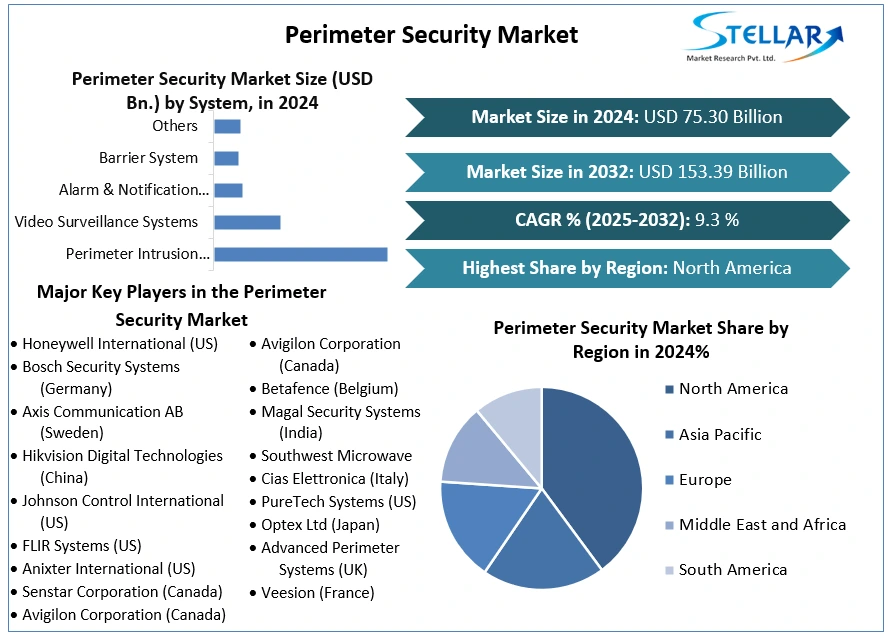
    The Perimeter Security Market includes systems and services deployed to safeguard outdoor boundaries of facilities, campuses, transportation hubs, and strategic assets. These solutions are designed to detect, deter, and respond to unauthorized physical activities and intrusion attempts. Core systems include perimeter intrusion detection systems (PIDS), video surveillance systems, alarm and notification systems, barrier systems, and other related technologies that combine hardware, software, and services to enable comprehensive protection. The global perimeter security market was valued at approximately USD 75.30 billion in 2024 and is projected to grow to around USD 153.39 billion by 2032, exhibiting a CAGR of about 9.3% over the forecast period.

    Market Growth Drivers & Opportunity

    A range of factors are fueling expansion in the perimeter security market:

    Escalating Security Threats: With the rising frequency and sophistication of intrusions, theft, and terrorism across public and private environments, organizations are adopting perimeter security solutions as a first line of defense. These systems enable real‑time detection, threat visualization, and rapid response, reducing vulnerability to breaches and external attacks.

    Urbanization and Smart Infrastructure Projects: Urban growth, smart city initiatives, and expansion of critical infrastructure projects require robust security frameworks to protect assets, public spaces, and transportation systems. Smart cities integrate perimeter security with citywide sensors, analytics, and IoT technologies to ensure seamless protection.

    Technological Advancements: Integration of advanced technologies — including artificial intelligence (AI), machine learning (ML), IoT connectivity, cloud‑based monitoring, and thermal imaging — has significantly enhanced perimeter protection capabilities. AI‑enabled video analytics minimize false alarms and enhance anomaly detection, while cloud solutions offer scalable, centralized management.

    Regulatory and Compliance Standards: Government and industry regulations have mandated robust security measures for critical sectors, including defense, transportation, energy, and commercial facilities. These mandates drive adoption of advanced perimeter systems to meet compliance and safety standards.

    What Lies Ahead: Emerging Trends Shaping the Future

    The perimeter security market is advancing along several key trends:

    AI‑Powered Surveillance and Analytics: The integration of AI and ML into video surveillance systems significantly improves threat detection, pattern recognition, and predictive security capabilities — allowing systems to autonomously identify suspicious behavior and reduce manual monitoring burdens.

    Cloud‑Based and Managed Security Services: Cloud deployments and managed perimeter security services (often delivered through a Security‑as‑a‑Service model) are gaining traction as businesses seek scalable, cost‑effective security management with real‑time data access and remote oversight.

    Integration with Broader Security Ecosystems: Perimeter security systems are increasingly being integrated with broader access control, identity management, and cyber‑physical security frameworks to provide unified protection across physical and digital domains.

    Advanced Sensor Technologies and Drone Detection: Emerging technologies such as radar sensors, LiDAR imaging, biometric access, and counter‑drone systems are being incorporated to extend coverage and enhance detection across challenging terrain and expansive perimeters.

    Request Free Sample Report : https://www.stellarmr.com/report/req_sample/Perimeter-Security-Market/2178

    About us


    Phase 3,Navale IT Zone, S.No. 51/2A/2,

    Office No. 202, 2nd floor,

    Near, Navale Brg,Narhe,

    Pune, Maharashtra 411041

    sales@stellarmr.com
    Alarm, Barrier & Advanced Detection Systems Shaping Security Solutions Perimeter Security Market: Strengthening Defense for Critical Infrastructure Worldwide The Perimeter Security Market is rapidly gaining global attention as organizations and governments prioritize protecting physical boundaries against unauthorized access, intrusion, and security breaches. Perimeter security encompasses a wide range of systems and services designed to monitor, detect, and respond to threats targeting property, assets, people, and critical infrastructure. With escalating concerns over terrorism, crime, industrial threats, and sophisticated intrusion techniques, perimeter security solutions are evolving with advanced technologies such as AI‑powered surveillance, sensor networks, and managed monitoring to address modern security needs. Request Free Sample Report : https://www.stellarmr.com/report/req_sample/Perimeter-Security-Market/2178 Market Estimation & Definition The Perimeter Security Market includes systems and services deployed to safeguard outdoor boundaries of facilities, campuses, transportation hubs, and strategic assets. These solutions are designed to detect, deter, and respond to unauthorized physical activities and intrusion attempts. Core systems include perimeter intrusion detection systems (PIDS), video surveillance systems, alarm and notification systems, barrier systems, and other related technologies that combine hardware, software, and services to enable comprehensive protection. The global perimeter security market was valued at approximately USD 75.30 billion in 2024 and is projected to grow to around USD 153.39 billion by 2032, exhibiting a CAGR of about 9.3% over the forecast period. Market Growth Drivers & Opportunity A range of factors are fueling expansion in the perimeter security market: Escalating Security Threats: With the rising frequency and sophistication of intrusions, theft, and terrorism across public and private environments, organizations are adopting perimeter security solutions as a first line of defense. These systems enable real‑time detection, threat visualization, and rapid response, reducing vulnerability to breaches and external attacks. Urbanization and Smart Infrastructure Projects: Urban growth, smart city initiatives, and expansion of critical infrastructure projects require robust security frameworks to protect assets, public spaces, and transportation systems. Smart cities integrate perimeter security with citywide sensors, analytics, and IoT technologies to ensure seamless protection. Technological Advancements: Integration of advanced technologies — including artificial intelligence (AI), machine learning (ML), IoT connectivity, cloud‑based monitoring, and thermal imaging — has significantly enhanced perimeter protection capabilities. AI‑enabled video analytics minimize false alarms and enhance anomaly detection, while cloud solutions offer scalable, centralized management. Regulatory and Compliance Standards: Government and industry regulations have mandated robust security measures for critical sectors, including defense, transportation, energy, and commercial facilities. These mandates drive adoption of advanced perimeter systems to meet compliance and safety standards. What Lies Ahead: Emerging Trends Shaping the Future The perimeter security market is advancing along several key trends: AI‑Powered Surveillance and Analytics: The integration of AI and ML into video surveillance systems significantly improves threat detection, pattern recognition, and predictive security capabilities — allowing systems to autonomously identify suspicious behavior and reduce manual monitoring burdens. Cloud‑Based and Managed Security Services: Cloud deployments and managed perimeter security services (often delivered through a Security‑as‑a‑Service model) are gaining traction as businesses seek scalable, cost‑effective security management with real‑time data access and remote oversight. Integration with Broader Security Ecosystems: Perimeter security systems are increasingly being integrated with broader access control, identity management, and cyber‑physical security frameworks to provide unified protection across physical and digital domains. Advanced Sensor Technologies and Drone Detection: Emerging technologies such as radar sensors, LiDAR imaging, biometric access, and counter‑drone systems are being incorporated to extend coverage and enhance detection across challenging terrain and expansive perimeters. Request Free Sample Report : https://www.stellarmr.com/report/req_sample/Perimeter-Security-Market/2178 About us Phase 3,Navale IT Zone, S.No. 51/2A/2, Office No. 202, 2nd floor, Near, Navale Brg,Narhe, Pune, Maharashtra 411041 sales@stellarmr.com
    0 Kommentare 0 Anteile
  • Smart & Connected Boilers: The Future of Combi Heating Solutions

    Combi Boiler Market Expands with Energy Efficiency Demand and Urbanization Trends Driving Growth

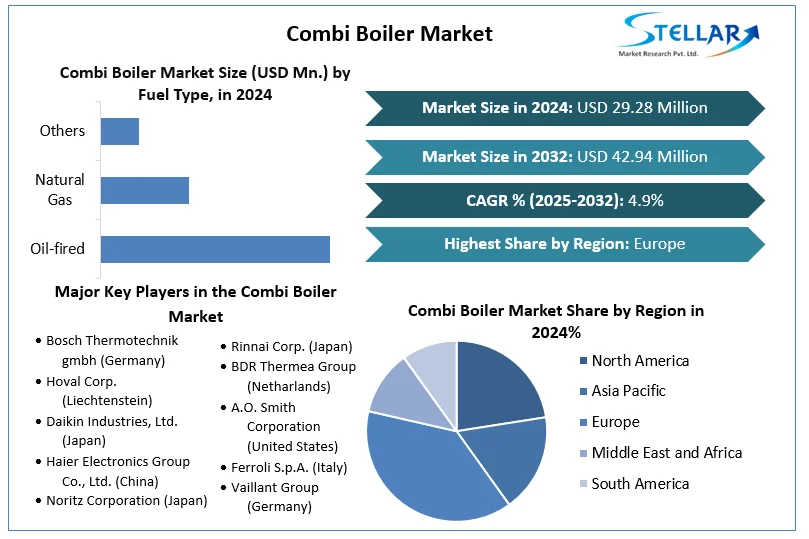
    The global Combi Boiler Market continues to advance steadily as residential and commercial heating needs evolve toward efficiency, compact design, and lower emissions. In 2024, the market was valued at approximately USD 29.28 million, and industry forecasts indicate it will expand to about USD 42.94 million by 2032, registering a compound annual growth rate (CAGR) of 4.9 percent during the forecast period from 2025 to 2032. This growth reflects rising demand for advanced heating technologies alongside broader infrastructure and sustainability priorities.

    Market Estimation & Definition
    A combi boiler, short for combination boiler, integrates central heating and hot water generation into a single compact unit. It eliminates the need for separate water storage tanks, making it especially popular in space‑constrained homes and commercial spaces. Combi boilers serve both residential and light commercial applications, catering to markets with variable heating demands and stringent efficiency standards.

    By combining ease of installation with dual‑function capacity, combi boilers provide a practical and cost‑effective alternative to traditional heating systems. The global market assessment segments products by fuel type (including oil‑fired, natural gas, and others) and technology (condensing and non‑condensing boilers), while also covering key geographic regions such as North America, Europe, Asia‑Pacific, South America, and the Middle East & Africa.

    Purchase This Research Report at up to 30% Off @ https://www.stellarmr.com/report/req_sample/combi-boiler-market/2560

    Market Growth Drivers & Opportunity
    One of the primary growth drivers for the combi boiler market is increasing demand for energy‑efficient heating solutions. Modern condensing combi boilers achieve efficiencies as high as 98.9 percent, significantly outperforming older systems that typically operate at 56–70 percent efficiency. This efficiency advantage reduces energy consumption and lowers overall heating costs for users.

    Urbanization and population growth in developing markets are creating further opportunities. As more people move into urban centers, demand for compact, versatile heating solutions rises in new residential and commercial buildings. Additionally, manufacturers are introducing innovative, technologically advanced combi boilers that incorporate smart controls and enhanced safety features, helping differentiate products in a competitive landscape.

    Regulatory frameworks pushing for reduced greenhouse gas emissions and improved energy performance also contribute to market expansion. Across Europe and other regions, building codes and energy standards increasingly mandate high efficiency and lower carbon emissions for heating equipment, encouraging both homeowners and contractors to choose combi boilers over conventional alternatives.

    What Lies Ahead: Emerging Trends Shaping the Future
    The combi boiler market is being reshaped by several key emerging trends. One of the most notable is digital and connected heating technology. New combi boiler models are incorporating smart thermostats, remote monitoring, and integration with home automation systems. These capabilities enable consumers to optimize heating schedules, monitor energy usage in real time, and reduce operating costs.

    Another trend gaining traction is the shift toward cleaner fuel sources and condensing technology, which supports environmental sustainability and aligns with broader climate goals. Condensing combi boilers, in particular, reduce carbon emissions by recovering heat from exhaust gases, offering performance benefits that are increasingly valued by environmentally conscious consumers and developers.

    Market players are also exploring hybrid systems and hydrogen‑ready boilers as future alternatives that can integrate with renewable energy sources, reflecting industry interest in long‑term decarbonization strategies.

    Purchase This Research Report at up to 30% Off @ https://www.stellarmr.com/report/req_sample/combi-boiler-market/2560


    About us

    Phase 3,Navale IT Zone, S.No. 51/2A/2,

    Office No. 202, 2nd floor,

    Near, Navale Brg,Narhe,

    Pune, Maharashtra 411041

    sales@stellarmr.com
    Smart & Connected Boilers: The Future of Combi Heating Solutions Combi Boiler Market Expands with Energy Efficiency Demand and Urbanization Trends Driving Growth The global Combi Boiler Market continues to advance steadily as residential and commercial heating needs evolve toward efficiency, compact design, and lower emissions. In 2024, the market was valued at approximately USD 29.28 million, and industry forecasts indicate it will expand to about USD 42.94 million by 2032, registering a compound annual growth rate (CAGR) of 4.9 percent during the forecast period from 2025 to 2032. This growth reflects rising demand for advanced heating technologies alongside broader infrastructure and sustainability priorities. Market Estimation & Definition A combi boiler, short for combination boiler, integrates central heating and hot water generation into a single compact unit. It eliminates the need for separate water storage tanks, making it especially popular in space‑constrained homes and commercial spaces. Combi boilers serve both residential and light commercial applications, catering to markets with variable heating demands and stringent efficiency standards. By combining ease of installation with dual‑function capacity, combi boilers provide a practical and cost‑effective alternative to traditional heating systems. The global market assessment segments products by fuel type (including oil‑fired, natural gas, and others) and technology (condensing and non‑condensing boilers), while also covering key geographic regions such as North America, Europe, Asia‑Pacific, South America, and the Middle East & Africa. Purchase This Research Report at up to 30% Off @ https://www.stellarmr.com/report/req_sample/combi-boiler-market/2560 Market Growth Drivers & Opportunity One of the primary growth drivers for the combi boiler market is increasing demand for energy‑efficient heating solutions. Modern condensing combi boilers achieve efficiencies as high as 98.9 percent, significantly outperforming older systems that typically operate at 56–70 percent efficiency. This efficiency advantage reduces energy consumption and lowers overall heating costs for users. Urbanization and population growth in developing markets are creating further opportunities. As more people move into urban centers, demand for compact, versatile heating solutions rises in new residential and commercial buildings. Additionally, manufacturers are introducing innovative, technologically advanced combi boilers that incorporate smart controls and enhanced safety features, helping differentiate products in a competitive landscape. Regulatory frameworks pushing for reduced greenhouse gas emissions and improved energy performance also contribute to market expansion. Across Europe and other regions, building codes and energy standards increasingly mandate high efficiency and lower carbon emissions for heating equipment, encouraging both homeowners and contractors to choose combi boilers over conventional alternatives. What Lies Ahead: Emerging Trends Shaping the Future The combi boiler market is being reshaped by several key emerging trends. One of the most notable is digital and connected heating technology. New combi boiler models are incorporating smart thermostats, remote monitoring, and integration with home automation systems. These capabilities enable consumers to optimize heating schedules, monitor energy usage in real time, and reduce operating costs. Another trend gaining traction is the shift toward cleaner fuel sources and condensing technology, which supports environmental sustainability and aligns with broader climate goals. Condensing combi boilers, in particular, reduce carbon emissions by recovering heat from exhaust gases, offering performance benefits that are increasingly valued by environmentally conscious consumers and developers. Market players are also exploring hybrid systems and hydrogen‑ready boilers as future alternatives that can integrate with renewable energy sources, reflecting industry interest in long‑term decarbonization strategies. Purchase This Research Report at up to 30% Off @ https://www.stellarmr.com/report/req_sample/combi-boiler-market/2560 About us Phase 3,Navale IT Zone, S.No. 51/2A/2, Office No. 202, 2nd floor, Near, Navale Brg,Narhe, Pune, Maharashtra 411041 sales@stellarmr.com
    0 Kommentare 0 Anteile
  • Thermal Energy Storage Market Growth: Driving the Future of Renewable Integration

    Thermal Energy Storage Market: Growth Dynamics, Key Trends & Future Outlook

    Market Estimation & Definition
    The Thermal Energy Storage (TES) market refers to technologies that store thermal energy — either heat or cold — for later use in power generation, industrial processes, building heating/cooling, and renewable energy integration. TES systems enable energy captured during low‑demand or peak generation periods to be deployed when needed, improving efficiency, flexibility, and grid reliability. These systems use mediums such as water, molten salt, and phase change materials to store energy through sensible heat, latent heat, or thermochemical processes.

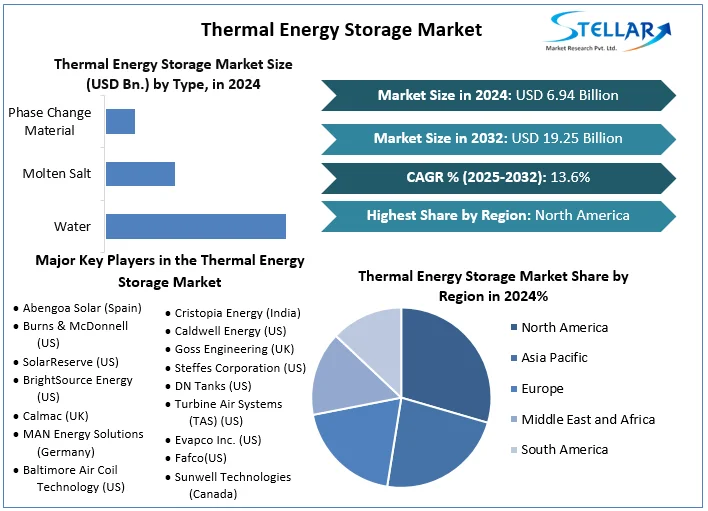
    In 2024, the global thermal energy storage market was valued at approximately USD 6.94 billion. It is projected to grow to around USD 19.25 billion by 2032, expanding at a compound annual growth rate (CAGR) of about 13.6 % through 2032, driven by increasing renewable energy penetration and rising demand for grid‑scale storage solutions.

    Purchase This Research Report at up to 30% Off @ https://www.stellarmr.com/report/req_sample/Thermal-Energy-Storage-Market/356

    Market Growth Drivers & Opportunity
    A key growth driver for the TES market is the integration with renewable energy sources, especially solar thermal and concentrated solar power (CSP). Because solar generation is intermittent, storing excess heat for use during non‑sunlight hours enhances energy reliability and enables continuous power generation from renewable energy. TES systems are essential in CSP plants to prolong generation beyond daylight hours.

    Decarbonization and energy transition goals globally are pushing utilities, governments, and industries to adopt storage solutions that reduce dependence on fossil fuels and balance supply‑demand variability in grids with high shares of wind and solar. TES helps to lower carbon emissions by shifting energy supply from peak fossil fuel generation to stored renewable heat or cold.

    Opportunities also arise from the growing district heating and cooling applications, where thermal storage decouples generation from demand, enabling seasonal and peak load management to reduce overall energy consumption in buildings and industry.

    What Lies Ahead: Emerging Trends Shaping the Future
    Several trends are poised to shape TES market growth in the coming years:

    • Advancement in materials and technology — Thermochemical storage and enhanced phase change materials (PCMs) are gaining interest for their high energy density and long‑term stability, offering efficiency improvements over traditional methods.

    • Grid‑scale integration with renewables — As energy systems expand solar and wind capacity, TES solutions will be increasingly deployed alongside digital grid platforms and smart energy management systems to balance intermittent outputs.

    • Cold storage and HVAC innovation — Ice and chilled water storage systems are being adopted for sustainable cooling solutions in large buildings and data centers, which helps flatten peak electricity demand and improve efficiency.

    • Policy and incentive support — Government incentives and regulatory frameworks aimed at decarbonization and energy efficiency are expected to accelerate TES adoption in utility and industrial applications.

    Purchase This Research Report at up to 30% Off @ https://www.stellarmr.com/report/req_sample/Thermal-Energy-Storage-Market/356

    Segmentation Analysis from the URL
    According to the industry report, the thermal energy storage market is segmented across type, technology, application, and end‑user.

    By Type:
    • Water — Common in sensible heat storage due to low cost and simplicity.
    • Molten Salt — Widely used in CSP and high‑temperature industrial applications.
    • Phase Change Material — Stores and releases energy at specific phase transition temperatures to enhance efficiency.

    By Technology:
    • Sensible Heat Storage — Dominates due to maturity and cost‑effectiveness for large thermal loads.
    • Latent Heat Storage — Efficient for moderate temperature applications.
    • Thermochemical Storage — Emerging for high‑density, long‑duration storage.

    By Application:
    • Power Generation — Largest share, enabling utilities to use stored heat during peak demand.
    • Heating & Cooling — Used in buildings, campuses, and industrial processes to shift energy usage patterns.

    By End‑User:
    • Residential — Smaller systems for home heating/cooling.
    • Commercial & Industrial — Large‑scale installations in factories, campuses, and commercial complexes.
    • Utility — Grid‑scale systems integrated with renewable energy and district energy networks.


    About us

    Phase 3,Navale IT Zone, S.No. 51/2A/2,

    Office No. 202, 2nd floor,

    Near, Navale Brg,Narhe,

    Pune, Maharashtra 411041

    sales@stellarmr.com
    Thermal Energy Storage Market Growth: Driving the Future of Renewable Integration Thermal Energy Storage Market: Growth Dynamics, Key Trends & Future Outlook Market Estimation & Definition The Thermal Energy Storage (TES) market refers to technologies that store thermal energy — either heat or cold — for later use in power generation, industrial processes, building heating/cooling, and renewable energy integration. TES systems enable energy captured during low‑demand or peak generation periods to be deployed when needed, improving efficiency, flexibility, and grid reliability. These systems use mediums such as water, molten salt, and phase change materials to store energy through sensible heat, latent heat, or thermochemical processes. In 2024, the global thermal energy storage market was valued at approximately USD 6.94 billion. It is projected to grow to around USD 19.25 billion by 2032, expanding at a compound annual growth rate (CAGR) of about 13.6 % through 2032, driven by increasing renewable energy penetration and rising demand for grid‑scale storage solutions. Purchase This Research Report at up to 30% Off @ https://www.stellarmr.com/report/req_sample/Thermal-Energy-Storage-Market/356 Market Growth Drivers & Opportunity A key growth driver for the TES market is the integration with renewable energy sources, especially solar thermal and concentrated solar power (CSP). Because solar generation is intermittent, storing excess heat for use during non‑sunlight hours enhances energy reliability and enables continuous power generation from renewable energy. TES systems are essential in CSP plants to prolong generation beyond daylight hours. Decarbonization and energy transition goals globally are pushing utilities, governments, and industries to adopt storage solutions that reduce dependence on fossil fuels and balance supply‑demand variability in grids with high shares of wind and solar. TES helps to lower carbon emissions by shifting energy supply from peak fossil fuel generation to stored renewable heat or cold. Opportunities also arise from the growing district heating and cooling applications, where thermal storage decouples generation from demand, enabling seasonal and peak load management to reduce overall energy consumption in buildings and industry. What Lies Ahead: Emerging Trends Shaping the Future Several trends are poised to shape TES market growth in the coming years: • Advancement in materials and technology — Thermochemical storage and enhanced phase change materials (PCMs) are gaining interest for their high energy density and long‑term stability, offering efficiency improvements over traditional methods. • Grid‑scale integration with renewables — As energy systems expand solar and wind capacity, TES solutions will be increasingly deployed alongside digital grid platforms and smart energy management systems to balance intermittent outputs. • Cold storage and HVAC innovation — Ice and chilled water storage systems are being adopted for sustainable cooling solutions in large buildings and data centers, which helps flatten peak electricity demand and improve efficiency. • Policy and incentive support — Government incentives and regulatory frameworks aimed at decarbonization and energy efficiency are expected to accelerate TES adoption in utility and industrial applications. Purchase This Research Report at up to 30% Off @ https://www.stellarmr.com/report/req_sample/Thermal-Energy-Storage-Market/356 Segmentation Analysis from the URL According to the industry report, the thermal energy storage market is segmented across type, technology, application, and end‑user. By Type: • Water — Common in sensible heat storage due to low cost and simplicity. • Molten Salt — Widely used in CSP and high‑temperature industrial applications. • Phase Change Material — Stores and releases energy at specific phase transition temperatures to enhance efficiency. By Technology: • Sensible Heat Storage — Dominates due to maturity and cost‑effectiveness for large thermal loads. • Latent Heat Storage — Efficient for moderate temperature applications. • Thermochemical Storage — Emerging for high‑density, long‑duration storage. By Application: • Power Generation — Largest share, enabling utilities to use stored heat during peak demand. • Heating & Cooling — Used in buildings, campuses, and industrial processes to shift energy usage patterns. By End‑User: • Residential — Smaller systems for home heating/cooling. • Commercial & Industrial — Large‑scale installations in factories, campuses, and commercial complexes. • Utility — Grid‑scale systems integrated with renewable energy and district energy networks. About us Phase 3,Navale IT Zone, S.No. 51/2A/2, Office No. 202, 2nd floor, Near, Navale Brg,Narhe, Pune, Maharashtra 411041 sales@stellarmr.com
    0 Kommentare 0 Anteile

  • Learning Models That Support Career Growth
    Modern IT academies focus on experiential learning that mirrors professional environments. Instead of passive instruction, learners engage in coding exercises, project simulations, and collaborative tasks. This approach strengthens problem-solving abilities and encourages independent thinking. Exposure to current tools, workflows, and development practices helps students understand how real teams operate. Such training models also emphasize communication and time management, ensuring learners are prepared not only technically but also professionally for workplace challenges and evolving job roles.

    Academic Foundations with IT courses Mohali
    Students seeking structured technical education often benefit from IT courses Mohali designed to build strong fundamentals. These programs typically cover programming logic, databases, operating systems, and software concepts while maintaining a hands-on approach.

    Visit site: https://www.digittrixacademy.com/course/mern

    Learners practice through assignments and guided projects that improve accuracy and confidence. The curriculum aligns with industry requirements, enabling students to transition smoothly into entry-level roles or advanced specializations. This foundation supports long-term growth across multiple technology-driven career paths.

    Full-Stack Skills Through MERN training in Chandigarh
    Web application development demands proficiency across both client-side and server-side technologies. MERN training in Chandigarh focuses on teaching learners how to design, develop, and manage complete web solutions. Students gain practical experience with modern frameworks while understanding application flow, data handling, and interface design. Project-based learning helps them grasp real deployment scenarios and debugging processes. These skills prepare learners for development roles that require efficiency, adaptability, and collaborative problem-solving in professional environments.
    Learning Models That Support Career Growth Modern IT academies focus on experiential learning that mirrors professional environments. Instead of passive instruction, learners engage in coding exercises, project simulations, and collaborative tasks. This approach strengthens problem-solving abilities and encourages independent thinking. Exposure to current tools, workflows, and development practices helps students understand how real teams operate. Such training models also emphasize communication and time management, ensuring learners are prepared not only technically but also professionally for workplace challenges and evolving job roles. Academic Foundations with IT courses Mohali Students seeking structured technical education often benefit from IT courses Mohali designed to build strong fundamentals. These programs typically cover programming logic, databases, operating systems, and software concepts while maintaining a hands-on approach. Visit site: https://www.digittrixacademy.com/course/mern Learners practice through assignments and guided projects that improve accuracy and confidence. The curriculum aligns with industry requirements, enabling students to transition smoothly into entry-level roles or advanced specializations. This foundation supports long-term growth across multiple technology-driven career paths. Full-Stack Skills Through MERN training in Chandigarh Web application development demands proficiency across both client-side and server-side technologies. MERN training in Chandigarh focuses on teaching learners how to design, develop, and manage complete web solutions. Students gain practical experience with modern frameworks while understanding application flow, data handling, and interface design. Project-based learning helps them grasp real deployment scenarios and debugging processes. These skills prepare learners for development roles that require efficiency, adaptability, and collaborative problem-solving in professional environments.
    WWW.DIGITTRIXACADEMY.COM
    MERN + AI Developer Program for North India Students
    Build production-ready MERN applications with AI features if you’re a student from Chandigarh, Mohali, Panchkula, Punjab, HP or J&K
    Love
    1
    0 Kommentare 0 Anteile
  • Solar Energy Market Share, Price, Trends, Growth, Analysis, Key Players, Outlook, Report, Forecast 2025-2032

    Global Solar Energy Market Accelerates Toward USD 600 Billion by 2032, Fueled by Net-Zero Ambitions and Cost Competitiveness

    Robust 15.4% CAGR Forecast as Utility-Scale Deployments and Distributed Generation Drive Unprecedented Adoption Worldwide

    A comprehensive new industry analysis projects transformative growth for the global Solar Energy market, positioning it as a cornerstone of the world's clean energy transition. Driven by urgent climate goals, dramatic cost reductions, and supportive policy frameworks, solar power is shifting from an alternative energy source to a mainstream, economically competitive pillar of the global power grid.

    Purchase This Research Report at up to 30% Off @ https://www.stellarmr.com/report/req_sample/Solar-Energy-Market/412

    Market Estimation & Definition
    The global Solar Energy market encompasses the technologies and infrastructure used to capture and convert sunlight into electricity, primarily through photovoltaic (PV) panels and concentrating solar power (CSP) systems. This market includes everything from massive utility-scale solar farms to commercial rooftop installations and residential solar systems. According to the report, the market was valued at USD 234.86 Billion in 2024. It is projected to grow at a remarkable Compound Annual Growth Rate (CAGR) of 15.4% from 2025 to 2032, reaching an estimated USD 598.21 Billion by 2032. This rapid expansion underscores solar energy's pivotal role in achieving global decarbonization and energy security.

    Market Growth Drivers & Opportunity
    The market's expansion is propelled by a powerful alignment of global policy momentum and stringent decarbonization targets. Over 130 countries have now set or are considering net-zero emissions targets, with solar energy identified as a critical technology to achieve these goals, leading to substantial government incentives, auctions, and renewable portfolio standards. Concurrently, the continued and dramatic decline in the Levelized Cost of Energy (LCOE) for solar PV has made it the cheapest source of new electricity generation in most parts of the world, driving adoption based on pure economics rather than just policy.

    Significant opportunities are being unlocked by the rapid growth of distributed solar generation—systems installed on residential, commercial, and industrial rooftops—which empowers energy consumers and enhances grid resilience. Furthermore, the convergence of solar with energy storage and green hydrogen production is creating new, high-value applications, allowing solar power to provide dispatchable, 24/7 clean energy and feed into decarbonized industrial processes.

    About us

    Phase 3,Navale IT Zone, S.No. 51/2A/2,

    Office No. 202, 2nd floor,

    Near, Navale Brg,Narhe,

    Pune, Maharashtra 411041

    sales@stellarmr.com
    Solar Energy Market Share, Price, Trends, Growth, Analysis, Key Players, Outlook, Report, Forecast 2025-2032 Global Solar Energy Market Accelerates Toward USD 600 Billion by 2032, Fueled by Net-Zero Ambitions and Cost Competitiveness Robust 15.4% CAGR Forecast as Utility-Scale Deployments and Distributed Generation Drive Unprecedented Adoption Worldwide A comprehensive new industry analysis projects transformative growth for the global Solar Energy market, positioning it as a cornerstone of the world's clean energy transition. Driven by urgent climate goals, dramatic cost reductions, and supportive policy frameworks, solar power is shifting from an alternative energy source to a mainstream, economically competitive pillar of the global power grid. Purchase This Research Report at up to 30% Off @ https://www.stellarmr.com/report/req_sample/Solar-Energy-Market/412 Market Estimation & Definition The global Solar Energy market encompasses the technologies and infrastructure used to capture and convert sunlight into electricity, primarily through photovoltaic (PV) panels and concentrating solar power (CSP) systems. This market includes everything from massive utility-scale solar farms to commercial rooftop installations and residential solar systems. According to the report, the market was valued at USD 234.86 Billion in 2024. It is projected to grow at a remarkable Compound Annual Growth Rate (CAGR) of 15.4% from 2025 to 2032, reaching an estimated USD 598.21 Billion by 2032. This rapid expansion underscores solar energy's pivotal role in achieving global decarbonization and energy security. Market Growth Drivers & Opportunity The market's expansion is propelled by a powerful alignment of global policy momentum and stringent decarbonization targets. Over 130 countries have now set or are considering net-zero emissions targets, with solar energy identified as a critical technology to achieve these goals, leading to substantial government incentives, auctions, and renewable portfolio standards. Concurrently, the continued and dramatic decline in the Levelized Cost of Energy (LCOE) for solar PV has made it the cheapest source of new electricity generation in most parts of the world, driving adoption based on pure economics rather than just policy. Significant opportunities are being unlocked by the rapid growth of distributed solar generation—systems installed on residential, commercial, and industrial rooftops—which empowers energy consumers and enhances grid resilience. Furthermore, the convergence of solar with energy storage and green hydrogen production is creating new, high-value applications, allowing solar power to provide dispatchable, 24/7 clean energy and feed into decarbonized industrial processes. About us Phase 3,Navale IT Zone, S.No. 51/2A/2, Office No. 202, 2nd floor, Near, Navale Brg,Narhe, Pune, Maharashtra 411041 sales@stellarmr.com
    0 Kommentare 0 Anteile
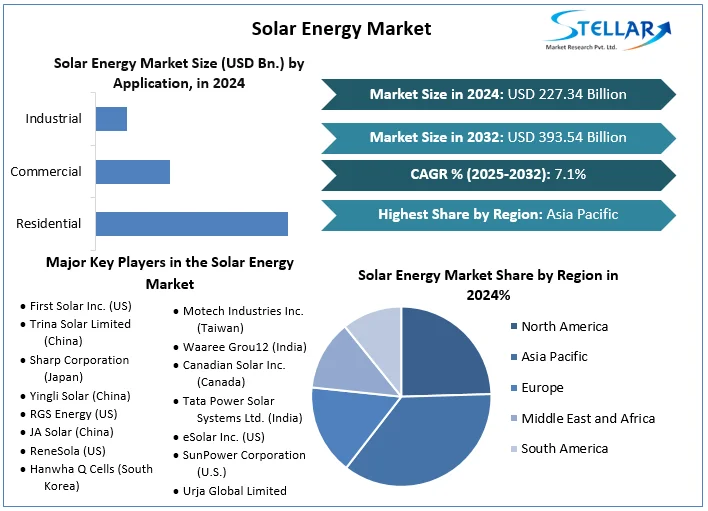
  • Green Coatings Market Size To Grow At A CAGR Of 3.9% In The Forecast Period Of 2025-2032

    Green Coatings Market Rises: Sustainability & Regulation Fuel Demand for Eco‑Friendly Finishes
    Market Estimation & Definition
    Green coatings refer to protective or decorative surface coatings (paints, varnishes, lacquers, specialized finishes) formulated to be environmentally friendly — with low or zero volatile organic compounds (VOCs), minimal hazardous chemicals, and compliance with stricter environmental and health regulations. These coatings are widely used in construction, automotive, furniture, industrial equipment, infrastructure, and consumer goods.

    With global emphasis on reducing environmental impact, improving indoor air quality, and meeting regulatory requirements on emissions and hazardous substances, demand for green coatings is growing. Manufacturers and end users increasingly prefer sustainable coating solutions over traditional solvent‑based paints.

    Request Free Sample Report:https://www.stellarmr.com/report/req_sample/green-coatings-market/2330

    Market Growth Drivers & Opportunities
    Stricter Environmental Regulations & Health Awareness
    Governments and regulatory bodies worldwide are enforcing laws limiting VOC emissions and hazardous chemical use. This drives industries toward compliant green coatings. Growing awareness of indoor air quality and environmental health among consumers also fuels demand.

    Sustainability Goals & Corporate ESG Policies
    Companies across construction, automotive, furniture, and manufacturing sectors are incorporating ESG (Environmental, Social, Governance) targets. Adopting green coatings helps meet sustainability commitments, reduce environmental footprint, and improve brand reputation.

    Growing Construction & Infrastructure Development
    Rapid urbanization and infrastructure expansion in many countries — including residential, commercial, public works and transportation projects — increases demand for coatings. Green coatings are preferred to meet environmental and regulatory standards for buildings and public structures.

    Automotive Industry Shift & Lightweight Materials
    As automobile manufacturers move toward lightweight materials and eco‑conscious production, green coatings compatible with modern substrates (plastics, composites, lighter metals) are increasingly used for vehicle exteriors and interiors.

    Consumer Demand for Eco-Friendly Products
    Consumers are more conscious about sustainability, low chemical exposure, and product life‑cycle impact. For furniture, home décor, appliances and consumer goods — green coatings offer a selling point, driving manufacturers to adopt them.

    What Lies Ahead: Emerging Trends Shaping the Future
    Water‑Based & High‑Solid Coatings
    Water‑borne coatings and high‑solid formulations (less solvent, more solids) will gain traction as they reduce VOC emissions while maintaining performance standards for durability and finish.

    Powder Coatings & UV‑Cured Coatings
    Alternative technologies like powder coatings and UV-cured coatings — which eliminate solvents and lower emissions — are expected to expand in industrial and furniture applications.

    Bio‑Based & Sustainable Raw Materials
    Use of bio‑derived resins, natural pigments, and sustainable additives will rise to reduce reliance on petrochemical feedstock and improve biodegradability/eco‑friendliness.

    Performance‑Optimized Green Coatings
    Improved formulations combining eco‑friendliness with high durability, corrosion resistance, UV‑protection, scratch resistance — suitable for harsh industrial or outdoor conditions — will push adoption beyond consumer use to heavy‑duty industrial and infrastructure applications.

    Regulation‑Driven Retrofits and Renovations
    New regulatory mandates for public buildings, schools, hospitals and offices on indoor air quality and emissions compliance may lead to widespread repainting or retrofitting using green coatings.

    Segmentation Analysis
    Based on typical segmentation frameworks, the green coatings market can be divided as:

    By Coating Type / Technology

    Water‑based Coatings

    Powder Coatings

    High‑Solid / Low‑VOC Solvent‑Reduced Coatings

    UV‑Cured Coatings

    Bio‑Based / Eco-Friendly Resin Coatings

    By Application / End‑Use Sector

    Residential & Commercial Construction (walls, ceilings, infrastructure)

    Industrial & Infrastructure (metal structures, pipelines, bridges, rail, power assets)

    Automotive & Transportation (vehicles, components)

    Furniture & Wood Products

    Consumer Goods & Appliances

    By Functionality

    Protective Coatings (anti‑corrosion, weather-resistant, abrasion‑resistant)

    About us

    Phase 3,Navale IT Zone, S.No. 51/2A/2,

    Office No. 202, 2nd floor,

    Near, Navale Brg,Narhe,

    Pune, Maharashtra 411041

    sales@stellarmr.com
    Green Coatings Market Size To Grow At A CAGR Of 3.9% In The Forecast Period Of 2025-2032 Green Coatings Market Rises: Sustainability & Regulation Fuel Demand for Eco‑Friendly Finishes Market Estimation & Definition Green coatings refer to protective or decorative surface coatings (paints, varnishes, lacquers, specialized finishes) formulated to be environmentally friendly — with low or zero volatile organic compounds (VOCs), minimal hazardous chemicals, and compliance with stricter environmental and health regulations. These coatings are widely used in construction, automotive, furniture, industrial equipment, infrastructure, and consumer goods. With global emphasis on reducing environmental impact, improving indoor air quality, and meeting regulatory requirements on emissions and hazardous substances, demand for green coatings is growing. Manufacturers and end users increasingly prefer sustainable coating solutions over traditional solvent‑based paints. Request Free Sample Report:https://www.stellarmr.com/report/req_sample/green-coatings-market/2330 Market Growth Drivers & Opportunities Stricter Environmental Regulations & Health Awareness Governments and regulatory bodies worldwide are enforcing laws limiting VOC emissions and hazardous chemical use. This drives industries toward compliant green coatings. Growing awareness of indoor air quality and environmental health among consumers also fuels demand. Sustainability Goals & Corporate ESG Policies Companies across construction, automotive, furniture, and manufacturing sectors are incorporating ESG (Environmental, Social, Governance) targets. Adopting green coatings helps meet sustainability commitments, reduce environmental footprint, and improve brand reputation. Growing Construction & Infrastructure Development Rapid urbanization and infrastructure expansion in many countries — including residential, commercial, public works and transportation projects — increases demand for coatings. Green coatings are preferred to meet environmental and regulatory standards for buildings and public structures. Automotive Industry Shift & Lightweight Materials As automobile manufacturers move toward lightweight materials and eco‑conscious production, green coatings compatible with modern substrates (plastics, composites, lighter metals) are increasingly used for vehicle exteriors and interiors. Consumer Demand for Eco-Friendly Products Consumers are more conscious about sustainability, low chemical exposure, and product life‑cycle impact. For furniture, home décor, appliances and consumer goods — green coatings offer a selling point, driving manufacturers to adopt them. What Lies Ahead: Emerging Trends Shaping the Future Water‑Based & High‑Solid Coatings Water‑borne coatings and high‑solid formulations (less solvent, more solids) will gain traction as they reduce VOC emissions while maintaining performance standards for durability and finish. Powder Coatings & UV‑Cured Coatings Alternative technologies like powder coatings and UV-cured coatings — which eliminate solvents and lower emissions — are expected to expand in industrial and furniture applications. Bio‑Based & Sustainable Raw Materials Use of bio‑derived resins, natural pigments, and sustainable additives will rise to reduce reliance on petrochemical feedstock and improve biodegradability/eco‑friendliness. Performance‑Optimized Green Coatings Improved formulations combining eco‑friendliness with high durability, corrosion resistance, UV‑protection, scratch resistance — suitable for harsh industrial or outdoor conditions — will push adoption beyond consumer use to heavy‑duty industrial and infrastructure applications. Regulation‑Driven Retrofits and Renovations New regulatory mandates for public buildings, schools, hospitals and offices on indoor air quality and emissions compliance may lead to widespread repainting or retrofitting using green coatings. Segmentation Analysis Based on typical segmentation frameworks, the green coatings market can be divided as: By Coating Type / Technology Water‑based Coatings Powder Coatings High‑Solid / Low‑VOC Solvent‑Reduced Coatings UV‑Cured Coatings Bio‑Based / Eco-Friendly Resin Coatings By Application / End‑Use Sector Residential & Commercial Construction (walls, ceilings, infrastructure) Industrial & Infrastructure (metal structures, pipelines, bridges, rail, power assets) Automotive & Transportation (vehicles, components) Furniture & Wood Products Consumer Goods & Appliances By Functionality Protective Coatings (anti‑corrosion, weather-resistant, abrasion‑resistant) About us Phase 3,Navale IT Zone, S.No. 51/2A/2, Office No. 202, 2nd floor, Near, Navale Brg,Narhe, Pune, Maharashtra 411041 sales@stellarmr.com
    0 Kommentare 0 Anteile
  • Prothrombin Complex Concentrate Market Share, Size, Analysis

    Prothrombin Complex Concentrate Market Gains Traction: Rapid Advances Fueling Hemostasis Therapeutics
    Market Estimation & Definition
    Prothrombin Complex Concentrate (PCC) is a plasma-derived medicinal product composed of vitamin K–dependent coagulation factors II, VII, IX, and X. It is used primarily for rapid reversal of anticoagulation (such as warfarin), and in managing bleeding in patients with coagulation deficiencies. According to the latest analysis from Stellar Market Research, the global PCC market was valued at USD 2.30 billion in 2024, and is projected to grow at a robust CAGR of 9.6% from 2025 to 2032, reaching approximately USD 4.8 billion by the end of the forecast period.

    Request Free Sample Report:https://www.stellarmr.com/report/req_sample/prothrombin-complex-concentrate-market/2708

    Market Growth Drivers & Opportunity
    Several key dynamics are driving the accelerated expansion of the PCC market:

    Rising Prevalence of Bleeding Disorders
    Disorders such as hemophilia, liver disease–related coagulation deficiencies, and acquired bleeding are increasingly common. Stellar’s report cites growing hemorrhagic risk, especially in aging populations and in patients on anticoagulants like warfarin, as a major growth engine.

    Emergency Reversal Needs
    In critical settings—such as trauma, surgery, or intracerebral hemorrhage—PCC offers a faster and more volume-efficient alternative to fresh frozen plasma (FFP), making it a preferred therapeutic.

    Advances in Coagulation Therapy
    Technological progress in plasma fractionation and purification (e.g., chromatographic methods) has improved the safety, yield, and efficacy of PCCs. This enables more consistent, reliable formulations, which in turn support wider adoption.

    Cost and Infrastructure Opportunities
    While PCC tends to be more expensive than traditional plasma products, its rapid action and lower infusion volume make it cost-effective in high-risk settings. As hospital infrastructure and critical care capabilities expand globally, the opportunity for PCC use grows.

    Replacing Plasma Transfusions
    The shift away from FFP toward PCC in many regions is gaining momentum, thanks to PCC’s faster onset and lower risk of volume overload—especially important in emergency and intensive-care contexts.

    What Lies Ahead: Emerging Trends Shaping the Future
    Looking forward, several themes are likely to define the next phase of the PCC market:

    Next-Generation PCC Formulations: Innovation will focus on enhanced safety profiles, lower infusion volumes, and possibly novel factor combinations. Improved purification may reduce thrombotic risk, a critical concern with PCCs.

    Personalized Coagulation Therapies: Growth in tailored dosing — based on patient genetics, age, or co-morbidities — may drive more efficient PCC use, especially in delicate populations (e.g., pediatrics, elderly).

    Expanded Indications: Beyond warfarin reversal, PCCs may gain traction in broader acquired coagulation deficiencies, trauma management, and surgery-bound bleeding prophylaxis.

    Regulatory & Reimbursement Evolution: As clinical guidelines increasingly support PCC use, reimbursement frameworks are likely to adapt. This could make PCCs more accessible in markets where cost remains a barrier.

    Supply Chain Resilience & Plasma Capacity: Given that PCC is plasma-derived, investment in plasma collection infrastructure, fractionation plants, and geographic diversification will be critical for sustained supply and growth.

    Segmentation Analysis
    According to Stellar Market Research, the global PCC market is segmented as follows:

    By Product Type

    3-factor PCC


    These players are investing in innovation, geographic expansion, and safety-optimized formulations. Strategic partnerships (e.g., with trauma centers or hospitals) and leveraging plasma-collection capacity are central to their competitive advantage.

    Press-Release Conclusion
    The Prothrombin Complex Concentrate market is poised for strong growth, driven by increasing bleeding disorder prevalence, the need for rapid anticoagulant reversal, and ongoing therapeutic innovation. With a projected increase from USD 2.30 billion in 2024 to nearly USD 4.8 billion by 2032, the PCC space offers compelling opportunities for both established plasma companies and emerging players. As regulators, clinicians, and payers align on best practices—and as next-generation products reduce risk while improving convenience—the future of rapid hemostasis via PCC looks brighter than ever.

    About us

    Phase 3,Navale IT Zone, S.No. 51/2A/2,

    Office No. 202, 2nd floor,

    Near, Navale Brg,Narhe,

    Pune, Maharashtra 411041

    sales@stellarmr.com
    Prothrombin Complex Concentrate Market Share, Size, Analysis Prothrombin Complex Concentrate Market Gains Traction: Rapid Advances Fueling Hemostasis Therapeutics Market Estimation & Definition Prothrombin Complex Concentrate (PCC) is a plasma-derived medicinal product composed of vitamin K–dependent coagulation factors II, VII, IX, and X. It is used primarily for rapid reversal of anticoagulation (such as warfarin), and in managing bleeding in patients with coagulation deficiencies. According to the latest analysis from Stellar Market Research, the global PCC market was valued at USD 2.30 billion in 2024, and is projected to grow at a robust CAGR of 9.6% from 2025 to 2032, reaching approximately USD 4.8 billion by the end of the forecast period. Request Free Sample Report:https://www.stellarmr.com/report/req_sample/prothrombin-complex-concentrate-market/2708 Market Growth Drivers & Opportunity Several key dynamics are driving the accelerated expansion of the PCC market: Rising Prevalence of Bleeding Disorders Disorders such as hemophilia, liver disease–related coagulation deficiencies, and acquired bleeding are increasingly common. Stellar’s report cites growing hemorrhagic risk, especially in aging populations and in patients on anticoagulants like warfarin, as a major growth engine. Emergency Reversal Needs In critical settings—such as trauma, surgery, or intracerebral hemorrhage—PCC offers a faster and more volume-efficient alternative to fresh frozen plasma (FFP), making it a preferred therapeutic. Advances in Coagulation Therapy Technological progress in plasma fractionation and purification (e.g., chromatographic methods) has improved the safety, yield, and efficacy of PCCs. This enables more consistent, reliable formulations, which in turn support wider adoption. Cost and Infrastructure Opportunities While PCC tends to be more expensive than traditional plasma products, its rapid action and lower infusion volume make it cost-effective in high-risk settings. As hospital infrastructure and critical care capabilities expand globally, the opportunity for PCC use grows. Replacing Plasma Transfusions The shift away from FFP toward PCC in many regions is gaining momentum, thanks to PCC’s faster onset and lower risk of volume overload—especially important in emergency and intensive-care contexts. What Lies Ahead: Emerging Trends Shaping the Future Looking forward, several themes are likely to define the next phase of the PCC market: Next-Generation PCC Formulations: Innovation will focus on enhanced safety profiles, lower infusion volumes, and possibly novel factor combinations. Improved purification may reduce thrombotic risk, a critical concern with PCCs. Personalized Coagulation Therapies: Growth in tailored dosing — based on patient genetics, age, or co-morbidities — may drive more efficient PCC use, especially in delicate populations (e.g., pediatrics, elderly). Expanded Indications: Beyond warfarin reversal, PCCs may gain traction in broader acquired coagulation deficiencies, trauma management, and surgery-bound bleeding prophylaxis. Regulatory & Reimbursement Evolution: As clinical guidelines increasingly support PCC use, reimbursement frameworks are likely to adapt. This could make PCCs more accessible in markets where cost remains a barrier. Supply Chain Resilience & Plasma Capacity: Given that PCC is plasma-derived, investment in plasma collection infrastructure, fractionation plants, and geographic diversification will be critical for sustained supply and growth. Segmentation Analysis According to Stellar Market Research, the global PCC market is segmented as follows: By Product Type 3-factor PCC These players are investing in innovation, geographic expansion, and safety-optimized formulations. Strategic partnerships (e.g., with trauma centers or hospitals) and leveraging plasma-collection capacity are central to their competitive advantage. Press-Release Conclusion The Prothrombin Complex Concentrate market is poised for strong growth, driven by increasing bleeding disorder prevalence, the need for rapid anticoagulant reversal, and ongoing therapeutic innovation. With a projected increase from USD 2.30 billion in 2024 to nearly USD 4.8 billion by 2032, the PCC space offers compelling opportunities for both established plasma companies and emerging players. As regulators, clinicians, and payers align on best practices—and as next-generation products reduce risk while improving convenience—the future of rapid hemostasis via PCC looks brighter than ever. About us Phase 3,Navale IT Zone, S.No. 51/2A/2, Office No. 202, 2nd floor, Near, Navale Brg,Narhe, Pune, Maharashtra 411041 sales@stellarmr.com
    0 Kommentare 0 Anteile
  • In a manufacturing era increasingly defined by real-time data flows, digital twins and integrated supply-chains, this high-capacity coil slitting line is engineered for the smart factory of tomorrow. Built to handle wide coils (up to 2,500 mm) of diverse materials — high-strength steels (HSS), cold-rolled (CRS), hot-rolled (HRS), stainless steels (SS) and aluminium — the system supports modern service centres and mini-mills that demand both versatility and automation readiness.
    https://sumikura.jp/slitting-lines/
    Smart Factory Integration

    In line with the surge in smart manufacturing adoption — sensors, IIoT connectivity, analytics and cloud-based monitoring are becoming table stakes in the steel and metal fabrication industries.

    This slitting line is designed with embedded instrumentation for coil tracking, strip width and tension monitoring, and event logging — enabling integration with plant-wide data systems, predictive maintenance modules and digital twin frameworks. With upstream tension units (felt plate, belt bridle, roll type) controlling strip behaviour precisely and log-tagging data, you get not just a mechanical asset but a connected production node.

    Capacity & Material Range

    Maximum coil width: 2,500 mm — gives broad feedstock flexibility and supports wide mother coils for high throughput.

    Maximum coil weight: 35 tons — enabling heavy-coil handling and reducing change-over frequency for large batch jobs.

    Material types: HSS / CRS / HRS / SS / Aluminium — supporting high-strength steels, stainless and aluminium without needing separate dedicated lines.

    Strips output: Up to 50 strips per coil — enabling high-value multislit configurations to maximise yield and reduce downstream handling/processing time.

    Thickness range: 0.2 mm to 9.0 mm — covering ultra-thin foil-gauge through medium/heavy gauge for diverse applications.

    Line speed range: 0 to 300 m/min — adjustable to match material, gauge and downstream process requirements.

    Advanced Tension & Slitting Features

    The tension unit upstream and/or downstream of the slitter head utilises selectable systems — felt plate, belt bridle or roll-type — so the machine can adapt to material differences (aluminium vs high-strength steel vs stainless) and deliver clean edges, minimal burrs and consistent coil winding. The slitter head employs a double-slitter or turnstile configuration — allowing rapid arbor changes, high‐precision knife clearance and multistrip output while preserving strip integrity and edge quality. These features align with the industry push toward automation, zero-defect output and digital traceability.

    Productivity & Operational Efficiency

    As smart-factory technologies advance across the metal sector, manufacturers are seeking equipment that supports not just higher throughput but also richer operational intelligence. For example, predictive maintenance via sensor data is becoming widespread in steel-processing plants.

    With this slitting line, you gain:

    Reduced downtime via automated coil loading/unloading and consistent high-speed performance.

    Higher first-pass yield, thanks to precise tension control, consistent edge quality and optimized strip count for each coil.

    Digital output — production data, coil/strip traceability and machine health metrics can be fed into existing MES/ERP systems, enabling analytics-driven decision-making.

    Flexibility to switch materials and gauges quickly, supporting shorter job-runs or mixed-material production — a growing necessity in the modern fabrication market.

    Sustainability & Competitive Advantage

    The steel/metal processing industry is trending toward smarter, greener, more efficient operations.

    A slitting line that handles multiple material types and gauges, minimises scrap and maximises yield via digital monitoring gives you a competitive advantage. The ability to log and analyse production data also supports sustainability programmes (less waste, better resource utilisation) and compliance with evolving customer and regulatory demands.

    User Experience & Change-over

    Recognising the skill-gap and labour-shift in today’s factories, this line is designed for ease of operation:

    Recipe-based HMI controls: material type, gauge, number of strips, speeds and tension profiles can be saved for repeatability.

    Quick tooling change: The turnstile/double slitter design supports rapid arbor swaps and strip width changes, reducing downtime between jobs.

    Embedded diagnostics and condition monitoring support proactive maintenance — aligning with the trend toward data-driven maintenance strategies.
    In a manufacturing era increasingly defined by real-time data flows, digital twins and integrated supply-chains, this high-capacity coil slitting line is engineered for the smart factory of tomorrow. Built to handle wide coils (up to 2,500 mm) of diverse materials — high-strength steels (HSS), cold-rolled (CRS), hot-rolled (HRS), stainless steels (SS) and aluminium — the system supports modern service centres and mini-mills that demand both versatility and automation readiness. https://sumikura.jp/slitting-lines/ Smart Factory Integration In line with the surge in smart manufacturing adoption — sensors, IIoT connectivity, analytics and cloud-based monitoring are becoming table stakes in the steel and metal fabrication industries. This slitting line is designed with embedded instrumentation for coil tracking, strip width and tension monitoring, and event logging — enabling integration with plant-wide data systems, predictive maintenance modules and digital twin frameworks. With upstream tension units (felt plate, belt bridle, roll type) controlling strip behaviour precisely and log-tagging data, you get not just a mechanical asset but a connected production node. Capacity & Material Range Maximum coil width: 2,500 mm — gives broad feedstock flexibility and supports wide mother coils for high throughput. Maximum coil weight: 35 tons — enabling heavy-coil handling and reducing change-over frequency for large batch jobs. Material types: HSS / CRS / HRS / SS / Aluminium — supporting high-strength steels, stainless and aluminium without needing separate dedicated lines. Strips output: Up to 50 strips per coil — enabling high-value multislit configurations to maximise yield and reduce downstream handling/processing time. Thickness range: 0.2 mm to 9.0 mm — covering ultra-thin foil-gauge through medium/heavy gauge for diverse applications. Line speed range: 0 to 300 m/min — adjustable to match material, gauge and downstream process requirements. Advanced Tension & Slitting Features The tension unit upstream and/or downstream of the slitter head utilises selectable systems — felt plate, belt bridle or roll-type — so the machine can adapt to material differences (aluminium vs high-strength steel vs stainless) and deliver clean edges, minimal burrs and consistent coil winding. The slitter head employs a double-slitter or turnstile configuration — allowing rapid arbor changes, high‐precision knife clearance and multistrip output while preserving strip integrity and edge quality. These features align with the industry push toward automation, zero-defect output and digital traceability. Productivity & Operational Efficiency As smart-factory technologies advance across the metal sector, manufacturers are seeking equipment that supports not just higher throughput but also richer operational intelligence. For example, predictive maintenance via sensor data is becoming widespread in steel-processing plants. With this slitting line, you gain: Reduced downtime via automated coil loading/unloading and consistent high-speed performance. Higher first-pass yield, thanks to precise tension control, consistent edge quality and optimized strip count for each coil. Digital output — production data, coil/strip traceability and machine health metrics can be fed into existing MES/ERP systems, enabling analytics-driven decision-making. Flexibility to switch materials and gauges quickly, supporting shorter job-runs or mixed-material production — a growing necessity in the modern fabrication market. Sustainability & Competitive Advantage The steel/metal processing industry is trending toward smarter, greener, more efficient operations. A slitting line that handles multiple material types and gauges, minimises scrap and maximises yield via digital monitoring gives you a competitive advantage. The ability to log and analyse production data also supports sustainability programmes (less waste, better resource utilisation) and compliance with evolving customer and regulatory demands. User Experience & Change-over Recognising the skill-gap and labour-shift in today’s factories, this line is designed for ease of operation: Recipe-based HMI controls: material type, gauge, number of strips, speeds and tension profiles can be saved for repeatability. Quick tooling change: The turnstile/double slitter design supports rapid arbor swaps and strip width changes, reducing downtime between jobs. Embedded diagnostics and condition monitoring support proactive maintenance — aligning with the trend toward data-driven maintenance strategies.
    China Silicon Steel Slitting Lines Manufacturer - SUMIKURA Co., Ltd
    Silicon Steel Slitting Lines are advanced coil processing systems designed specifically for cutting electrical steel (silicon steel) into precise narrow strips.
    0 Kommentare 0 Anteile
  • Asset-Backed Securities Market Overview
    The Asset-Backed Securities (ABS) market has witnessed steady growth over the past few years, driven by increasing demand for structured finance instruments and a robust financial ecosystem. The market size was estimated at USD 6886.77 billion in 2024 and is projected to grow from USD 7264.30 billion in 2025 to USD 11743.57 billion by 2034, reflecting a compound annual growth rate (CAGR) of 5.48% during the forecast period (2025–2034).
    Market Dynamics
    Growth Drivers:
    1. Rising Demand for Credit Expansion: The ABS market is benefiting from the increasing need for financial institutions to expand credit offerings while mitigating risks through asset securitization.
    2. Diversification of Investment Portfolios: Investors are increasingly seeking diversified fixed-income securities, making ABS an attractive option.
    3. Technological Advancements in Financial Services: The integration of AI and blockchain in financial markets has improved transparency, efficiency, and risk assessment in ABS transactions.
    4. Regulatory Frameworks Supporting Market Stability: Governments and regulatory bodies are establishing policies that promote a stable securitization market, encouraging investor confidence.
    5. Growth in Consumer and Auto Loans: Rising auto loans, credit card receivables, and student loans contribute to the expansion of ABS issuances.
    Sample Request For Free Pdf - https://www.marketresearchfuture.com/sample_request/23890
    Market Restraints:
    • Regulatory Challenges and Compliance Costs: Strict regulations and compliance requirements can pose challenges for issuers and investors.
    • Economic Uncertainties: Market fluctuations, interest rate volatility, and geopolitical risks can impact ABS performance and investor sentiment.
    Market Segmentation
    The ABS market is segmented based on asset types, end-users, and geographical regions:
    1. By Asset Type:
    o Auto Loan-Backed Securities
    o Credit Card Receivables
    o Mortgage-Backed Securities (MBS)
    o Student Loan-Backed Securities
    o Equipment Leasing
    o Others
    2. By End-User:
    o Banks & Financial Institutions
    o Institutional Investors
    o Individual Investors
    3. By Region:
    o North America
    o Europe
    o Asia-Pacific
    o Latin America
    o Middle East & Africa
    Regional Insights
    • North America: Leading the global ABS market due to a well-developed financial sector and high investor participation.
    • Europe: Growing adoption of ABS due to favorable regulatory conditions and demand for diversified fixed-income instruments.
    • Asia-Pacific: Rapid expansion in financial services, increasing consumer loans, and economic growth fuel the ABS market in the region.
    Future Trends
    • Integration of AI & Blockchain: These technologies are expected to enhance risk analysis, streamline transactions, and improve transparency.
    • Green & ESG-Linked ABS: The rising interest in sustainable finance is likely to drive the development of environmentally and socially responsible ABS.
    • Evolution of Digital Asset Securitization: Tokenization of ABS through blockchain-based platforms could revolutionize the market by improving accessibility and liquidity.
    Conclusion
    The Asset-Backed Securities market is poised for significant growth in the coming decade, driven by increasing demand for structured finance solutions, investor diversification, and technological advancements. Despite regulatory and economic challenges, the market remains attractive due to its ability to offer liquidity, risk mitigation, and stable returns to investors. Market participants must navigate regulatory landscapes and embrace innovation to capitalize on emerging opportunities in this evolving sector.
    Related Report –
    https://www.marketresearchfuture.com/reports/us-automotive-insurance-market-14063
    https://www.marketresearchfuture.com/reports/us-digital-payment-healthcare-market-14092
    https://www.marketresearchfuture.com/reports/us-financial-analytics-market-14342
    https://www.marketresearchfuture.com/reports/us-investment-banking-market-14860
    https://www.marketresearchfuture.com/reports/us-digital-identity-in-bfsi-market-14926
    Asset-Backed Securities Market Overview The Asset-Backed Securities (ABS) market has witnessed steady growth over the past few years, driven by increasing demand for structured finance instruments and a robust financial ecosystem. The market size was estimated at USD 6886.77 billion in 2024 and is projected to grow from USD 7264.30 billion in 2025 to USD 11743.57 billion by 2034, reflecting a compound annual growth rate (CAGR) of 5.48% during the forecast period (2025–2034). Market Dynamics Growth Drivers: 1. Rising Demand for Credit Expansion: The ABS market is benefiting from the increasing need for financial institutions to expand credit offerings while mitigating risks through asset securitization. 2. Diversification of Investment Portfolios: Investors are increasingly seeking diversified fixed-income securities, making ABS an attractive option. 3. Technological Advancements in Financial Services: The integration of AI and blockchain in financial markets has improved transparency, efficiency, and risk assessment in ABS transactions. 4. Regulatory Frameworks Supporting Market Stability: Governments and regulatory bodies are establishing policies that promote a stable securitization market, encouraging investor confidence. 5. Growth in Consumer and Auto Loans: Rising auto loans, credit card receivables, and student loans contribute to the expansion of ABS issuances. Sample Request For Free Pdf - https://www.marketresearchfuture.com/sample_request/23890 Market Restraints: • Regulatory Challenges and Compliance Costs: Strict regulations and compliance requirements can pose challenges for issuers and investors. • Economic Uncertainties: Market fluctuations, interest rate volatility, and geopolitical risks can impact ABS performance and investor sentiment. Market Segmentation The ABS market is segmented based on asset types, end-users, and geographical regions: 1. By Asset Type: o Auto Loan-Backed Securities o Credit Card Receivables o Mortgage-Backed Securities (MBS) o Student Loan-Backed Securities o Equipment Leasing o Others 2. By End-User: o Banks & Financial Institutions o Institutional Investors o Individual Investors 3. By Region: o North America o Europe o Asia-Pacific o Latin America o Middle East & Africa Regional Insights • North America: Leading the global ABS market due to a well-developed financial sector and high investor participation. • Europe: Growing adoption of ABS due to favorable regulatory conditions and demand for diversified fixed-income instruments. • Asia-Pacific: Rapid expansion in financial services, increasing consumer loans, and economic growth fuel the ABS market in the region. Future Trends • Integration of AI & Blockchain: These technologies are expected to enhance risk analysis, streamline transactions, and improve transparency. • Green & ESG-Linked ABS: The rising interest in sustainable finance is likely to drive the development of environmentally and socially responsible ABS. • Evolution of Digital Asset Securitization: Tokenization of ABS through blockchain-based platforms could revolutionize the market by improving accessibility and liquidity. Conclusion The Asset-Backed Securities market is poised for significant growth in the coming decade, driven by increasing demand for structured finance solutions, investor diversification, and technological advancements. Despite regulatory and economic challenges, the market remains attractive due to its ability to offer liquidity, risk mitigation, and stable returns to investors. Market participants must navigate regulatory landscapes and embrace innovation to capitalize on emerging opportunities in this evolving sector. Related Report – https://www.marketresearchfuture.com/reports/us-automotive-insurance-market-14063 https://www.marketresearchfuture.com/reports/us-digital-payment-healthcare-market-14092 https://www.marketresearchfuture.com/reports/us-financial-analytics-market-14342 https://www.marketresearchfuture.com/reports/us-investment-banking-market-14860 https://www.marketresearchfuture.com/reports/us-digital-identity-in-bfsi-market-14926
    WWW.MARKETRESEARCHFUTURE.COM
    Sample Request for Asset-Backed Securities Market Size, Share Report and Trends 2034
    Sample Request - Asset-backed Securities Market is projected to reach USD 11743.57 Billion at a CAGR of 5.48% by 2034, Global Asset-backed Securities Industry Growth by Asset Class, Security Structure, Credit Rating, Maturity, Region
    0 Kommentare 0 Anteile
Suchergebnis