• Looking to buy a home in LILAC PARK, Jumeirah Village Circle, Dubai? Lilac Park is a modern residential development located in the heart of Jumeirah Village Circle (JVC), one of Dubai’s most sought-after family-friendly communities. Offering stylish apartments, contemporary layouts, and access to parks, schools, retail outlets, and major road networks, Lilac Park is ideal for both end-users and property investors. Its strategic location provides quick connectivity to key areas of Dubai, while maintaining a peaceful neighborhood lifestyle. Whether you’re searching for a comfortable home or a high-yield real estate investment, Lilac Park in JVC delivers excellent value, strong rental demand, and long-term growth potential.

    https://taprealestatebroker.com/properties/for-buy/lilac-park-by-sol
    Looking to buy a home in LILAC PARK, Jumeirah Village Circle, Dubai? Lilac Park is a modern residential development located in the heart of Jumeirah Village Circle (JVC), one of Dubai’s most sought-after family-friendly communities. Offering stylish apartments, contemporary layouts, and access to parks, schools, retail outlets, and major road networks, Lilac Park is ideal for both end-users and property investors. Its strategic location provides quick connectivity to key areas of Dubai, while maintaining a peaceful neighborhood lifestyle. Whether you’re searching for a comfortable home or a high-yield real estate investment, Lilac Park in JVC delivers excellent value, strong rental demand, and long-term growth potential. https://taprealestatebroker.com/properties/for-buy/lilac-park-by-sol
    0 Commenti 0 condivisioni
  • Access Control Installation: DIY vs Professional
    #uninterruptible #power #supplies #access #control #system #installation #network #cabling #in #Singapore

    This is where the core argument for why professional access control system installation beats manual DIY setups becomes evident.

    This ensures reliable network cabling in Singapore for integrated office security hardware and integration with other systems like closed-circuit television (CCTV).

    A key component of a professional install is the integration of essential uninterruptible power supplies (UPS) for maintaining constant property protection.

    Find out More >> https://bit.ly/4aumsfn
    Access Control Installation: DIY vs Professional #uninterruptible #power #supplies #access #control #system #installation #network #cabling #in #Singapore This is where the core argument for why professional access control system installation beats manual DIY setups becomes evident. This ensures reliable network cabling in Singapore for integrated office security hardware and integration with other systems like closed-circuit television (CCTV). A key component of a professional install is the integration of essential uninterruptible power supplies (UPS) for maintaining constant property protection. Find out More >> https://bit.ly/4aumsfn
    0 Commenti 0 condivisioni
  • Global Neuromorphic Computing Market Set to Grow from USD 7.82 Billion in 2024 to USD 45.72 Billion by 2032

    Neuromorphic Computing Market: Brain-Inspired Architectures Powering the Next Era of Intelligent Systems

    The Neuromorphic Computing Market represents one of the most promising frontiers in computing technology as industries seek faster, more energy-efficient, and human-like data processing solutions. In 2024, the market was valued at around USD 7.82 billion, and it is expected to expand rapidly at a compound annual growth rate (CAGR) of approximately 24.7 % through 2032, reaching nearly USD 45.72 billion by the end of the forecast period. This surge reflects growing demand for brain-inspired computing architectures that outperform traditional systems in tasks such as artificial intelligence (AI), autonomous systems, and real-time edge processing.

    Request Free Sample Report : https://www.stellarmr.com/report/req_sample/neuromorphic-computing-market/2595

    Market Estimation & Definition

    Neuromorphic computing refers to a class of computing architectures inspired by the structure and functions of the human brain and nervous system. Unlike conventional von Neumann designs — which separate data storage from processing — neuromorphic systems mimic neural networks by co-locating memory and computation, employing spiking neural networks and specialized hardware that simulates neurons and synapses. This design enables highly parallel, low-power processing that can learn and adapt in real time, making it ideal for applications requiring rapid, energy-efficient decision-making.

    Neuromorphic systems are poised to fuel advances in next-generation AI, robotics, autonomous vehicles, smart sensors, and edge computing platforms that must process large amounts of data with minimal energy consumption.

    Market Growth Drivers & Opportunity

    Several key forces are driving the market’s accelerated growth:

    Energy-Efficient AI Requirements: As demand for AI accelerates globally — from data centers to mobile devices and autonomous machines — traditional processors struggle with high power consumption and latency. Neuromorphic architectures significantly reduce energy usage while maintaining performance, making them attractive for sustainable AI solutions.

    Autonomous Systems and Robotics: Real-world applications such as self-driving cars, drones, industrial automation, and humanoid robots require real-time perception, adaptation, and decision-making. Neuromorphic systems are uniquely suited to these workloads, particularly those involving sensor fusion, object detection, and environment interaction.

    Edge Computing Demand: Neuromorphic chips’ ability to process data locally — close to the source — with low latency and minimal power makes them ideal for edge deployments in IoT devices, wearables, smart cameras, and healthcare monitoring tools.

    Academic and Government Research: Widespread interest from universities and government programs in brain-inspired computing accelerates innovation and fosters collaborations between research labs and industry, fueling technology breakthroughs.

    These drivers create significant opportunities for vendors, system integrators, and technology innovators to develop scalable solutions that can replace or augment traditional computing in AI-intensive applications.

    Request Free Sample Report : https://www.stellarmr.com/report/req_sample/neuromorphic-computing-market/2595

    What Lies Ahead: Emerging Trends Shaping the Future

    The future of neuromorphic computing is shaped by several notable trends:


    About us

    Phase 3,Navale IT Zone, S.No. 51/2A/2,

    Office No. 202, 2nd floor,

    Near, Navale Brg,Narhe,

    Pune, Maharashtra 411041

    sales@stellarmr.com

    Global Neuromorphic Computing Market Set to Grow from USD 7.82 Billion in 2024 to USD 45.72 Billion by 2032 Neuromorphic Computing Market: Brain-Inspired Architectures Powering the Next Era of Intelligent Systems The Neuromorphic Computing Market represents one of the most promising frontiers in computing technology as industries seek faster, more energy-efficient, and human-like data processing solutions. In 2024, the market was valued at around USD 7.82 billion, and it is expected to expand rapidly at a compound annual growth rate (CAGR) of approximately 24.7 % through 2032, reaching nearly USD 45.72 billion by the end of the forecast period. This surge reflects growing demand for brain-inspired computing architectures that outperform traditional systems in tasks such as artificial intelligence (AI), autonomous systems, and real-time edge processing. Request Free Sample Report : https://www.stellarmr.com/report/req_sample/neuromorphic-computing-market/2595 Market Estimation & Definition Neuromorphic computing refers to a class of computing architectures inspired by the structure and functions of the human brain and nervous system. Unlike conventional von Neumann designs — which separate data storage from processing — neuromorphic systems mimic neural networks by co-locating memory and computation, employing spiking neural networks and specialized hardware that simulates neurons and synapses. This design enables highly parallel, low-power processing that can learn and adapt in real time, making it ideal for applications requiring rapid, energy-efficient decision-making. Neuromorphic systems are poised to fuel advances in next-generation AI, robotics, autonomous vehicles, smart sensors, and edge computing platforms that must process large amounts of data with minimal energy consumption. Market Growth Drivers & Opportunity Several key forces are driving the market’s accelerated growth: Energy-Efficient AI Requirements: As demand for AI accelerates globally — from data centers to mobile devices and autonomous machines — traditional processors struggle with high power consumption and latency. Neuromorphic architectures significantly reduce energy usage while maintaining performance, making them attractive for sustainable AI solutions. Autonomous Systems and Robotics: Real-world applications such as self-driving cars, drones, industrial automation, and humanoid robots require real-time perception, adaptation, and decision-making. Neuromorphic systems are uniquely suited to these workloads, particularly those involving sensor fusion, object detection, and environment interaction. Edge Computing Demand: Neuromorphic chips’ ability to process data locally — close to the source — with low latency and minimal power makes them ideal for edge deployments in IoT devices, wearables, smart cameras, and healthcare monitoring tools. Academic and Government Research: Widespread interest from universities and government programs in brain-inspired computing accelerates innovation and fosters collaborations between research labs and industry, fueling technology breakthroughs. These drivers create significant opportunities for vendors, system integrators, and technology innovators to develop scalable solutions that can replace or augment traditional computing in AI-intensive applications. Request Free Sample Report : https://www.stellarmr.com/report/req_sample/neuromorphic-computing-market/2595 What Lies Ahead: Emerging Trends Shaping the Future The future of neuromorphic computing is shaped by several notable trends: About us Phase 3,Navale IT Zone, S.No. 51/2A/2, Office No. 202, 2nd floor, Near, Navale Brg,Narhe, Pune, Maharashtra 411041 sales@stellarmr.com

    0 Commenti 0 condivisioni
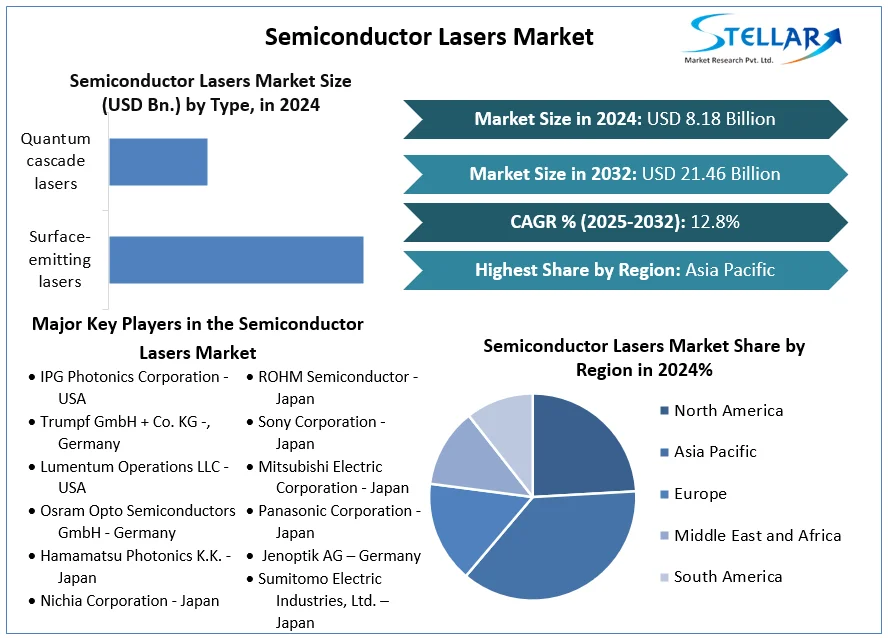
  • Global Semiconductor Lasers Market Set to Reach USD 21.46 Billion by 2032: Growth Drivers & Forecast

    Semiconductor Lasers Market: Innovation Driving Global Growth and Technological Leadership

    The Semiconductor Lasers Market is poised for remarkable expansion as photonics and optoelectronics transform modern technology landscapes. According to the Stellar Market Research analysis, the global semiconductor lasers market was valued at approximately USD 8.18 billion in 2024. It is projected to grow at a compound annual growth rate (CAGR) of 12.80 % from 2025 to 2032, reaching near USD 21.46 billion by 2032. This projected growth highlights the increasing adoption of semiconductor lasers across multiple sectors, including communications, healthcare, industrial applications, and defense.

    Request Free Sample Report : https://www.stellarmr.com/report/req_sample/semiconductor-lasers-market/2296

    Market Estimation & Definition

    Semiconductor lasers — also known as laser diodes — are unique laser sources that use heavily doped semiconductor materials to generate coherent light. Unlike traditional gas or solid-state lasers, semiconductor lasers are compact in size, energy-efficient, and highly suitable for integration into electronic and photonic systems. Materials such as Gallium Arsenide (GaAs) and Indium Phosphide (InP) serve as base materials in these devices, enabling efficient light emission with minimal external components. Their versatility in direct modulation, small footprint, and superior energy profiles make them essential in advanced technologies ranging from fiber-optic communications to augmented reality systems.

    Market Growth Drivers & Opportunity

    The semiconductor lasers market is experiencing strong growth propelled by several key factors:

    High-Speed Communication Networks: Increasing demand for high-speed data transmission and global broadband connectivity — driven by 5G, cloud computing, and data center expansion — is fuelling the need for semiconductor lasers in optical communication systems. These lasers form the backbone of fiber-optic communication links, enabling faster, low-latency data transfer across networks.

    Emerging Technology Integration: Applications such as LiDAR for autonomous vehicles and sensor systems in robotics and smart devices are expanding demand. Semiconductor lasers are vital components in augmented reality (AR) and virtual reality (VR) hardware, supporting advanced projection displays, optical sensors, and gesture detection systems used across consumer electronics and industrial automation.

    Medical & Healthcare Uptake: The medical industry is increasingly integrating semiconductor lasers in diagnostic imaging, surgical devices, dermatology, and dental procedures. Their precision, efficiency, and relatively compact systems are key contributors to expanding clinical applications.

    These drivers create extensive opportunities for both existing players and new entrants to innovate and tailor solutions for specific industry requirements, pushing the market beyond traditional defense and communication segments.

    Request Free Sample Report : https://www.stellarmr.com/report/req_sample/semiconductor-lasers-market/2296

    About us

    Phase 3,Navale IT Zone, S.No. 51/2A/2,

    Office No. 202, 2nd floor,

    Near, Navale Brg,Narhe,

    Pune, Maharashtra 411041

    sales@stellarmr.com

    Global Semiconductor Lasers Market Set to Reach USD 21.46 Billion by 2032: Growth Drivers & Forecast Semiconductor Lasers Market: Innovation Driving Global Growth and Technological Leadership The Semiconductor Lasers Market is poised for remarkable expansion as photonics and optoelectronics transform modern technology landscapes. According to the Stellar Market Research analysis, the global semiconductor lasers market was valued at approximately USD 8.18 billion in 2024. It is projected to grow at a compound annual growth rate (CAGR) of 12.80 % from 2025 to 2032, reaching near USD 21.46 billion by 2032. This projected growth highlights the increasing adoption of semiconductor lasers across multiple sectors, including communications, healthcare, industrial applications, and defense. Request Free Sample Report : https://www.stellarmr.com/report/req_sample/semiconductor-lasers-market/2296 Market Estimation & Definition Semiconductor lasers — also known as laser diodes — are unique laser sources that use heavily doped semiconductor materials to generate coherent light. Unlike traditional gas or solid-state lasers, semiconductor lasers are compact in size, energy-efficient, and highly suitable for integration into electronic and photonic systems. Materials such as Gallium Arsenide (GaAs) and Indium Phosphide (InP) serve as base materials in these devices, enabling efficient light emission with minimal external components. Their versatility in direct modulation, small footprint, and superior energy profiles make them essential in advanced technologies ranging from fiber-optic communications to augmented reality systems. Market Growth Drivers & Opportunity The semiconductor lasers market is experiencing strong growth propelled by several key factors: High-Speed Communication Networks: Increasing demand for high-speed data transmission and global broadband connectivity — driven by 5G, cloud computing, and data center expansion — is fuelling the need for semiconductor lasers in optical communication systems. These lasers form the backbone of fiber-optic communication links, enabling faster, low-latency data transfer across networks. Emerging Technology Integration: Applications such as LiDAR for autonomous vehicles and sensor systems in robotics and smart devices are expanding demand. Semiconductor lasers are vital components in augmented reality (AR) and virtual reality (VR) hardware, supporting advanced projection displays, optical sensors, and gesture detection systems used across consumer electronics and industrial automation. Medical & Healthcare Uptake: The medical industry is increasingly integrating semiconductor lasers in diagnostic imaging, surgical devices, dermatology, and dental procedures. Their precision, efficiency, and relatively compact systems are key contributors to expanding clinical applications. These drivers create extensive opportunities for both existing players and new entrants to innovate and tailor solutions for specific industry requirements, pushing the market beyond traditional defense and communication segments. Request Free Sample Report : https://www.stellarmr.com/report/req_sample/semiconductor-lasers-market/2296 About us Phase 3,Navale IT Zone, S.No. 51/2A/2, Office No. 202, 2nd floor, Near, Navale Brg,Narhe, Pune, Maharashtra 411041 sales@stellarmr.com
    0 Commenti 0 condivisioni
  • Wireless Display Market Set to Grow from USD 5.87 Billion in 2024 to USD 15.49 Billion by 2032 at 12.9% CAGR

    Wireless Display Market Analysis: Growth Drivers, Trends, Segmentation, Country Insights, and Future Outlook
    The Wireless Display Market is rapidly transforming how people consume, share, and interact with visual content across consumer, business, education, and entertainment arenas. Defined broadly, a wireless display allows video, images, and data to be transmitted from a source device such as a smartphone, laptop, or tablet to a display screen — such as a flat-panel TV, monitor, projector, or video wall — without cables or physical connections. This market is expanding as connectivity technologies such as Wi-Fi, Bluetooth, and other wireless protocols evolve and become more reliable and capable.

    According to recent industry estimates, the global Wireless Display Market was valued at around USD 5.87 billion in 2024 and is expected to grow to nearly USD 15.49 billion by 2032, exhibiting a strong compound annual growth rate (CAGR) of approximately 12.9 percent from 2025 to 2032.

    Request Free Sample Report : https://www.stellarmr.com/report/req_sample/Wireless-Display-Market/2189
    Market Estimation & Definition
    At its core, wireless display technology eliminates the need for HDMI cables and similar wired connections by using wireless networking standards — predominantly Wi-Fi — to mirror or stream content between devices. Modern solutions range from dedicated hardware devices and adapters to integrated software protocols that support high-resolution streaming, screen sharing, and seamless connectivity across ecosystems. These technologies are now embedded in many consumer electronics and professional collaboration tools, reflecting their broad utility across residential and enterprise environments.

    Wireless display solutions are increasingly relied upon for entertainment streaming, remote collaboration, classroom teaching, digital signage, corporate presentations, and more. They are also instrumental in supporting BYOD (Bring Your Own Device) trends in enterprise and educational settings, enabling users to project content directly from their personal devices.

    Market Growth Drivers & Opportunity
    A convergence of technological trends and user-centric requirements is driving market growth. One of the most significant drivers is the surge in adoption of smart and connected devices. Smartphones, tablets, smart TVs, and laptops now commonly enable wireless casting and screen-mirroring technologies, prompting households and organizations to seek convenient ways to share high-quality content without cables.

    The demand for seamless collaboration in hybrid and remote work environments further propels the market. As businesses adopt flexible workplace models, wireless display tools are becoming essential for presentations, team meetings, and interactive workflows that support diverse device ecosystems.

    Another growth catalyst is advancement in connectivity technologies such as Wi-Fi 6 and 5G. These standards enable faster data transmission, reduced latency, and more reliable streaming — all critical for wireless displays to support high-resolution content and multi-screen synchronization.

    Consumer preferences for entertainment on large screens are also contributing to market expansion. As on-demand streaming services, gaming, and multimedia consumption rise, users increasingly rely on wireless display systems to watch content on TVs or projectors without the inconvenience of physical wires.

    Request Free Sample Report : https://www.stellarmr.com/report/req_sample/Wireless-Display-Market/2189
    What Lies Ahead: Emerging Trends Shaping the Future
    Several forward-looking trends are expected to define the trajectory of the Wireless Display Market. Integration with Internet of Things (IoT) ecosystems will allow wireless displays to become part of broader connected environments where content, controls, and user profiles are synchronized across devices.

    The expansion of augmented reality (AR) and virtual reality (VR) applications also offers opportunities for immersive visual experiences that leverage wireless display technologies, especially in gaming, training simulations, and interactive education.

    Additionally, ongoing improvements in video quality, such as 4K and ultra-high-definition streaming with reduced latency, are enhancing user experiences across consumer and professional use cases. Manufacturers are focusing on lowering latency, boosting frame rates, and ensuring smooth multi-device synchronization to support these advanced capabilities.

    About us

    Phase 3,Navale IT Zone, S.No. 51/2A/2,

    Office No. 202, 2nd floor,

    Near, Navale Brg,Narhe,

    Pune, Maharashtra 411041

    sales@stellarmr.com
    Wireless Display Market Set to Grow from USD 5.87 Billion in 2024 to USD 15.49 Billion by 2032 at 12.9% CAGR Wireless Display Market Analysis: Growth Drivers, Trends, Segmentation, Country Insights, and Future Outlook The Wireless Display Market is rapidly transforming how people consume, share, and interact with visual content across consumer, business, education, and entertainment arenas. Defined broadly, a wireless display allows video, images, and data to be transmitted from a source device such as a smartphone, laptop, or tablet to a display screen — such as a flat-panel TV, monitor, projector, or video wall — without cables or physical connections. This market is expanding as connectivity technologies such as Wi-Fi, Bluetooth, and other wireless protocols evolve and become more reliable and capable. According to recent industry estimates, the global Wireless Display Market was valued at around USD 5.87 billion in 2024 and is expected to grow to nearly USD 15.49 billion by 2032, exhibiting a strong compound annual growth rate (CAGR) of approximately 12.9 percent from 2025 to 2032. Request Free Sample Report : https://www.stellarmr.com/report/req_sample/Wireless-Display-Market/2189 Market Estimation & Definition At its core, wireless display technology eliminates the need for HDMI cables and similar wired connections by using wireless networking standards — predominantly Wi-Fi — to mirror or stream content between devices. Modern solutions range from dedicated hardware devices and adapters to integrated software protocols that support high-resolution streaming, screen sharing, and seamless connectivity across ecosystems. These technologies are now embedded in many consumer electronics and professional collaboration tools, reflecting their broad utility across residential and enterprise environments. Wireless display solutions are increasingly relied upon for entertainment streaming, remote collaboration, classroom teaching, digital signage, corporate presentations, and more. They are also instrumental in supporting BYOD (Bring Your Own Device) trends in enterprise and educational settings, enabling users to project content directly from their personal devices. Market Growth Drivers & Opportunity A convergence of technological trends and user-centric requirements is driving market growth. One of the most significant drivers is the surge in adoption of smart and connected devices. Smartphones, tablets, smart TVs, and laptops now commonly enable wireless casting and screen-mirroring technologies, prompting households and organizations to seek convenient ways to share high-quality content without cables. The demand for seamless collaboration in hybrid and remote work environments further propels the market. As businesses adopt flexible workplace models, wireless display tools are becoming essential for presentations, team meetings, and interactive workflows that support diverse device ecosystems. Another growth catalyst is advancement in connectivity technologies such as Wi-Fi 6 and 5G. These standards enable faster data transmission, reduced latency, and more reliable streaming — all critical for wireless displays to support high-resolution content and multi-screen synchronization. Consumer preferences for entertainment on large screens are also contributing to market expansion. As on-demand streaming services, gaming, and multimedia consumption rise, users increasingly rely on wireless display systems to watch content on TVs or projectors without the inconvenience of physical wires. Request Free Sample Report : https://www.stellarmr.com/report/req_sample/Wireless-Display-Market/2189 What Lies Ahead: Emerging Trends Shaping the Future Several forward-looking trends are expected to define the trajectory of the Wireless Display Market. Integration with Internet of Things (IoT) ecosystems will allow wireless displays to become part of broader connected environments where content, controls, and user profiles are synchronized across devices. The expansion of augmented reality (AR) and virtual reality (VR) applications also offers opportunities for immersive visual experiences that leverage wireless display technologies, especially in gaming, training simulations, and interactive education. Additionally, ongoing improvements in video quality, such as 4K and ultra-high-definition streaming with reduced latency, are enhancing user experiences across consumer and professional use cases. Manufacturers are focusing on lowering latency, boosting frame rates, and ensuring smooth multi-device synchronization to support these advanced capabilities. About us Phase 3,Navale IT Zone, S.No. 51/2A/2, Office No. 202, 2nd floor, Near, Navale Brg,Narhe, Pune, Maharashtra 411041 sales@stellarmr.com
    0 Commenti 0 condivisioni
  • Challenges for Businesses Entering India’s Digital Market
    Developing mobile applications for India requires attention to a variety of factors.

    Visit site: https://www.digittrix.com/web-development

    High device fragmentation, variable network speeds, regional languages, and differing purchasing habits mean that a one-size-fits-all approach rarely works. Businesses need apps that are lightweight, functional on multiple platforms, and capable of providing seamless experiences to users across regions. Customization, security, and scalability become critical for retaining users and ensuring operational efficiency.
    Challenges for Businesses Entering India’s Digital Market Developing mobile applications for India requires attention to a variety of factors. Visit site: https://www.digittrix.com/web-development High device fragmentation, variable network speeds, regional languages, and differing purchasing habits mean that a one-size-fits-all approach rarely works. Businesses need apps that are lightweight, functional on multiple platforms, and capable of providing seamless experiences to users across regions. Customization, security, and scalability become critical for retaining users and ensuring operational efficiency.
    WWW.DIGITTRIX.COM
    Best website development company in Chandigarh
    Professional web development services to create modern, user-friendly websites that improve performance and engage visitors for business growth
    Love
    1
    0 Commenti 0 condivisioni
  • Dermatoscope Market to Reach USD 82.6 Million by 2032 | Growth Trends & Insights

    According to a newly published market research report by 24LifeSciences, global dermatoscope market is valued at USD 41.4 million in 2026 and is projected to reach USD 82.6 million by 2034, growing at a compound annual growth rate (CAGR) of 10.6% during the forecast period.

    A dermatoscope is a vital non-invasive diagnostic instrument used in dermatoscopy for examining skin lesions with enhanced visualization. This handheld device employs magnification and specialized lighting systems to reveal subsurface skin structures invisible to the naked eye. Modern dermatoscopes increasingly utilize polarized light technology which eliminates the need for contact fluids, allowing clinicians to examine pigment networks, vascular patterns, and other morphological features critical for accurate diagnosis of skin cancers like melanoma and various dermatological conditions. Its established role in improving diagnostic accuracy continues to underpin its importance in dermatological practice and primary care settings worldwide.

    Download a Free Sample Report (PDF): https://www.24lifesciences.com/download-sample/6685/dermatoscope-market-market
    Dermatoscope Market to Reach USD 82.6 Million by 2032 | Growth Trends & Insights According to a newly published market research report by 24LifeSciences, global dermatoscope market is valued at USD 41.4 million in 2026 and is projected to reach USD 82.6 million by 2034, growing at a compound annual growth rate (CAGR) of 10.6% during the forecast period. A dermatoscope is a vital non-invasive diagnostic instrument used in dermatoscopy for examining skin lesions with enhanced visualization. This handheld device employs magnification and specialized lighting systems to reveal subsurface skin structures invisible to the naked eye. Modern dermatoscopes increasingly utilize polarized light technology which eliminates the need for contact fluids, allowing clinicians to examine pigment networks, vascular patterns, and other morphological features critical for accurate diagnosis of skin cancers like melanoma and various dermatological conditions. Its established role in improving diagnostic accuracy continues to underpin its importance in dermatological practice and primary care settings worldwide. Download a Free Sample Report (PDF): https://www.24lifesciences.com/download-sample/6685/dermatoscope-market-market
    0 Commenti 0 condivisioni
  • Alarm, Barrier & Advanced Detection Systems Shaping Security Solutions

    Perimeter Security Market: Strengthening Defense for Critical Infrastructure Worldwide

    The Perimeter Security Market is rapidly gaining global attention as organizations and governments prioritize protecting physical boundaries against unauthorized access, intrusion, and security breaches. Perimeter security encompasses a wide range of systems and services designed to monitor, detect, and respond to threats targeting property, assets, people, and critical infrastructure. With escalating concerns over terrorism, crime, industrial threats, and sophisticated intrusion techniques, perimeter security solutions are evolving with advanced technologies such as AI‑powered surveillance, sensor networks, and managed monitoring to address modern security needs.

    Request Free Sample Report : https://www.stellarmr.com/report/req_sample/Perimeter-Security-Market/2178

    Market Estimation & Definition

    The Perimeter Security Market includes systems and services deployed to safeguard outdoor boundaries of facilities, campuses, transportation hubs, and strategic assets. These solutions are designed to detect, deter, and respond to unauthorized physical activities and intrusion attempts. Core systems include perimeter intrusion detection systems (PIDS), video surveillance systems, alarm and notification systems, barrier systems, and other related technologies that combine hardware, software, and services to enable comprehensive protection. The global perimeter security market was valued at approximately USD 75.30 billion in 2024 and is projected to grow to around USD 153.39 billion by 2032, exhibiting a CAGR of about 9.3% over the forecast period.

    Market Growth Drivers & Opportunity

    A range of factors are fueling expansion in the perimeter security market:

    Escalating Security Threats: With the rising frequency and sophistication of intrusions, theft, and terrorism across public and private environments, organizations are adopting perimeter security solutions as a first line of defense. These systems enable real‑time detection, threat visualization, and rapid response, reducing vulnerability to breaches and external attacks.

    Urbanization and Smart Infrastructure Projects: Urban growth, smart city initiatives, and expansion of critical infrastructure projects require robust security frameworks to protect assets, public spaces, and transportation systems. Smart cities integrate perimeter security with citywide sensors, analytics, and IoT technologies to ensure seamless protection.

    Technological Advancements: Integration of advanced technologies — including artificial intelligence (AI), machine learning (ML), IoT connectivity, cloud‑based monitoring, and thermal imaging — has significantly enhanced perimeter protection capabilities. AI‑enabled video analytics minimize false alarms and enhance anomaly detection, while cloud solutions offer scalable, centralized management.

    Regulatory and Compliance Standards: Government and industry regulations have mandated robust security measures for critical sectors, including defense, transportation, energy, and commercial facilities. These mandates drive adoption of advanced perimeter systems to meet compliance and safety standards.

    What Lies Ahead: Emerging Trends Shaping the Future

    The perimeter security market is advancing along several key trends:

    AI‑Powered Surveillance and Analytics: The integration of AI and ML into video surveillance systems significantly improves threat detection, pattern recognition, and predictive security capabilities — allowing systems to autonomously identify suspicious behavior and reduce manual monitoring burdens.

    Cloud‑Based and Managed Security Services: Cloud deployments and managed perimeter security services (often delivered through a Security‑as‑a‑Service model) are gaining traction as businesses seek scalable, cost‑effective security management with real‑time data access and remote oversight.

    Integration with Broader Security Ecosystems: Perimeter security systems are increasingly being integrated with broader access control, identity management, and cyber‑physical security frameworks to provide unified protection across physical and digital domains.

    Advanced Sensor Technologies and Drone Detection: Emerging technologies such as radar sensors, LiDAR imaging, biometric access, and counter‑drone systems are being incorporated to extend coverage and enhance detection across challenging terrain and expansive perimeters.

    Request Free Sample Report : https://www.stellarmr.com/report/req_sample/Perimeter-Security-Market/2178

    About us


    Phase 3,Navale IT Zone, S.No. 51/2A/2,

    Office No. 202, 2nd floor,

    Near, Navale Brg,Narhe,

    Pune, Maharashtra 411041

    sales@stellarmr.com
    Alarm, Barrier & Advanced Detection Systems Shaping Security Solutions Perimeter Security Market: Strengthening Defense for Critical Infrastructure Worldwide The Perimeter Security Market is rapidly gaining global attention as organizations and governments prioritize protecting physical boundaries against unauthorized access, intrusion, and security breaches. Perimeter security encompasses a wide range of systems and services designed to monitor, detect, and respond to threats targeting property, assets, people, and critical infrastructure. With escalating concerns over terrorism, crime, industrial threats, and sophisticated intrusion techniques, perimeter security solutions are evolving with advanced technologies such as AI‑powered surveillance, sensor networks, and managed monitoring to address modern security needs. Request Free Sample Report : https://www.stellarmr.com/report/req_sample/Perimeter-Security-Market/2178 Market Estimation & Definition The Perimeter Security Market includes systems and services deployed to safeguard outdoor boundaries of facilities, campuses, transportation hubs, and strategic assets. These solutions are designed to detect, deter, and respond to unauthorized physical activities and intrusion attempts. Core systems include perimeter intrusion detection systems (PIDS), video surveillance systems, alarm and notification systems, barrier systems, and other related technologies that combine hardware, software, and services to enable comprehensive protection. The global perimeter security market was valued at approximately USD 75.30 billion in 2024 and is projected to grow to around USD 153.39 billion by 2032, exhibiting a CAGR of about 9.3% over the forecast period. Market Growth Drivers & Opportunity A range of factors are fueling expansion in the perimeter security market: Escalating Security Threats: With the rising frequency and sophistication of intrusions, theft, and terrorism across public and private environments, organizations are adopting perimeter security solutions as a first line of defense. These systems enable real‑time detection, threat visualization, and rapid response, reducing vulnerability to breaches and external attacks. Urbanization and Smart Infrastructure Projects: Urban growth, smart city initiatives, and expansion of critical infrastructure projects require robust security frameworks to protect assets, public spaces, and transportation systems. Smart cities integrate perimeter security with citywide sensors, analytics, and IoT technologies to ensure seamless protection. Technological Advancements: Integration of advanced technologies — including artificial intelligence (AI), machine learning (ML), IoT connectivity, cloud‑based monitoring, and thermal imaging — has significantly enhanced perimeter protection capabilities. AI‑enabled video analytics minimize false alarms and enhance anomaly detection, while cloud solutions offer scalable, centralized management. Regulatory and Compliance Standards: Government and industry regulations have mandated robust security measures for critical sectors, including defense, transportation, energy, and commercial facilities. These mandates drive adoption of advanced perimeter systems to meet compliance and safety standards. What Lies Ahead: Emerging Trends Shaping the Future The perimeter security market is advancing along several key trends: AI‑Powered Surveillance and Analytics: The integration of AI and ML into video surveillance systems significantly improves threat detection, pattern recognition, and predictive security capabilities — allowing systems to autonomously identify suspicious behavior and reduce manual monitoring burdens. Cloud‑Based and Managed Security Services: Cloud deployments and managed perimeter security services (often delivered through a Security‑as‑a‑Service model) are gaining traction as businesses seek scalable, cost‑effective security management with real‑time data access and remote oversight. Integration with Broader Security Ecosystems: Perimeter security systems are increasingly being integrated with broader access control, identity management, and cyber‑physical security frameworks to provide unified protection across physical and digital domains. Advanced Sensor Technologies and Drone Detection: Emerging technologies such as radar sensors, LiDAR imaging, biometric access, and counter‑drone systems are being incorporated to extend coverage and enhance detection across challenging terrain and expansive perimeters. Request Free Sample Report : https://www.stellarmr.com/report/req_sample/Perimeter-Security-Market/2178 About us Phase 3,Navale IT Zone, S.No. 51/2A/2, Office No. 202, 2nd floor, Near, Navale Brg,Narhe, Pune, Maharashtra 411041 sales@stellarmr.com

    0 Commenti 0 condivisioni
  • Guide to 6 Types of Door Access Control Systems
    #smart #access #control #system #uninterruptible #power #supplies #network #cabling #services #Singapore #Philippines

    At Comnet, we believe that a safe working environment starts with the proper access control system. An investment in a smart access control system enhances the level of security but also yields convenience and responsibility.

    Biometric systems provide one of the safest security options. These setups often require uninterruptible power supplies to remain active during local power outages, ensuring high-security areas are never left vulnerable.

    Small businesses utilise keypad or card-based systems, while large firms utilise biometric or cloud-based systems for advanced control. Our experts handle every step from network cabling services and system planning to maintenance.

    Trusted Source >> https://tinyurl.com/ms33r4uy
    Guide to 6 Types of Door Access Control Systems #smart #access #control #system #uninterruptible #power #supplies #network #cabling #services #Singapore #Philippines At Comnet, we believe that a safe working environment starts with the proper access control system. An investment in a smart access control system enhances the level of security but also yields convenience and responsibility. Biometric systems provide one of the safest security options. These setups often require uninterruptible power supplies to remain active during local power outages, ensuring high-security areas are never left vulnerable. Small businesses utilise keypad or card-based systems, while large firms utilise biometric or cloud-based systems for advanced control. Our experts handle every step from network cabling services and system planning to maintenance. Trusted Source >> https://tinyurl.com/ms33r4uy
    0 Commenti 0 condivisioni
  • Top Network Security Firewalls Tools in India for 2026 Enterprises

    In 2026, Indian businesses are rapidly expanding their digital infrastructure, relying on cloud services, mobile platforms, and real-time applications. While this digital growth creates opportunities, it also increases exposure to cyber threats. Network Security Firewalls Tools have become a core component of IT security, helping organizations monitor, filter, and protect network traffic. Integrated with modern network security software, these tools ensure data safety, regulatory compliance, and uninterrupted business operations.
    For More Info:- https://www.digittrix.com/blogs/top-network-security-firewalls-tools-in-india-2026-reviews
    Top Network Security Firewalls Tools in India for 2026 Enterprises In 2026, Indian businesses are rapidly expanding their digital infrastructure, relying on cloud services, mobile platforms, and real-time applications. While this digital growth creates opportunities, it also increases exposure to cyber threats. Network Security Firewalls Tools have become a core component of IT security, helping organizations monitor, filter, and protect network traffic. Integrated with modern network security software, these tools ensure data safety, regulatory compliance, and uninterrupted business operations. For More Info:- https://www.digittrix.com/blogs/top-network-security-firewalls-tools-in-india-2026-reviews
    WWW.DIGITTRIX.COM
    Top Network Security Firewalls Tools in India 2026 Reviews
    Detailed review of network security firewall tools in India for 2026. Compare features, use cases, costs, and suitability for businesses
    0 Commenti 0 condivisioni
Pagine in Evidenza